
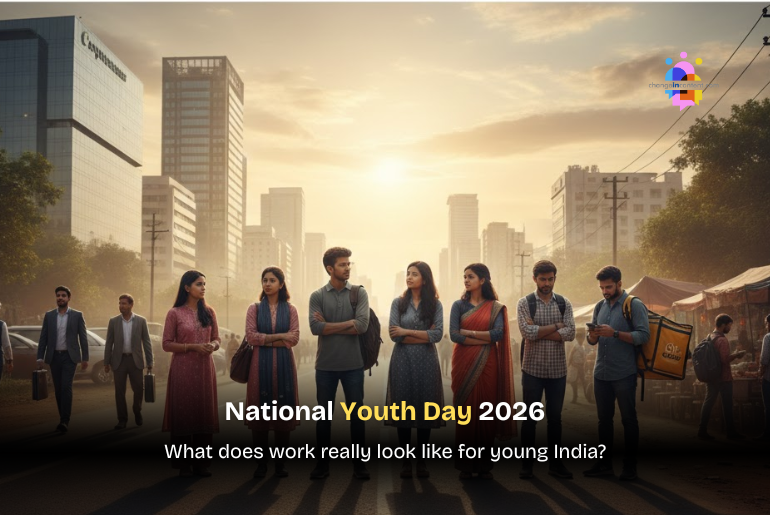
National Youth Day 2026, observed on January 12, marks the birth anniversary of Swami Vivekananda. He was a figure whose ideas on courage, discipline, and service continue to be invoked whenever India speaks about its youth. The day celebrates young people as the country’s strength and future.
India undoubtedly has the numbers. Nearly 40% of the population falls between the ages of 15 and 29. More than half the country is under 25, and over 65% is below 35. It corresponds to approximately 371 million young people in the core working-age group.
Young Indians form the backbone of the workforce and the economy. But once the slogans fade and the hashtags move on, a harder question remains. Are young people actually finding stable, meaningful work? Or is there still a growing gap between India’s youth potential and the reality of its labour market?
National Youth Day 2026: Youth unemployment remains high
The Ministry of Labour and Employment reports that total employment grew from 47.5 crore in 2017–18 to 64.33 crore in 2023–24. These figures indicate that the economy added 16.83 crore jobs over six years. It is primarily due to the government’s push for youth-focused schemes and its Viksit Bharat vision.
Still, the Periodic Labour Force Survey for June 2025 shows that unemployment rose to 5.6%, up from 5.1% in May. Joblessness remains exceptionally high among educated youth. In 2023, more than 42% of graduates were unemployed.
Youth unemployment in cities stands at 17.2% for those aged 15 to 29, compared to 10.6% in rural regions. Young women face greater challenges, with an unemployment rate of 21.6%, compared to 15.8% for young men.
Graduate women remain outside the labour market
Regarding NEET (Not in Employment, Education, or Training) Rates, a substantial proportion of young people are neither working nor studying. Moreover, they are not enrolled in any skills or training programme. In 2022, one in three young people in India qualified for the NEET. Young women constitute the largest share of this group, with nearly five times as many as men.
Only about 40% of women graduates report being in the labour force. This number indicates that 60% are not working or seeking employment. A large share of these women, across all age groups, report that they are out of the workforce due to household duties and care work. These include caring for children and elderly family members, as well as managing domestic responsibilities.
Read our article on what India’s latest data reveals about women’s workforce inclusion.
The gig revolution and India’s youth
The gig economy has grown fast in India over the past decade. In 2020–21, around 7.7 million people worked as gig or platform workers. Estimates suggest this number could reach 23.5 million by 2030, making gig work a major source of jobs for young people.
Gig work covers a wide range of roles. NITI Aayog data indicate that approximately 47% of workers hold medium-skilled jobs such as delivery, driving, and service support. About 22% work in high-skilled roles, including tech, design, and consulting. The remaining 31% engage in low-skilled work, often with irregular hours and pay.
For many young people, the gig economy has opened new doors. It offers flexible work, faster entry into the labour market, and income options for those who struggle to secure formal employment. It has also created space for both men and women to participate, especially in urban areas where platform-based work continues to expand.
However, challenges remain. Most gig workers lack job security, a fixed income, and social protection, including health coverage and paid leave. Women gig workers face additional barriers, including safety concerns, unequal pay, and limited access to higher-paying opportunities. Long working hours, unpredictable earnings, and weak legal safeguards also make gig work unstable for many.
National Youth Day 2026: Gen Z is redefining work and well-being
Young workers, especially Gen Z, are asking for better work-life balance. Many no longer want fixed office hours or daily office travel. About 70-73% of Gen Z job seekers prefer companies that allow flexible work. Most of them like hybrid work, where they can work both from home and the office.
Gen Z also wants clear limits between work and personal life. Approximately 67% of workers report that they want their employers to support mental health. This generation speaks openly about stress, burnout, and the need to rest.
These demands are particularly salient in India. Indian workers put in some of the longest hours in the world, averaging 47 hours per week. Long hours leave little time to recover or switch off.
Stress levels show the impact. Young workers aged 27 to 39 feel the most pressure [Economic Times]. Approximately 11% report high stress, which is higher than the national average of 9%. Among workers aged 18 to 26, only 51% report handling stress well.
Young professionals today work in fast and demanding spaces. The youth’s push for flexibility and balance reflects their desire for work that supports both their income and their well-being.
The closing thoughts
National Youth Day 2026 offers an opportunity to reflect on how India engages with its young workforce. While demographic strength remains an advantage, the ability to convert this advantage into sustained economic participation depends on the quality of work available to young people.
Today’s youth are expressing clear expectations from the labour market. They seek fair pay, reasonable working hours, safe conditions, and space to balance professional and personal responsibilities.
Changeincontent perspective
At Changeincontent, we believe National Youth Day should be less about inspiration and more about honesty. India’s youth are not short on ambition, effort, or adaptability. What they lack is a labour market that consistently offers stability, dignity, and growth.
Young people today are not rejecting work. They are rejecting exploitation, burnout, and uncertainty disguised as “experience.” If India wants its demographic advantage to endure, it must move beyond celebrating youth and start building systems that allow them to remain employed, healthy, and hopeful.
Disclaimer: The views expressed in this article are based on the writer’s insights, supported by data and resources available both online and offline, as applicable. Changeincontent.com is committed to promoting inclusivity across all forms of content. We broadly define inclusivity as media, policies, law, and history. It encompasses all elements that influence the lives of women and marginalised individuals. Our goal is to promote understanding and advocate for comprehensive inclusivity.
