
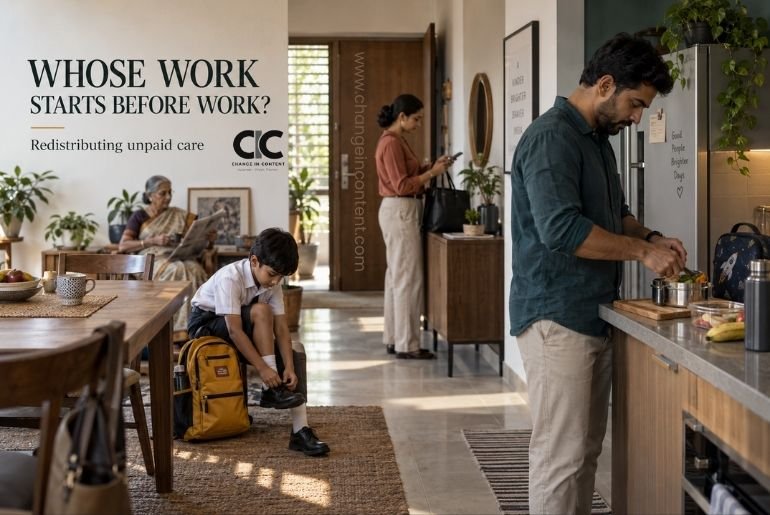
The Brief
- India’s Time Use Survey 2024 found that women who performed unpaid domestic services spent an average of 289 minutes a day on them, compared with 88 minutes for men. Women providing unpaid caregiving spent 137 minutes a day, compared with 75 minutes for men.
- Redistribution does not mean replacing women’s unpaid work with another form of invisible female labour. The larger idea is to recognise, reduce and redistribute care across women, men, families, employers, communities and the state.
- Employers have a role, but they cannot solve unequal care simply by offering women more flexibility. India’s Labour Ministry has itself advised employers to consider paternity leave, parental leave, family-emergency leave and flexible work for both women and men.
- Better childcare and care infrastructure can improve women’s employment while supporting children, families and the wider economy. The World Bank says affordable, quality childcare is increasingly being treated as employment and human-capital infrastructure.
- The long-term goal is not to help women become better at doing everything. It is to make sure everything does not continue to depend on women doing it.
Redistribute women’s unpaid care work
There is a familiar scene in many homes.
Both partners work. Both leave in the morning. And both return tired.
Yet somehow one person knows that the milk is nearly over, the school has changed tomorrow’s timing, the parent’s prescription needs renewing, the domestic worker is taking leave, the birthday gift has not been bought, and the child needs chart paper by morning.
Very little of this work has a salary. Much of it does not even have a name. But it takes time. And in India, that time is still distributed very unevenly.
The 2024 national Time Use Survey found that among people who performed unpaid domestic services, women spent an average of 289 minutes a day doing them. Men spent 88 minutes.
Among those providing unpaid care to household members, women spent 137 minutes a day and men 75.
There is progress in women’s education, employment, entrepreneurship and leadership. Yet none of those developments magically removes the second shift waiting at home.
That is why the conversation now needs to move beyond recognition.
We know women do more unpaid care. The harder task is to redistribute women’s unpaid care work.
First, what exactly are we redistributing?
Care is broader than childcare. It includes looking after children, older parents, people who are ill or disabled, and anyone who depends on someone else for daily support.
Domestic work sits alongside it: cooking, cleaning, washing, shopping, arranging transport, maintaining the household.
And then there is the work that does not always appear in time diaries.
Remembering. Planning. Booking. Checking. Anticipating. Following up.
Knowing who needs what before they ask. A person may not physically cook dinner every evening and still carry most of the responsibility for ensuring dinner happens.
This distinction matters because families sometimes believe they have divided chores when they have only divided execution.
The management of home remains with one person. Usually, she is a woman.
Redistribution is not the same as “helping”
Language tells us a lot here.
A man who washes dishes is often described as “helping his wife”.
A father caring for his own child is “helping with the baby”.
An adult son accompanying a parent to the hospital is “helping his sister”.
The wording quietly identifies who supposedly owns the responsibility.
Redistribution starts when care becomes a shared obligation, not a favour. That does not mean every household needs a spreadsheet dividing every task exactly 50:50.
Lives do not work like that.
One person may work longer hours during a particular month. Another may be better placed to manage hospital visits. Someone may cook more because they enjoy it. A couple may outsource some work.
Fairness is not mathematical symmetry. The relevant question is: Does one person’s career, time, and wellbeing repeatedly absorb the cost of keeping everybody else’s life running?
If the answer is yes, the household has a distribution problem.
What changes when men take on care as their own responsibility?
Women gain something extraordinarily valuable. Time.
- Time to work.
- Time to sleep.
- Time to study.
- Time to exercise.
- Time to travel.
- Time to accept a promotion.
- Time to do nothing.
But redistribution can benefit men as well.
A father who is expected to care gets a different relationship with his children.
A son who participates in eldercare is not merely performing duty; he becomes more present in his parents’ lives.
And a man who is allowed to organise his working day around family responsibilities is released from another gender rule: that paid employment should always take priority over care.
Our recent article on men and inclusive workplace practices explored exactly this point. Treating men as genuine caregivers can help women professionally while giving men more permission to participate in family life.
The goal is not to transfer exhaustion from women to men. It is to organise life so that neither gender automatically inherits the same role.
But a household cannot solve everything by itself
This is where discussions of unpaid care sometimes become too moralistic.
“Men should do more.” They should. But imagine a couple in which both partners share care relatively well.
- They still need affordable childcare.
- An elderly parent may still require professional support.
- A child may still have a school day that ends hours before the adult workday.
- A person with a disability may need specialist care a family cannot reasonably provide alone.
Care is not simply a private negotiation between husbands and wives. It is infrastructure.
UN Women increasingly frames care through a broader model: recognise, reduce and redistribute unpaid care, while also rewarding and representing people performing paid care work. It argues that redistribution must take place not only between women and men, but between households, communities, businesses and governments.
That expands the question considerably.
- Who provides childcare?
- What happens when a parent becomes dependent?
- How far away is water?
- Is public transport usable with a young child?
- Are good care services affordable?
- Can employees take leave for someone other than a newborn baby?
- Does care remain possible only for households rich enough to buy it privately?
These are economic questions.
Childcare is employment infrastructure
This is probably the clearest example.
The World Bank estimates that nearly 350 million children globally lack adequate childcare. It argues that quality childcare can simultaneously support child development, enable women’s employment and create jobs in the care economy. Its childcare-related operations expanded from six projects a decade ago to more than 130 by 2025.
India already has public childcare architecture through the Anganwadi system and the Palna component of Mission Shakti.
As of March 2025, the government reported approving 11,395 Anganwadi-cum-Crèches across 34 States and Union Territories.
The principle is worth remembering. A crèche does not “give women special treatment”. It recognises that somebody has to care for the child while adults work.
If organised care does not exist, that labour does not disappear. It generally moves into the family. And within many families, disproportionately onto women.
Offices can redistribute care without pretending to be homes
Employers obviously cannot decide who cooks dinner. Nor should HR attempt to redesign people’s marriages. But organisations can influence whether care always creates a larger professional penalty for women.
India’s Ministry of Labour and Employment has already advised employers to promote a better balance between paid work and care responsibilities for both men and women.
Its 2024 advisory specifically referred to measures including:
- paternity leave;
- parental leave;
- family-emergency leave;
- flexible working arrangements;
- and encouraging men as well as women to use flexibility to participate in care.
That last point is particularly important.
A flexible-working policy used almost entirely by women can become another form of occupational signalling.
The woman works flexibly because she has care responsibilities. The man remains visibly available. Soon the policy that was intended to help women begins quietly marking them as less committed. Normalise men using it too, and the meaning changes.
Flexibility becomes a way people manage life. Not a concession to mothers.
Parental leave works differently when fathers actually take it
Maternity leave protects women around pregnancy, childbirth and recovery. That protection remains necessary. But a workplace can simultaneously ask what happens to care once the medically specific period ends.
If the mother receives months away from work and the father receives almost nothing, the policy unintentionally teaches the family something: she is the caregiver; he is the worker.
The ILO’s global work on care policies treats paternity and parental leave as part of a wider package for reducing gender inequality around work and family responsibilities.
India does not currently provide a universal statutory paternity-leave entitlement for private-sector employees, although individual employers can create their own arrangements. The Labour Ministry’s more recent guidance encouraging parental and paternity leave is therefore particularly relevant.
A good employer policy does more than put parental leave in a handbook.
- Senior men must take it.
- Managers must not punish it.
- Colleagues should not describe it as a holiday.
- Men should not have to perform extraordinary commitment before or after leave to prove they still take work seriously.
Until men can care without professional stigma, women will continue to pay a higher career price for the same family.
Stop making women prove how much they can carry
There is another workplace habit worth removing.
We admire women for managing everything.
The job. Children. Parents. Home. Health. Deadlines.
We call them resilient. Organised. Superwomen.
Sometimes that admiration disguises something less flattering: We have become comfortable watching them absorb unreasonable amounts of work.
Our recent guide on helping women stay in work made the arithmetic clear. A training programme, promotion or new job opportunity can sit on top of nearly five hours of unpaid domestic work for a woman performing those activities.
The response should not be: “How can she become more efficient?”
It should be: “What part of this load should not be hers alone?”
That is a completely different management question.
Flexibility helps only when it reduces friction
Work-from-home and hybrid arrangements can make care easier. They can also simply allow women to perform paid and unpaid work in the same location.
A woman joins a call while cooking. Answers emails between school pickups. Logs back in after children sleep. Takes no commute, but gains no rest.
That is not redistribution. It is compression.
Our piece on work-life balance for contemporary women made this distinction directly: women do not primarily need better calendars; they need more control over time and a fairer distribution of what fills it.
Good flexibility should therefore come with reasonable workloads and career protection.
If flexible workers receive fewer visible assignments, weaker appraisals or slower promotions, employers have reduced logistical friction while creating a career penalty.
Care does not stop when children grow up
Many workplace policies still imagine care as a short phase involving babies.
Life is less tidy. Parents age. Partners become ill. A sibling develops a disability. A teenager needs significant support. An elderly relative develops dementia.
That is why the care conversation must eventually become broader than maternity and childcare.
Our article on the Sandwich Generation explored what happens when experienced midlife women are simultaneously supporting children and ageing parents. That is also why caregiver leave may become increasingly relevant.
An employee should not have to invent a personal illness because her mother is undergoing surgery. Nor should every family emergency automatically consume annual leave. Organisations can create limited, well-designed care leave without turning the workplace into an unlimited welfare system.
The policy simply acknowledges that employees have dependent people in their lives.
Outsourcing helps. It does not erase the gender question.
For households that can afford it, domestic workers, nannies, cooks, daycare and eldercare can dramatically reduce time pressure. That can be useful. But there are two things to remember:
First, outsourcing does not necessarily redistribute the mental load. The woman may still recruit the help, pay them, organise schedules, replace them when absent, plan meals and coordinate everyone.
Second, much outsourced care is itself performed by women. A professional woman may gain time because another woman, often with fewer economic protections, has taken over the task.
That is why UN Women and the ILO add two more Rs to the care framework:
- Reward paid care work.
- Represent care workers in decisions affecting them.
A fair care system cannot create professional opportunity for one group of women by normalising poor conditions for another.
The redistribution test
Instead of another long checklist, we would give households and organisations one simple test.
When care increases suddenly, ask:
- Who changes their life first? A child becomes ill.
- Who cancels work? An older parent needs regular appointments.
- Whose calendar changes? School holidays begin.
- Who solves childcare? A domestic worker takes leave.
- Who reorganises the household? A parent needs six weeks of recovery.
- Who becomes the default coordinator? If the answer is repeatedly the same woman, the problem is visible.
And if that same woman is then judged for being less available at work, the household inequality has become workplace inequality.
That is the bridge organisations need to understand.
What does better redistribution look like?
At home, it means ownership rather than assistance.
The person responsible for school needs not simply to “pick up the child when asked”. They know the calendar, attend meetings, respond to messages and solve the logistics.
At work, it means benefits designed around caregivers rather than around women alone wherever medically appropriate.
- It means fathers taking parental leave.
- Managers accepting care as part of adult life.
- Flexible work that does not damage progression.
- Emergency leave that reflects actual families.
- Childcare support where organisations can provide it.
- Eldercare gradually entering benefit design.
- And leaders using the same policies they tell employees are safe to use.
At policy level, it means childcare, health services, public transport, water, energy and long-term care becoming part of economic infrastructure.
The ILO has long argued that unequal unpaid care and unequal labour-market participation are inseparable.
We cannot keep solving one without touching the other.
Change in Perspective: Give Women Back Some of Their Time
There is a temptation to make unpaid care sound like a complaint about families. It is not.
Care is good. Children need it. Parents need it. Communities depend on it. Most of us will both give and receive substantial care during our lives.
The problem is not care. The problem is deciding, usually without discussion, who will keep providing most of it.
Redistribution does not require us to make families transactional. Nor does it diminish the value of women who choose to spend significant time caring.
Choice matters. So does recognising when “choice” has quietly become expectation.
Women have been asked for decades to enter the workforce without society fully redesigning what happens to the work they were already doing. The next phase of inclusion has to correct that.
Not by sympathising with women. Not by telling them how impressive it is that they manage everything. And not by building policies that mark them as exceptions. But by making care a normal part of how households, workplaces and public systems are organised.
There may be no more valuable resource we can redistribute than time. And equality becomes considerably easier when women finally get some of theirs back.
FAQs
Q: What is unpaid care work?
A: Unpaid care work includes activities performed without pay to support household and family wellbeing, such as childcare, eldercare, caring for people who are ill or disabled, cooking, cleaning and household management. It is economically essential even though it is generally outside conventional paid-employment measures.
Q: Why is unpaid care work a workplace issue?
A: Unequal care responsibilities can affect employees’ availability, working hours, travel, career continuity, training access and willingness or ability to take promotions. The ILO therefore treats care policy as an important part of creating a more gender-equal world of work.
Q: How can employers help redistribute women’s unpaid care work?
A: Employers can offer gender-inclusive parental leave, encourage fathers to take leave, provide flexible work without career penalties, introduce family-emergency or caregiver leave, support childcare where practical and normalise care responsibilities across genders.
Q: Does redistributing care mean men and women must do exactly 50% each?
A: No. Redistribution is about fairness, not daily arithmetic. Families have different circumstances and preferences. The aim is to prevent one person, usually a woman, from automatically carrying most of the care burden and its economic consequences.
Q: Is flexible work enough to solve the problem?
A: No. Flexibility can help people manage care, but it does not redistribute care by itself. If women remain responsible for most household work, flexibility can simply allow them to perform paid and unpaid work simultaneously.
Editorial Note & Sources
This guide focuses on unpaid care because national and international time-use evidence continues to show women carrying a disproportionate share. It does not assume that all women are caregivers, that all men avoid care or that every household should divide responsibilities identically. Care arrangements vary according to preference, employment, health, income, family structure and circumstance. The objective is to increase choice and reduce the automatic assignment of unpaid care by gender.
Sources
- Ministry of Statistics and Programme Implementation, Government of India: Time Use Survey 2024. Primary national source for time spent by women and men on unpaid domestic services, caregiving, paid employment and other activities.
- International Labour Organisation: Care at Work: Investing in Care Leave and Services for a More Gender Equal World of Work. Global evidence and policy framework covering maternity, paternity and parental leave, childcare, long-term care and workers with family responsibilities.
- International Labour Organisation: Care Work and Care Jobs for the Future of Decent Work. Foundational evidence linking unpaid care inequalities with labour-market inequalities and investment in care systems.
- UN Women: Toolkit on Paid and Unpaid Care Work / Care and Support framework. Source for the recognise, reduce, redistribute, reward and represent framework and the principle that responsibility for care must be shared across households, communities, employers and governments.
- Ministry of Labour & Employment, Government of India: Advisory for Employers to Promote Women Workforce Participation. Official guidance encouraging paternity leave, parental leave, family-emergency leave, flexible work and greater participation by men in care responsibilities.
- Ministry of Women and Child Development, Government of India: Mission Shakti / Palna childcare support. Official government information on Anganwadi-cum-Crèches and other measures supporting women’s participation in employment.
- World Bank: Childcare That Works: Investing in Human Capital, Creating Jobs and Unlocking Women’s Employment. Evidence on childcare as employment, human capital, and care-economy infrastructure.
