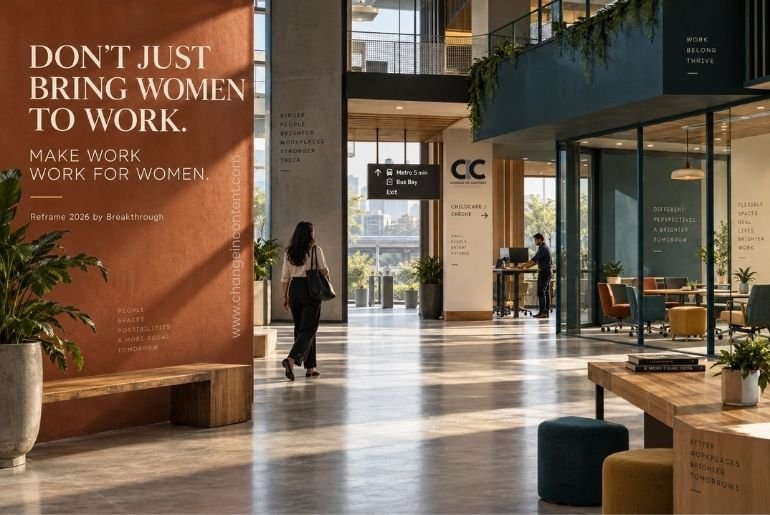
The Brief
- Reframe 2026 by Breakthrough was held from 8–10 September at the India International Centre in New Delhi, bringing together voices from government, business, philanthropy, academia, media, civil society and youth.
- The summit centred on a broader proposition: increasing women’s workforce participation requires changes to workplace culture, care systems, safety, mobility, leadership and the social norms surrounding women’s work.
- In Breakthrough’s listening exercise with more than 1,400 women, 54% said respectful workplace culture was the defining feature of a women-friendly workplace, across ages and occupations.
- Reframe included seven panels and seven workshops and was designed to contribute towards an inclusive Framework for Women-Centred Workplaces.
- Discussions ranged from care and workplace design to education, health, men and boys as allies, youth participation, media narratives and practical ways of turning gender equality into everyday organisational practice.
We usually count a woman getting a job as progress. But Reframe 2026 by Breakthrough asked what happens next.
- Can she get to work safely?
- Will the workplace take her seriously as a professional?
- Can she remain after marriage or motherhood?
- Does care automatically become her problem?
- Can she move into leadership?
- Will flexibility quietly damage her career?
- And are organisations fixing the environment around her, or continuing to ask women to become better at surviving it?
Those questions shaped Reframe 2026: Reimagining India’s Future – Equal Participation of Women in the Workforce, Breakthrough’s annual flagship summit held in New Delhi from September 8 to 10. Its premise was deliberately wider than employment numbers.
India does not merely need more women to enter work. It needs more women to be able to remain, progress, lead and thrive once they get there.
Respect may matter more than another workplace benefit
One number from Breakthrough’s own research cut through much of the discussion.
The organisation said a listening exercise involving more than 1,400 women across rural and urban India found that 54% identified a respectful workplace culture as the defining feature of a women-friendly workplace.
That is revealing because organisations often approach women’s inclusion through provisions.
Leave. Transport. Insurance. Flexible work. Childcare. Returnships.
All can matter. But employees experience the workplace through people as much as policies.
- Who gets interrupted?
- Whose ambition is taken seriously?
- Who is assumed to be unavailable because she has children?
- Who receives the difficult assignment?
- Whose safety concerns are dismissed?
- Who can report inappropriate behaviour without becoming the problem herself?
A well-written policy cannot compensate indefinitely for a culture that tells women they are guests.
Anubha Bhonsle captured this sharply during the summit: “Stop making women fit for work. Women are already fit for work.”
Her argument was to make workplaces fitter for women instead. That is also where Reframe 2026 moved beyond the familiar language of skilling women.
The summit treated participation as a systems question
Breakthrough framed the workforce problem around the systems and gender norms that influence women long before a recruitment interview begins.
- Who is encouraged to pursue a career?
- Whose job is considered essential to family income?
- Who relocates?
- Who takes responsibility when a child is ill?
- Who can return home safely after a late shift?
- Who has enough freedom to accept an opportunity in another city?
These decisions happen across homes, communities, transport systems and workplaces. They eventually show up in employment data. That makes women’s workforce participation much harder to solve through recruitment campaigns alone.
Our recent guide on helping women stay in work reached a similar conclusion. India may improve access to education, skills and employment, but care, transport, health, geography, social expectations and job design can still determine whether an opportunity becomes a sustained career.
Reframe brought those pieces into the same room.
Care was treated as everybody’s business
Care was one of the recurring themes.
Former Rajya Sabha MP Fauzia Khan challenged the assumption that women should carry care responsibilities alone, placing responsibility across partners, colleagues, the state and the law.
That matters because women cannot participate equally in paid work while unpaid work remains overwhelmingly attached to them.
India’s Time Use Survey already makes the imbalance visible. Women who participate in unpaid domestic services spend substantially more time on them than men. Our earlier analysis of the Time Use Survey and women’s unpaid workload examined how that imbalance can limit employment choices even when women want to work.
Reframe’s approach was therefore not to treat women’s employment as an isolated labour-market problem.
Home follows women to work. What happens at work can also travel back home.
Safety and mobility shape which jobs are realistically available
A job offer is not useful if reaching it is unsafe or practically impossible. That sounds obvious, yet mobility is frequently treated as something outside workforce policy.
Breakthrough’s own work leading into Reframe argued that the journey to work deserves as much design attention as the workplace itself, drawing attention to safer streets, transport and public spaces as conditions for women’s economic participation.
For women, especially in jobs involving early starts, late shifts, field work or industrial locations, mobility can determine whether an opportunity can be taken at all. That is why employment infrastructure extends beyond an office gate.
Our reporting on female employment in Uttar Pradesh has made the same connection: transport, safe rentals, policing, street lighting and last-mile mobility are economic infrastructure when they affect whether women can work.
Men were part of the conversation too
Another useful aspect of Reframe was that the future of women’s work was not framed as something women alone must fix.
Men and Boys as Allies formed part of the summit agenda, alongside sessions on women in the workforce, health, education, youth, investment and storytelling.
That connection becomes particularly important around care.
If flexible work remains something predominantly used by women, it can reinforce the idea that women are the primary caregivers. And if parental responsibilities are shared more visibly by men, the meaning of flexibility itself begins to change.
That is why our recent piece on men and inclusive workplace practices argued that inclusion can benefit men while simultaneously reducing some of the penalties women experience around care.
The two ambitions do not compete with each other. They can reinforce each other.
The conversation also began much earlier than employment
Reframe did not start the equality story at age 22. Its programme also included inclusive education, with UN Women India Country Representative Kanta Singh delivering an opening address focused on gender-transformative education systems. That is significant.
Girls do not suddenly acquire beliefs about what kind of work is suitable for them when they graduate.
Ideas about ambition, leadership, science, mobility, care and gender begin much earlier.
Families shape them. Schools reinforce or challenge them. Popular culture adds another layer. Eventually employers inherit the results. It gives workforce inclusion a longer timeline.
By the time HR encounters an adult candidate, several decisions about what women and men are “supposed” to do may already have been made.
Reframe also widened who gets to design the solution
The summit brought together over 40 speakers across sectors, including representatives from UN Women, NITI Aayog, the World Bank, corporates, foundations, civil-society organisations, grassroots groups and youth networks.
The purpose was not simply diversity of speakers. It reflected the problem itself. No HR department can solve women’s workforce participation alone.
- Employers influence job design and culture.
- Governments influence transport, childcare, education and labour policy.
- Families shape care and mobility.
- Schools shape aspiration.
- Civil society works on norms.
- Media shapes what people consider normal.
- And women themselves know where systems fail in ways dashboards often do not.
That is why Reframe described its approach as bringing together evidence, lived realities and cross-sector learning.
The practical outcome is meant to be a workplace framework
Reframe was not positioned only as a 3-day exchange of ideas.
Breakthrough says the discussions are intended to contribute to an inclusive Framework for Women-Centred Workplaces. That could become the most useful outcome if the framework translates broad principles into decisions employers can actually make.
- What does respectful culture look like in practice?
- How should employers design flexibility without penalising users?
- How should mobility and safety enter job design?
- How do organisations account for caregiving without treating women as less ambitious?
- How do men participate?
- How should women’s progression be measured after recruitment?
- How do workplaces listen to women whose realities differ by income, occupation, disability, location, age or family structure?
The value will be in moving from aspiration to operating practice.
The last day deliberately moved from panels to workshops
Reframe closed with seven participatory workshops.
Breakthrough said these addressed areas including gender-transformative education, supportive workplace policies, youth decision-making, digital media in grassroots programmes, and evidence and social expectations around women’s work.
That ending fits the central message of the summit.
India already has plenty of discussion about why women should work. The more urgent questions are increasingly about what needs to change around them when they do.
That is a different workforce conversation. And probably the more useful one.
Change in Perspective: Getting the Job Was Never the Whole Job
Women’s workforce participation often becomes a number.
Up. Down. Rural. Urban. Formal. Informal.
Useful numbers, certainly. But a participation rate cannot tell us whether a woman is respected at work.
- Whether she can get home safely.
- Whether she declined the promotion because care would collapse without her.
- Whether flexibility cost her visibility.
- Whether her family sees her career as equally valuable.
- Or whether she entered the workforce only to leave a few years later because everything around the job made continuing impossible.
Reframe 2026 by Breakthrough put those questions back into the workforce conversation. Perhaps that is its most useful contribution.
India does need more women working. But the stronger ambition is not merely to count how many women enter. It is to build an economy in which entering, staying, progressing and leading all become ordinary possibilities.
Editorial Note & Sources
This article reports on the themes, discussions and stated objectives of Reframe 2026, hosted by Breakthrough from 8–10 September 2026. Change in Content has prioritised Breakthrough’s own event material and official communications as primary sources rather than relying on secondary news coverage.
Sources
- Breakthrough — Reframe 2026: Reimagining India’s Future: Equal Participation of Women in the Workforce. Official event page covering the summit’s purpose, agenda, speakers, panels, workshops and proposed Framework for Women-Centred Workplaces.
- Breakthrough — Reframe 2026 event updates. Official post-event reporting, including findings from its listening exercise with 1,400+ women, the 54% workplace-culture finding and remarks from summit participants.
- Breakthrough — Reframe 2026: The Future of Work Must Work for Women. Official pre-summit framing on care, workplace culture, mobility, safety, leadership and the gender norms shaping women’s employment.
- Ministry of Statistics and Programme Implementation: Periodic Labour Force Survey 2025. Official national labour-market source used for wider context on women’s workforce participation in India.