
The Brief
- Equity Theory explains how people judge their rewards relative to their contribution, compared with others.
- For women, a useful question is whether necessary but overlooked work counts in career decisions.
- Feeling unfairly treated is a reason to investigate, rather than automatic proof of discrimination.
- Fair decisions require relevant evidence, consistent processes and honest explanations.
- Managers should review how work and opportunities are allocated, alongside pay and recognition.
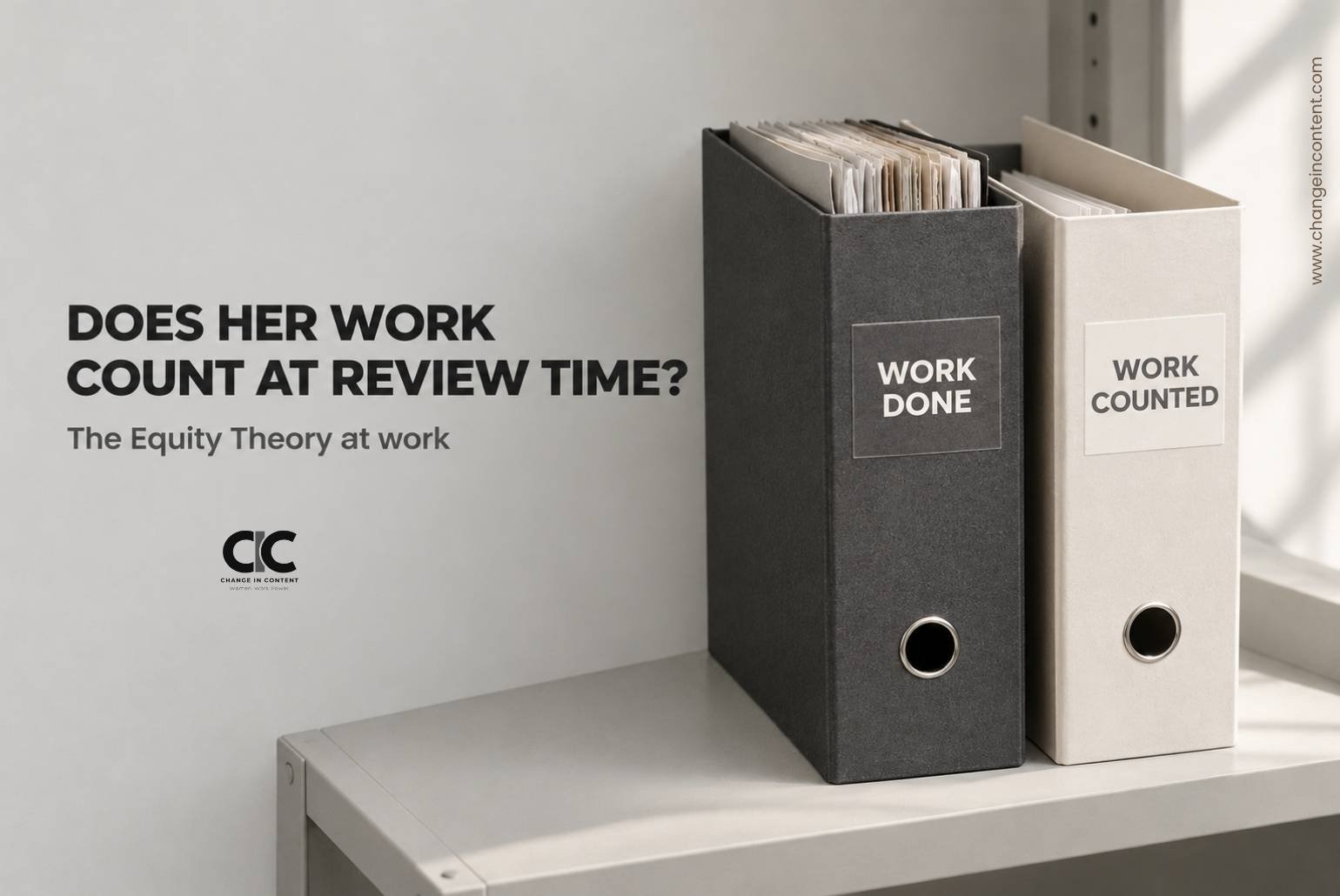
Consider this fictional appraisal. Asha has delivered her projects, trained 2 new colleagues and repeatedly taken over difficult handovers. Her manager thanks her for being dependable. A colleague who was given the flagship assignment receives a promotion; Asha is told she needs more exposure. The Equity Theory helps explain why she might leave that meeting questioning the deal she has with her employer.
She may be pleased for her colleague. She may also wonder how she was supposed to gain exposure while doing the work that kept everyone else moving. Before telling her to be more ambitious, her manager needs to examine how those assignments were divided.
What does Equity Theory explain?
Developed by psychologist J. Stacy Adams in the 1960s, Equity Theory concerns perceived fairness in an exchange. At work, employees weigh what they receive against what they contribute, then compare that relationship with someone else’s.
Contributions can include skill, effort, experience and responsibility. Returns can include pay, recognition and status. A colleague may earn more without the arrangement feeling unfair if their greater responsibility provides a convincing explanation.
When people perceive an imbalance, the theory proposes that they may try to restore fairness: Seeking better rewards, changing their effort, reconsidering the comparison or leaving. These are possible responses, not a prediction of what any particular employee will do.
The comparison is essential. Asha’s question is whether her contribution receives a fair return relative to colleagues, rather than whether every demanding day brings an immediate reward.
That gives the discussion of recognition at work a practical edge. Being noticed helps. What the organisation does with that knowledge deserves equal attention.
Who decides which work counts?
Asha’s situation contains two questions.
- Was the promotion decision reasonable on the evidence available?
- And did the organisation give her a fair chance to produce the evidence it wanted?
An employer could answer the first carefully while overlooking the second. If high-profile assignments demonstrate leadership, managers need to examine who receives them and who repeatedly handles the essential work left behind.
Research offers a reason to ask. In a 2017 paper, Linda Babcock, Maria P. Recalde, Lise Vesterlund and Laurie Weingart found that women in their study settings were more likely than men to volunteer for, receive requests for and accept tasks with low promotability. Expectations that women would agree helped explain the pattern. These findings do not establish how common it is in Indian workplaces.
They do suggest a useful local check: Look at the actual allocation of work.
Training a colleague may be valuable leadership experience in one role and an unrecognised extra in another. Taking minutes may be a stated responsibility or a task that repeatedly falls to whoever is least comfortable refusing. The job, workload and assessment criteria determine what needs to change.
This is where workplace invisible labour becomes relevant. An organisation can depend on a contribution while giving the person making it little opportunity to advance.
3 situations worth looking at more closely
The examples below are hypothetical. They show questions to investigate, rather than conclusions about a particular employer.
|
Workplace situation |
What needs checking |
A useful next step |
|
A woman trains new joiners while retaining all her existing targets. |
Whether the extra responsibility has been recognised in workload, objectives and reward. |
Agree time for training, adjust priorities and record its results in her review. |
|
A colleague receives a higher salary for an apparently similar job. |
Actual scope, relevant expertise, performance criteria and the basis for the pay difference. |
Review the roles and pay bands; explain justified differences and correct unjustified ones. |
|
A woman using an agreed flexible schedule is passed over for a major assignment. |
Whether the decision reflects a genuine scheduling requirement or an assumption about her availability. |
Discuss the assignment with her and assess delivery requirements before deciding. |
A longer working day does not necessarily mean a greater contribution. Different roles can legitimately attract different rewards. The problem begins when the reasons are inconsistent, relevant work goes uncounted, or employees cannot find out how decisions were reached.
Nor should an agreed working arrangement create an informal debt. If someone meets the expectations of her role, flexibility should not become a reason to expect unlimited gratitude or unrelated extra work.
Perception deserves an answer
The theory’s emphasis on perception can be misused. A manager might hear a concern and decide that the employee simply needs to think differently. A better starting point is to check the facts: responsibilities, assignment history, performance evidence and what was communicated. That review belongs in the wider discussion of conditions affecting career progression.
Incomplete information can create a mistaken impression. It can also conceal a real problem. An explanation helps only if it accurately describes a defensible decision.
Later organisational justice research broadens this discussion. Jason Colquitt’s 2001 study supported four separate dimensions: the fairness of outcomes, the decision-making process, interpersonal treatment and the information people receive.
In everyday terms, an employee can question the result, the rules used to reach it, how she was treated, or the explanation she was given. A courteous meeting cannot repair an unjustified pay gap. A justified decision still deserves a respectful explanation.
Equity Theory also has limits. Later work by Richard Huseman, John Hatfield and Edward Miles proposed that people differ in their sensitivity to unequal exchanges. We should not assume that someone who appears over-rewarded will feel guilty, or that an under-rewarded employee will necessarily resign.
We would add a practical caution: Staying in a job does not demonstrate satisfaction. Someone may need the income, location or working hours. Likewise, women do not all value the same rewards or respond in the same way.
A better conversation than “be more visible”
For an employee, a useful preparation is a short record of responsibilities and results, including work added since objectives were agreed. This can help with recognising the value of your own work. It should help establish what changed, rather than become another unpaid reporting burden.
Asha could ask: “Training new colleagues has become a regular part of my role. How will that be reflected in my objectives, and what will we change so I can take on an assignment that supports my progression?”
That question gives the manager something concrete to address. It also connects today’s workload with a specific opportunity to progress.
Managers can review recurring support tasks across the team, allocate them deliberately and explain which contributions influence advancement. Where a task is necessary but offers little development, share it fairly. Where it develops useful skills, make those skills visible in assessment.
The conversation should end with a decision, an owner and a review date. If the answer is no, explain why and what would need to change. Repeated encouragement without a route forward leaves the original concern untouched.
The Change We Need
A fair workplace should be able to explain what it asks of people, how it values their contribution and how they can progress. Women should have room to question that arrangement without the question itself becoming evidence that they lack commitment.
Before asking the reliable woman to take on one more task, a manager could pause over 2 questions: What will this add to her career, and what will it take away from her time? The answers should influence the assignment.
Editorial Note
This knowledge article draws on Adams’s Equity Theory and subsequent research on task allocation and organisational justice. All workplace examples and suggested dialogue are illustrative. International research is not presented as an estimate of Indian workplace conditions. Practical recommendations are CIC’s editorial interpretation; the theory is not a diagnostic test or a legal standard for establishing discrimination. Sources reviewed on 19 October 2026.
Sources
- J. Stacy Adams — Inequity in Social Exchange, 1965
- Babcock, Recalde, Vesterlund and Weingart — Gender Differences in Accepting and Receiving Requests for Tasks with Low Promotability, 2017
- Jason A. Colquitt — On the Dimensionality of Organisational Justice: A Construct Validation of a Measure, 2001
- Huseman, Hatfield and Miles — A New Perspective on Equity Theory: The Equity Sensitivity Construct, 1987
