
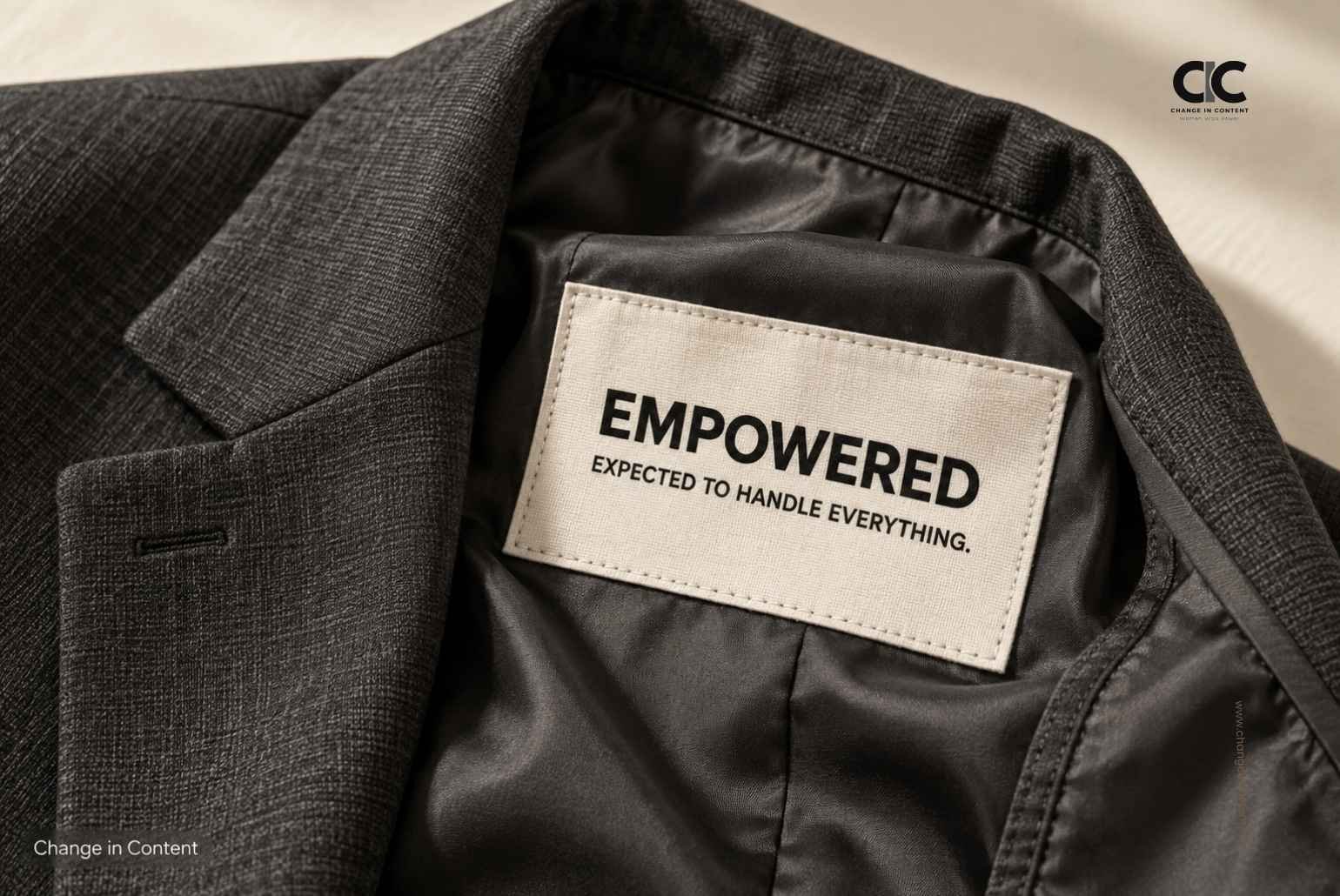
The Brief
- Girlboss messaging can turn women’s advancement into a test of individual stamina.
- Ambition needs money, time, opportunity and support. Confidence cannot supply all four.
- Research documents unequal care responsibilities and gaps in career support, not a proven “girlboss effect”.
- Criticising the message gives nobody permission to dictate women’s careers or family lives.
- A credible empowerment promise should explain what changes beyond the woman herself.
Girlboss Messaging and the lies women have been told
Girlboss messaging has a generous offer for women: build a career, earn your own money, become impossible to ignore. Read the small print, though. The cooking, caring, remembering and smoothing things over may still be waiting when you get home.
Apparently, liberation comes with excellent multitasking opportunities.
There is plenty worth keeping in the original invitation to aim higher. Money matters. Authority matters. Seeing a woman run a business can widen someone else’s sense of what is possible. But encouragement becomes a poor bargain when it asks women to absorb every inconvenience on the way to success, then treat exhaustion as evidence that they need a better routine.
The problem begins when a promise of more choice becomes a demand for unlimited capacity.
What is girlboss messaging?
Here, girlboss messaging means a style of empowerment rhetoric that presents confidence, relentless effort and individual career success as the main route to women’s freedom. At its shallowest, it gives unequal conditions a motivational answer: Work on yourself until you can manage them.
Sophia Amoruso’s book #GIRLBOSS, published in 2014, is an obvious marker in the term’s history. Its publisher describes a story of building a business from unconventional beginnings. That is a narrower proposition than making every woman’s life a permanent enterprise. (Publisher’s listing.)
An ambitious woman is not automatically selling this message. Neither is every creator who shares career advice. Learning to negotiate, finding mentors and gaining confidence can be useful. The trouble comes when those suggestions crowd out questions about pay, discrimination, staffing and care.
The old expectation that women will manage everyone’s needs can fit remarkably comfortably inside a new language of achievement. The double shift and its invisible labour do not disappear because the person doing them now has a more impressive email signature.
The missing slide in the success story
Consider a hypothetical morning-routine Reel. A woman exercises, prepares breakfast, reads, gets ready and arrives at work looking composed. Nothing about those activities deserves ridicule. The useful question is what the edit cannot tell us: who else contributed, what was outsourced and how much the arrangement cost.
Without that context, a viewer may compare her entire working day with somebody else’s selected minutes. Advice that is manageable with savings, reliable care and control over working hours can become punishing when those resources are absent.
A retail worker cannot necessarily move her shift to protect her morning routine. A woman supporting relatives may need a predictable wage more urgently than a personal brand. Telling either to take a bold career risk is incomplete advice unless it also addresses the cost of failure.
And when paid domestic workers make someone else’s professional life possible, their work deserves recognition, fair pay and rest. An empowerment story should have room for the woman cleaning the home as well as the woman recording inside it.
The workload has evidence behind it
India’s Time Use Survey 2024 found that female participants aged 15–59 spent about 305 minutes a day on unpaid domestic services. Among people in that age group who participated in household caregiving, females spent about 140 minutes, compared with 74 minutes for males.
These are participant averages for separate activities; they should not be added into a universal working woman’s daily total. (MoSPI findings.)
A 2026 YouGov survey for Deloitte adds a different, explicitly British perspective. Among 2,066 working parents surveyed online, 64% of mothers and 38% of fathers reported feeling overwhelmed by responsibilities as an effect of being unable to take time for themselves. That is a self-reported experience, not a clinical diagnosis or an estimate for India. (Deloitte’s survey and methodology.)
Neither study tests girlboss messaging. They document the workload against which we should judge advice to do more. If a recommendation adds another daily obligation, it should explain where the time is supposed to come from.
There is a workplace version of this question, too. The discussion of Claudia Goldin’s “greedy jobs” examines the rewards attached to demanding hours and availability. A confidence exercise cannot make two competing obligations happen at once.
The backlash can sell women another script
Lisa Britton’s April 2026 Institute for Family Studies essay argues that girlboss messaging harms working-class women by encouraging them to deprioritise partnership and family. It raises a fair question about advice that overlooks economic circumstances. Its wider causal claim needs more evidence. (The original essay.)
The marriage research linked in that essay examines US patterns by education and economic circumstances. Its authors report relatively stable marriage outcomes among college-educated women and declining marriage among women without degrees. They emphasise working-class men’s economic prospects. The research summary does not establish social-media girlboss slogans as the cause. (Authors’ research summary.)
Women deserve better than a choice between two instructions: prove your worth through professional achievement, or prove it through marriage and motherhood. A loving partnership can provide meaningful support. So can friendships, family and community. None should require a woman to surrender authority over her life.
Some women want children, while some do not. Some want to lead companies; others want decent work that leaves room for the rest of life. None owes a lifestyle trend an explanation. Financial independence and needing other people can coexist.
Ask who is providing the support
There is a revealing finding in McKinsey and LeanIn.Org’s Women in the Workplace 2025. In its corporate America research, women and men receiving comparable career support were equally interested in promotion. The study surveyed roughly 10,000 employees and collected pipeline data from 124 organisations. It identifies a relationship between support and aspirations; it is not an experiment proving what caused an individual’s ambition. (The report.)
For employers, that offers a better place to start than another talk about confidence. Give someone access to a consequential assignment. Explain promotion decisions. Check workloads before praising resilience. Make it possible for employees of every gender to take responsibility for care.
At home, shared responsibility should include noticing, planning and finishing the task. Being willing to help after receiving instructions leaves someone else managing the operation. Protecting time for rest also matters. The gender hobby gap asks whose free time remains available after everyone’s needs have been organised.
Creators and brands have their own responsibility. Explain the resources behind the routine. Say whether a recommendation is sponsored. Show the limits and trade-offs of the advice. Give the person watching enough information to decide whether it fits her life.
Girlboss Messaging: Change the Terms
Before accepting the next empowerment message, ask three questions: what does this require from me, what support comes with it, and what is somebody else agreeing to change?
A useful answer might involve money, a fairer rota, shared care or access to an opportunity. It should leave a woman with more room to live. Her ambition deserves support, and her ordinary days deserve dignity even when she has nothing impressive to post.
Editorial Note
This is an original, research-informed commentary. “Girlboss messaging” is used as an editorial description, not a diagnosis or a variable measured by the cited surveys. The Reel is hypothetical; no interviews or personal experiences are invented. Indian time-use data, British parental survey findings and US workplace and marriage research are identified separately. They provide context, not proof that a slogan causes burnout, poverty or changes in marriage. Sources checked on 22 September 2026.
Sources
- Penguin Random House: #GIRLBOSS by Sophia Amoruso, original publication 6 May 2014.
- Ministry of Statistics and Programme Implementation: Time Use Survey 2024: official findings, 25 February 2025. Age- and participation-specific figures used above.
- Deloitte UK/YouGov: The unequal burden: UK working mothers bear brunt of parental stress and burnout, 4 June 2026. Online fieldwork: 22 April–5 May 2026; 2,066 working parents.
- Lisa Britton, Institute for Family Studies: The Girlboss Lie That’s Breaking Working-class Women’s Hearts, 20 April 2026. Opinion essay that prompted this analysis, not treated as causal research.
- Clara Chambers, Benjamin Goldman and Joseph Winkelmann, American Institute for Boys and Men: Will college-educated women find someone to marry?, 27 January 2025. Authors’ summary of their working paper.
- McKinsey and LeanIn.Org: Women in the Workplace 2025, 9 December 2025.
