
The Brief
- Equal pay for work of equal value allows different jobs to be compared using objective, gender-neutral criteria.
- A gender earnings gap measures a wider pattern; it does not establish discrimination in every individual salary.
- India’s Supreme Court upheld a pay difference linked to teachers’ experience and service histories.
- India’s wage law separately prohibits gender discrimination in pay for the same or similar work.
- Employers should be able to explain both how they value jobs and how employees progress through pay bands.
Equal Pay for Work of Equal Value: Who gets to decide what work is worth?
A salary difference needs an explanation. “He has more experience” might begin one. “That is what we have always paid for this role” should invite another question. Equal pay for work of equal value asks employers to examine how they arrive at those figures, including whether work associated with women has been priced too cheaply.
The debate becomes confusing when three questions are folded into one:
- Are women and men earning different amounts overall?
- Are comparable employees being paid fairly?
- And have we valued their jobs fairly in the first place?
Each needs its own evidence. A national earnings statistic cannot settle an individual salary dispute. Equally, a defensible difference between two employees cannot establish that the wider pay system is fair.
The discussion around International Equal Pay Day gives this issue urgency. Understanding what employers should actually compare gives it practical meaning.
What does “work of equal value” mean?
Equal pay for equal work addresses people doing the same or similar work. The broader equal-value principle also reaches different jobs. Under the ILO’s Equal Remuneration Convention, 1951 (No. 100), women’s and men’s work should be remunerated without discrimination based on sex. Different job titles do not, by themselves, settle whether work deserves different pay. The ILO explains this broader scope in its job-evaluation guidance.
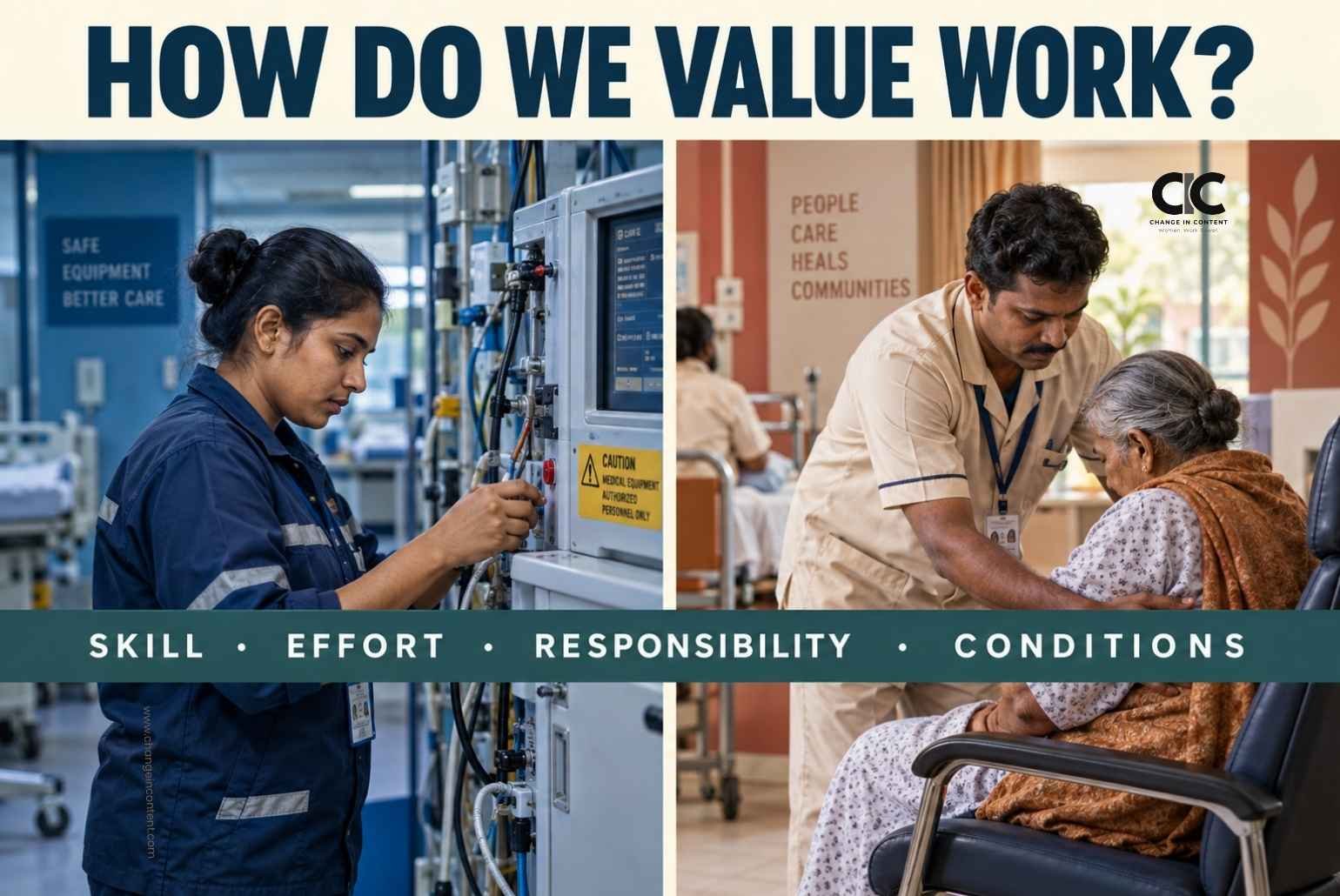
Assessing value means examining the requirements of the job. The ILO’s 2026 pay-equity guide identifies skills, effort, responsibility and working conditions as key factors. Effort can be physical, mental or emotional; responsibility can involve people as well as equipment or money.
Consider a hypothetical hospital comparing a maintenance technician’s role with a patient-services coordinator’s. Their tasks differ. One may deal with equipment faults; the other with distressed families, confidential information and urgent coordination. A serious assessment would examine what each role requires, using a common framework. It might establish equal value, or it might identify substantial differences. The outcome needs evidence.
Simply assuming that technical work is demanding while interpersonal work comes naturally would prejudge the exercise. So would declaring the jobs equivalent because both are useful. Equal-value assessment requires more care than either shortcut.
What the UN and ILO are warning about
In its September 2026 explainer, UN Women reports that women in Europe and Central Asia earn an average of 20.4% less per month than men. It links the gap to unpaid care, occupational concentration, career interruptions, part-time work and discrimination. This is a regional monthly earnings measure, not an Indian statistic or a comparison of identical jobs. (UN Women’s explainer.)
The ILO’s International Equal Pay Day statement calls for governments, employers and workers to address structural barriers, improve pay transparency and tackle the undervaluation of women’s work through dialogue, including collective bargaining.
An overall gap deserves investigation, but its size alone cannot tell us how much comes from each cause. Imagine an employer paying women and men equally within every grade, while men occupy most senior positions. An organisation-wide earnings gap could remain. The next questions would concern promotion, recruitment and access to experience.
That is why redistributing unpaid care belongs in the pay conversation. Someone who repeatedly has to turn down training or reduce paid hours can lose future earning opportunities even when the immediate hourly rate is fair.
What did India’s Supreme Court decide?
In G.P. Sangeetha & Ors. v. State of Kerala & Ors., 2026 INSC 1004, decided on 8 September 2026, directly recruited junior higher-secondary teachers in Kerala’s government-aided schools sought the full-time pay scale received by teachers appointed through transfer or promotion.
The groups shared qualifications, duties and responsibilities. However, the promoted teachers had long prior teaching service and previously held full-time posts. Their pay arrangements protected that earlier status. The Court accepted experience as a valid basis for the difference and dismissed the appeals.
The judgment explains that similar functions alone do not automatically establish entitlement to identical scales in such service disputes. Relevant recruitment, experience, appointment and responsibility factors must also be examined. It also preserves the possibility of relief where the required parity is established. (Read the judgment, particularly paragraphs 2, 6, 8 and 13–19.)
This was a dispute between recruitment groups, rather than a ruling authorising lower pay for women. Reading it as a rejection of gender pay equality would give the decision a reach its facts do not support.
India’s statutory protection also remains relevant.
- Section 3 of the Code on Wages, 2019 prohibits gender discrimination in wages by the same employer for the same or similar work.
- Section 2(v) considers the skill, effort, experience and responsibility required under similar working conditions.
- Section 3 also prohibits reducing an employee’s wage rate to comply with its equality requirement. These provisions took effect on 21 November 2025. (Code on Wages; commencement notification.)
The wording of Indian legislation, the requirements of a service-law claim and the international equal-value principle should be explained on their own terms. An individual claim depends on the applicable law and facts.
Can fair pay still reward experience?
A sensible pay system can recognise experience while questioning how that experience is assessed. Our editorial test would be: What additional capability does the employer reward, how is it assessed, and would the same rule apply to another employee?
Employers should also review access to the opportunities that earn higher pay. Who gets the demanding client, the training budget or the acting-manager assignment? Work that rewards constant availability raises further questions about whether the reward reflects a necessary job requirement and who can realistically qualify for it.
For example, a pay band might have progression points for demonstrated competence and additional responsibilities. Employees should be able to understand how those points work. An unexplained preference for someone who “feels more senior” deserves closer examination.
Nor should pay equity require treating men’s contributions as less valuable. A man in an undervalued occupation has an interest in a fair assessment too. The principle challenges the discount attached to work because of its association with women; it gives organisations a reason to examine the whole role.
For employers, we recommend starting with a small, accountable review. Choose a group of roles, record what people actually do and explain how their pay bands were set. Examine salary alongside bonuses and benefits. Invite employees to identify responsibilities missing from job descriptions. Give any correction a named owner, a budget and a date.
These are practical starting points, not a substitute for a professional pay audit. The ILO’s 2026 framework places job evaluation alongside wage policy, transparency, care policies, labour inspection and worker participation. A salary spreadsheet alone cannot resolve every source of inequality.
A change in perspective
“Equal value” asks an uncomfortable question of every employer: Have you properly understood the work you are paying for?
A credible answer should explain the demands of the role, recognise relevant experience and leave employees able to question the result. Women should not have to become exceptional negotiators to obtain a fair valuation of ordinary, necessary work. Employers who can show their reasoning give everyone a stronger basis for trusting the pay packet.
Editorial note
This explainer draws on the linked UN Women and ILO publications, the Supreme Court judgment and the notified text of India’s Code on Wages, checked on 21 September 2026. Workplace examples are hypothetical; the proposed employer review is Change in Content’s editorial recommendation. Regional earnings data are identified by scope. This is general information, not legal advice; an individual claim requires assessment of the applicable law and facts.
