
The Brief
- International Equal Pay Day 2026 is observed on 18 September, marking the global commitment to equal pay for work of equal value. The United Nations says women are still paid around 20% less than men globally.
- UN Women’s 2026 statement says progress needs to move from commitment to action, highlighting renewed international commitments, the new global standard for platform workers and the economic consequences of lower lifetime earnings.
- Pay transparency has advanced sharply. The OECD says 84% of OECD countries are expected to mandate private-sector gender-pay-gap reporting by the end of 2026, compared with 55% currently.
- India’s Code on Wages, 2019 came into force on 21 November 2025, prohibiting gender discrimination in wages for the same or similar work.
- India’s latest PLFS shows average monthly earnings among regular salaried workers rose in 2025 for both sexes: from ₹22,891 to ₹24,217 for men, and from ₹17,126 to ₹18,353 for women. These are average earnings figures, not proof of a like-for-like pay gap between people doing identical jobs.
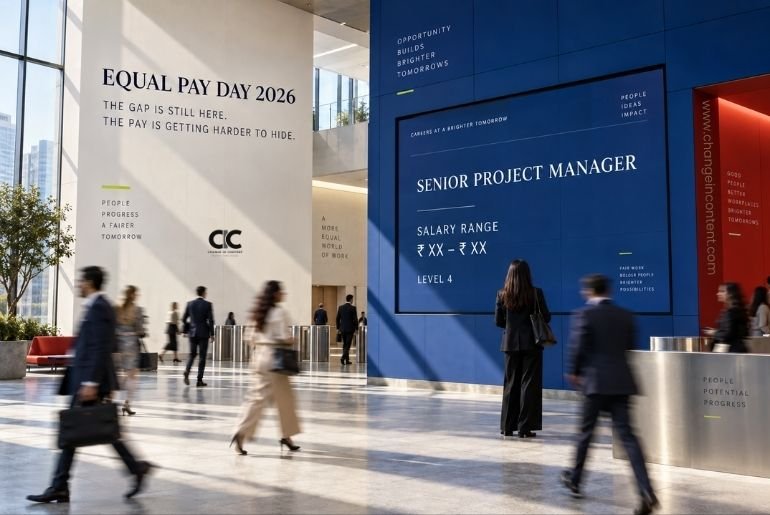
International Equal Pay Day 2026
A year ago, on International Equal Pay Day, Change in Content asked why the gender pay gap was still so difficult to close.
12 months later, something has changed.
Not enough in the pay cheque. But quite a lot around it.
Governments are making pay harder to hide. Employers are being asked to compare jobs more objectively. India has brought a new wage framework into force. International labour law has moved into the platform economy. And the policy conversation is increasingly connecting pay with care, occupational segregation, job evaluation and career progression rather than treating salary negotiation as the whole problem.
Yet on International Equal Pay Day 2026, the global headline remains stubborn. Women in wage employment still earn, on average, about 20% less than men. So perhaps the right question this year is not simply whether the gap remains. It is: Have we become better at understanding what has to change to close it?
The answer is yes.
First, equal pay and the gender pay gap are not the same thing
This distinction matters before we compare any numbers.
Equal pay for work of equal value is a principle. It says women and men should receive equal remuneration not only for identical work, but also for different jobs that are objectively assessed as being of equal value.
The gender pay gap is a statistical outcome. It usually compares average or median earnings between women and men across a labour market, company or group of employees. It can therefore reflect many things besides direct unequal pay for identical work:
- which industries women enter;
- which occupations they hold;
- hours worked;
- part-time work;
- seniority;
- career interruptions;
- leadership representation;
- bonuses;
- and differences in pay for similar or equally valuable work.
The OECD defines its gender wage-gap indicator as the difference between men’s and women’s median earnings relative to men’s median earnings. That is why a national gender pay gap cannot automatically be interpreted as: “A woman receives X% less than the man sitting next to her for exactly the same job.”
Sometimes that happens. But the wider gap measures something bigger.
The global number remains difficult to celebrate
The ILO’s latest 2026 guidance puts the global gender pay gap among wage employees at approximately 20%. Women with children face still wider gaps, as do several groups including migrant women, women with disabilities and women working informally.
Another ILO measure tells the story slightly differently. Looking at annual employee earnings globally, women earned around 78 cents for every dollar earned by male employees in 2025. When total labour income is considered, which also captures differences in participation and work intensity, the disparity becomes much larger.
Those measures should not be blended into one statistic. But they point in the same direction. Women still earn less. And pay inequality accumulates.
One smaller salary difference this month becomes:
- lower annual income;
- smaller pension contributions;
- less savings;
- less capital available for investment;
- greater vulnerability during a career break;
- and eventually a lifetime wealth difference.
That is why UN Women’s 2026 statement emphasises that the gender pay gap extends far beyond the monthly pay cheque.
What changed in 2026? Pay transparency became much harder to ignore
Perhaps the clearest development over the past year has been around visibility. For decades, pay inequality benefited from one remarkably effective condition: nobody knew what anybody else earned. That environment is changing.
The OECD’s April 2026 report, Pay Transparency in Progress, found that countries are increasingly adopting:
- gender-pay-gap reporting;
- pay audits;
- employee rights to pay information;
- and gender-neutral job evaluation and classification.
By the end of 2026, the OECD expects 84% of OECD countries to mandate private-sector pay-gap reporting, compared with 55% currently. Almost 40% already require private employers to conduct gender-neutral job evaluations, or are moving towards comparable measures.
That is a meaningful shift. Pay equity is moving from: “Do you believe your company pays fairly?” towards: “Show us.”
Europe crossed an important deadline
The EU Pay Transparency Directive reached its national-transposition deadline on 7 June 2026.
The Directive is intended to strengthen employees’ ability to identify unequal pay and requires Member States to build its provisions into national law. Its approach includes greater access to pay information and clearer ways to assess whether different jobs are genuinely of equal value.
In March, the European Commission and European Institute for Gender Equality also launched EU-wide guidance on gender-neutral job evaluation and classification.
That sounds technical. It is actually one of the hardest parts of the pay problem.
Suppose one company pays:
- an equipment technician one salary;
- a customer-support specialist another;
- and a care-intensive or people-management role much less.
The jobs are different. So simply checking whether men and women with the same title receive the same amount will miss a deeper issue.
The question becomes whether jobs requiring comparable levels of skill, responsibility, effort and working conditions have been valued consistently.
That is what “work of equal value” is designed to expose.
This is where Finland offered an interesting example
Earlier this month, Change in Content reported on Finland’s new gender-neutral Job Demand Assessment Model.
Instead of relying heavily on job titles or assumptions about “men’s work” and “women’s work”, it asks employers to evaluate six dimensions of a job, including skills, responsibility, problem-solving, interaction and physical and psychosocial demands.
This matters because some work can become undervalued precisely. After all, the skill involved stops being recognised as skill.
- Patience becomes “personality”.
- Emotional intelligence becomes “being good with people”.
- Conflict management becomes “soft skills”.
- Responsibility for relationships becomes invisible.
Objective job evaluation attempts to put those demands back into the value of the job. That is one of the more important directions equal-pay policy has taken in 2026.
India changed too
There has been a significant legal development since last International Equal Pay Day.
India’s four Labour Codes took effect on 21 November 2025, including the Code on Wages, 2019.
Section 3 of the Code prohibits discrimination on the ground of gender in wages by the same employer for the same work or work of a similar nature. It also prohibits sex discrimination in recruitment for such work, subject to legal restrictions applicable to particular employment.
The principle itself is not new to India. The Equal Remuneration Act, 1976 had long provided protections around equal remuneration. What changed is the statutory architecture: those provisions now sit within India’s consolidated Code on Wages framework.
That gives International Equal Pay Day 2026 a distinctly different Indian policy backdrop from the one we wrote about last September.
And India’s latest earnings data contains progress and unfinished work
The PLFS Annual Report 2025, released this year, gives us fresh official earnings numbers.
Among regular wage and salaried workers, average monthly earnings in 2025 were:
- Men: ₹24,217
- Women: ₹18,353
A year earlier, they were:
- Men: ₹22,891
- Women: ₹17,126.
There is some encouraging movement inside those numbers.
Female average earnings grew 7.2% between 2024 and 2025, compared with 5.8% for men. But we need to interpret this responsibly. These figures do not prove that Indian employers are paying women ₹18,353 for the exact same jobs for which men receive ₹24,217.
PLFS is showing average earnings across millions of people in different occupations, industries, states, levels of seniority, working arrangements, and jobs. Part of the difference therefore reflects where women and men work.
That is still economically important. But it is different from direct pay discrimination.
This is one reason Change in Content will not simply replace last year’s 34% headline with another single “India gender pay gap” percentage. The better question is: Where exactly is the earnings difference coming from?
The pay gap begins before salary is decided
A company can technically have perfect equal-pay compliance and still have a substantial gender pay gap.
Imagine everyone at the same level is paid identically. But:
- most junior employees are women;
- most senior employees are men;
- women dominate lower-paying departments;
- men dominate P&L roles;
- women take longer career breaks;
- fewer women receive bonuses;
- and the highest-paying positions reward long, inflexible hours.
The company can have “equal salaries” within each job and still produce very unequal overall earnings. That is why Nobel laureate Claudia Goldin’s work on “greedy jobs” and the gender pay gap remains useful.
Some jobs reward constant availability disproportionately. When care remains unequally distributed, those reward structures can turn time differences into pay differences.
Equal pay therefore eventually takes us into care, promotion, job design, leadership, working hours, and who gets access to the highest-value work.
UN Women’s 2026 statement reflects that wider view
UN Women’s message this year is noticeably action-oriented. It points to renewed commitments made at the 70th Commission on the Status of Women and highlights another development that would barely have featured in an equal-pay discussion a few years ago: platform work.
In June, the International Labour Conference adopted Convention No. 193 on Decent Work in the Platform Economy, the first global labour standard dedicated specifically to platform work. The relevance to women is significant.
Increasing numbers of people earn through delivery platforms, ride-hailing, freelance marketplaces, online labour platforms, and digitally mediated work. Pay in those systems can be influenced not only by a manager but by an algorithm.
- How work is allocated.
- How performance is rated.
- How accounts are ranked.
- How incentives are calculated.
- How workers are deactivated.
The 2026 equal-pay conversation therefore has a new participant: code.
UN Women specifically points to the potential of the new Convention to strengthen protection against unfair pay, harassment, discrimination and opaque algorithmic decisions in platform work.
Our earlier reporting on the gig workforce in India showed why this deserves attention here too. When work moves outside a conventional employer–employee structure, understanding who gets paid what can become even harder.
The problem is becoming more measurable
This might be the most optimistic development since last year.
Not solved. Measurable.
Employers increasingly have tools to ask:
- What is our raw gender pay gap?
- What happens when we compare employees at the same level?
- Do starting salaries differ?
- Who receives bonuses?
- Whose pay rises faster?
- Where are women clustered?
- Does parenthood affect earnings progression?
- Do part-time or flexible workers pay a penalty?
- Are jobs dominated by women being undervalued?
- What happens to pensions and lifetime earnings?
Those are better questions than: “Do we have an equal-pay policy?”
Because almost every serious organisation can write the policy. The numbers tell us whether it works.
What should organisations do differently in 2026?
The first move is surprisingly basic: know your own number. Not one corporate average.
- Break pay down by role, level, function, location and employment type.
- Then examine starting pay. A gap established on the day of hiring compounds through every percentage-based increment afterwards.
- Look at bonuses separately.
- Audit promotion velocity.
- Examine whether flexible workers lose access to high-value assignments.
- Use gender-neutral job evaluation where different functions involve work of comparable value.
- And stop assuming that negotiation alone is a neutral salary-setting mechanism.
An opaque system rewards people who know what everybody else earns. Transparency removes some of that information advantage.
Our recent Gender Equality Concepts guide makes an important distinction here: equality cannot be diagnosed from representation alone. The same applies to pay.
A company may hire women successfully while paying, promoting and rewarding them differently over time.
The workforce number cannot answer the pay question.
Closing thoughts: The gap is becoming harder to hide
Last International Equal Pay Day, we asked why equal pay still looked so distant. A year later, we are not going to pretend the answer suddenly became encouraging. The global gap remains. Women still lose income during their working years.
That difference still travels into savings, pensions and economic security. But something has moved.
- More employers are being required to publish.
- More countries are auditing.
- More attention is being paid to the value of different jobs.
- India’s new wage framework is now operational.
- Platform workers have their first international labour standard.
- And the conversation has moved noticeably beyond telling women to negotiate harder.
All of that matters because inequality thrives unusually well in darkness. For decades, one of pay inequality’s greatest protections was that very few people could see it clearly.
2026 has made parts of it more visible. The next test is whether visibility changes the number on the pay cheque.
FAQs
Q: When is International Equal Pay Day 2026?
A: International Equal Pay Day is observed globally on 18 September. The United Nations General Assembly established the observance in 2019 to advance equal pay for work of equal value. It is different from country-specific Equal Pay Days, including the US observance, which fell on 26 March 2026.
Q: What is the global gender pay gap in 2026?
A: The ILO and UN Women currently describe the global gender pay gap among wage earners as approximately 20%. Different measures can produce different figures because some compare hourly wages, others monthly or annual earnings, and some include differences in employment participation.
Q: What is equal pay for work of equal value?
A: It means women and men should receive equal remuneration not only when performing identical work, but also where different jobs are objectively assessed as having comparable value based on factors such as skill, responsibility, effort and working conditions.
Q: What is the gender pay gap in India?
A: There is no single universally applicable India gender-pay-gap figure because the result depends on the dataset and method used. The latest PLFS 2025 reports average monthly regular salaried earnings of ₹24,217 for men and ₹18,353 for women, but these averages cover different jobs, industries, locations and workers and should not be treated as a controlled same-job pay-gap estimate.
Q: What changed on equal pay in India since 2025?
A: The Code on Wages, 2019 became operational on 21 November 2025. Among its provisions is a prohibition on gender discrimination in wages for the same or similar work by the same employer.
Q: Does pay transparency reduce the gender pay gap?
A: The OECD says pay-transparency tools can help identify and address gaps by giving workers, employers and representatives better information. Their effectiveness depends on policy design, enforcement and organisations acting on the differences they uncover.
Editorial Note & Sources
Gender pay-gap figures are highly sensitive to methodology. Hourly, monthly and annual earnings gaps measure different things; adjusted and unadjusted gaps answer different questions; and national average earnings do not prove unequal pay for identical work. Change in Content has therefore avoided reproducing last year’s India headline percentage without a directly comparable current methodology. PLFS earnings figures are presented as evidence of overall earnings inequality, not as proof of same-job discrimination.
Sources
- UN Women: Statement for International Equal Pay Day 2026, 18 September 2026. Primary source for UN Women’s 2026 position, including the global 20% figure, lifetime economic effects, CSW70 commitments and Convention No. 193.
- United Nations: International Equal Pay Day. Official UN observance page defining equal pay for work of equal value, the global pay-gap context and the role of the Equal Pay International Coalition.
- International Labour Organisation: Towards Pay Equity: A Comprehensive Response to the Gender Pay Gap, March 2026. New 2026 global framework covering pay transparency, job evaluation, wage policy, labour inspection, social protection, care and social dialogue.
- OECD: Pay Transparency in Progress: Valuing Jobs, Closing Gender Pay Gaps, April 2026. Primary source for changing pay-transparency policy across OECD countries.
- European Commission: EU Action for Equal Pay. Primary source for the EU Pay Transparency Directive’s 7 June 2026 transposition deadline and the 2026 gender-neutral job-evaluation guidance.
- International Labour Organisation: Decent Work in the Platform Economy Convention, 2026 (No. 193). Primary international legal source for the new platform-economy labour standard adopted in June 2026.
- Ministry of Labour & Employment, Government of India: Code on Wages implementation notification, 21 November 2025. Primary legal source confirming commencement of the Code.
- Ministry of Statistics & Programme Implementation: PLFS Annual Report 2025. Primary Indian statistical source for average earnings among regular salaried, self-employed and casual workers.
