
The Brief
- Research by The 100% Project found men’s responses to gender-equity initiatives differed by generation, career stage, industry and life experience, challenging one-size-fits-all engagement strategies.
- Inclusive practices can benefit men directly through flexible work, parental leave, psychological safety and greater freedom from restrictive ideas about masculinity.
- Opportunities for women can sometimes be interpreted as opportunities being removed from men. Understanding that perception is more productive than either endorsing or mocking it. The 100% Project’s earlier quota research explicitly studied perceived losses of opportunity, leadership identity and belief in meritocracy.
- Men can influence inclusion through ordinary workplace behaviour: hiring, sponsorship, leave-taking, meeting culture, informal networks, jokes, credit and how they respond when another man challenges a stereotype.
- In India, this conversation is especially relevant because care remains strongly gendered while universal statutory paternity leave for private-sector workers is still absent.
- Government guidance has nevertheless encouraged employers to consider paternity leave, parental leave and flexible working arrangements for both women and men.
Men and Inclusive Workplace Practices
I have increasingly become uncomfortable with one part of the gender-equality conversation.
We speak about women.
Then we speak to organisations.
And when we speak about men, it is often because somebody has behaved badly.
- The biased manager.
- The colleague who interrupted.
- The senior leader who hired people who looked like him.
- The husband who did not share enough care.
- The man who objected to a diversity programme.
All of those conversations can be necessary. But if the only role we can imagine for men in gender equality is “please stop being part of the problem”, I am not sure we are building the widest possible coalition for change.
- Men work in these organisations too.
- They manage people.
- Become fathers.
- Care for ageing parents.
- Want flexibility.
- Get burnt out.
- Feel pressure to earn.
- Sometimes stay silent because they do not know the approved language.
- Sometimes disagree.
- Sometimes feel threatened by a policy.
- Sometimes support equality strongly.
- Sometimes support the principle but dislike the method.
- Sometimes change their minds.
That last group interests me the most. Because inclusion will move much faster when we stop imagining men as one block.
The research has a useful message: There isn’t one kind of man
The 100% Project surveyed 241 employed Australian men to understand attitudes towards four workplace practices: gender quotas; pay equity; equal parental leave; and flexible work.
The study examined how those attitudes related to hostile sexist beliefs and found that resistance was not distributed neatly across “men”. It shifted with age, career stage, industry and lived experience.
Only 12% strongly endorsed hostile sexist beliefs in the research.
Another 32% were indifferent to the hostile-sexism statements tested, making them especially interesting to the researchers as a group whose views may be more open to movement.
There were differences within differences.
Baby Boomers, middle managers and men without children showed particular patterns of lower support for some initiatives when hostile attitudes were present. Gen Z men behaved differently on some measures, including recognition of the gender pay gap as systemic.
This is Australian research. I would not claim those percentages describe Indian men. But the organisational lesson travels rather well.
Why would we expect one gender-equality message to work on every man?
- A 24-year-old unmarried analyst in Bengaluru.
- A 38-year-old new father in Pune.
- A 51-year-old factory supervisor in Chennai.
- A second-generation business owner in Surat.
- A senior banker in Mumbai.
- A nurse.
- A sales manager.
- A man supporting two ageing parents.
They may all be men. That may be one of the least useful things we know about them when deciding how to engage them.
One-size-fits-all inclusion can become surprisingly exclusionary
There is an irony here.
An organisation launches an inclusion initiative. Then communicates it in a way that assumes an entire demographic group thinks alike. That is not particularly inclusive.
- Some men understand gender inequality intellectually but do not see what role they are supposed to play.
- Some believe opportunities are genuinely unfairly distributed.
- Some support women at work but feel uncomfortable with quotas.
- Some support quotas.
- Some want to take parental leave but fear the career consequences.
- Some do not yet see a problem.
- Some feel the entire conversation has already decided what they think before they enter the room.
Those are different starting points. HR cannot respond to all of them with the same PowerPoint. And disagreement should not automatically end the conversation.
A man asking, “Will this reduce my chances of promotion?” may be expressing hostility.
Or anxiety, or confusion, or a perfectly understandable question about how a new process will work.
We can answer it. Inclusion becomes fragile when curiosity itself becomes evidence of guilt.
There is a zero-sum fear hiding in some gender conversations
Here is the harder bit.
Suppose an organisation has ten senior roles. Historically, 9 usually went to men. It introduces an intervention intended to improve women’s representation.
A man competing for one of those positions may think: If more women get these jobs, surely fewer men will. In the narrowest numerical sense, that can sometimes be true.
There are 10 chairs. Changing who occupies them changes somebody’s probability of sitting down. Pretending otherwise makes the equality conversation less credible.
The 100% Project has studied precisely this perception of loss. Its earlier work examined whether gender quotas could trigger concerns among men around loss of opportunity, leadership identity and belief in meritocracy.
But there is another way of looking at the same 10 chairs. If 9 have historically gone to men partly because informal networks, assumptions about leadership, care patterns, sponsorship or biased criteria made it easier for men to compete, correcting those conditions is not stealing somebody’s share.
It is changing the competition.
That can feel uncomfortable to somebody who benefited from the previous structure without deliberately creating it.
Both ideas can exist together. Fairer systems can alter individual outcomes. And an individual man is not automatically being treated unfairly because a system is becoming fairer to women.
We should be able to hold both thoughts without shouting at each other.
Our recent guide to gender equality concepts makes a related distinction: equality and equity are not promises that everybody will receive the same outcome; they concern whether the conditions for opportunity are fair.
Inclusion gives men things too
This is the part that deserves much more attention.
Gender inclusion is frequently presented to men as an ethical request: Support this because women deserve equality. They do. But inclusive workplaces can also materially improve men’s lives.
A father can actually be a father
India offers a useful example.
Women covered by the Maternity Benefit framework may receive up to 26 weeks of maternity leave in eligible establishments. India does not have a corresponding universal statutory paternity-leave entitlement for men working in the private sector.
The government said in 2020 that it had no plans for such a private-sector system. However, a 2024 Labour Ministry advisory later encouraged employers to consider family-friendly measures, including paternity leave, parental leave, and flexible working arrangements.
Some companies voluntarily go much further. That matters to women. It also matters to men.
A workplace that treats fathers as genuine caregivers gives a man something traditional workplaces often denied him: time with his child without having to pretend work should always come first. And when more men use caregiving leave, care becomes less strongly coded as a woman’s career event.
That helps women too. 1 inclusive policy. 2 directions of benefit.
Our reporting on paternity leave in India has looked at this connection directly: equal parenting is not simply a men’s benefit. It can also weaken the assumption that employers incur a greater caregiving “risk” when they hire women.
Flexibility stops looking like a concession to women
We did something strange with flexibility for years. We associated it with mothers.
Need to leave early? Woman.
Work from home? Woman.
Need time for a school function? Woman.
That association has consequences for everybody.
Women can become stereotyped as less committed. Men can become reluctant to ask for flexibility because doing so conflicts with the image of the always-available male employee.
Earlier research by The 100% Project found both men and women more strongly associated work-life balance with women than men, highlighting how deeply flexibility had become gender-coded.
An inclusive organisation makes flexibility less remarkable.
- The man can use it because his father has a hospital appointment.
- The woman can use it for a completely non-care reason.
- The father can pick up his daughter.
- The single employee can have a life too.
- The benefit stops carrying a gender label.
That is inclusion doing useful work.
Men also live inside stereotypes about men
This point is sometimes lost because gender inequality has disadvantaged women so extensively across economic and professional life. But acknowledging that history does not require us to pretend gender expectations cannot constrain men.
Men are also handed scripts.
- Provide. Compete. Do not appear weak. Earn more. Take responsibility.
- Do not cry in the office. Do not admit you are overwhelmed.
- Do not choose care over career.
- Do not take the full parental leave.
- Do not tell the team you need help.
The script can reward men in some areas and hurt them in others. That complexity should not frighten us.
An inclusive workplace can make it easier for a woman to lead without being penalised for behaving assertively.
The same workplace can make it easier for a man to say he is struggling without feeling his masculinity has somehow been downgraded.
We do not have to choose which freedom counts.
Men’s participation changes women’s inclusion at home too
That is where Indian workplaces cannot entirely separate office culture from household culture.
India’s Time Use Survey continues to show a large gender difference in unpaid work.
Women participating in unpaid domestic services spent 289 minutes a day on those activities, compared with 88 minutes for men. Women also spent substantially more time on caregiving.
Workplaces cannot allocate chores inside people’s homes. But they can influence what becomes normal.
- If a company offers fathers meaningful parental leave and men take it, something shifts.
- If senior male leaders openly leave to care for children, something shifts.
- If a man can decline a 7 pm meeting because he has caregiving responsibilities without being laughed at, something shifts.
- If men at the top use flexibility rather than merely offering it to women lower down, something shifts.
The workplace sends behaviour back into the household. That can eventually return to the workplace as a woman with slightly more time.
Hence, men’s inclusion is not a detour from women’s equality. It can be part of the machinery that produces it.
Allyship is useful. The superhero version is not.
Then comes the word ally. I like the idea more than I like some of the performance around it.
A male ally does not need to save women. He certainly does not need applause for treating a colleague fairly.
Breath Beings makes a useful point in its work on male allyship: effective allies avoid the “White Knight” instinct and instead create room for honest conversation and participation. That is a much healthier model.
You do not need a cape. Try something smaller.
You are in a meeting, and somebody repeats a woman’s idea five minutes after she said it.
Give the credit back. A capable woman is not being considered for a client-facing assignment because somebody assumes she cannot travel.
Ask whether anybody asked her. A male colleague takes parental leave. Do not joke that he is enjoying a holiday. A woman receives a difficult leadership role.
Do not assume she was chosen because the organisation “needed diversity”. A hiring panel describes one candidate as “aggressive” and another as “decisive”.
Ask what behaviour produced those two descriptions.
Somebody makes a sexist joke.
You do not have to deliver a TED Talk. You can simply not reward it with laughter.
That is close to what we meant in our earlier piece on feminist allyship at work: participation is more useful than applause.
There is another allyship that organisations forget: peer-to-peer
We often imagine allyship vertically.
Senior man sponsors junior woman. Useful.
But men influence other men horizontally all day.
- The WhatsApp group.
- The lunch table.
- The sales trip.
- The factory floor.
- The informal debrief after the meeting.
- The joke after the HR session.
Culture travels through those spaces faster than most policies do.
A man challenging another man can also land differently from HR issuing another guideline. Not because women should need male validation. Because humans respond to peers. That is basic social behaviour.
The colleague who says, “Come on, that’s not fair,” can sometimes move a norm more effectively than an annual compulsory module.
Organisations looking for transformative male allies should therefore stop looking only for senior champions.
There are cultural influencers everywhere.
But do not recruit men by making women disappear
There is a trap here.
In an effort to make gender equality more palatable to men, organisations can dilute the original problem so thoroughly that women’s inequality almost vanishes. That would be absurd.
Women continue to face measurable gaps in employment, pay, leadership, unpaid care and occupational opportunity in India.
Our goal is not to rename women’s disadvantage as a generic wellbeing problem so nobody feels uncomfortable. Gendered inequality should still be named.
The better approach is to be precise about the problem without making every man personally responsible for creating it.
“Women are promoted at a lower rate at this level” is data.
“Men don’t want women to succeed” is an assumption unless you have evidence.
“Our senior roles remain disproportionately male” is measurable.
“Men are the problem” is useless organisational analysis.
Precision lowers defensiveness without lowering accountability.
HR should stop designing inclusion only around believers and opponents
One finding from The 100% Project’s research stayed with me. The “moveable middle”.
Not the people already volunteering for every inclusion committee. Not the small group firmly hostile to gender-equity efforts. The people somewhere in between.
Unsure. Inconsistent. Supportive of one intervention, sceptical about another. Open to evidence. Influenced by how something is framed.
That may be where HR’s most productive work sits.
Instead of asking: How do we convince men to support gender equality?
Try: What is stopping this group of men from supporting this specific practice?
Those are different research questions.
- A young father reluctant to take leave may need visible leadership permission.
- A middle manager sceptical of quotas may need a transparent explanation of how selection and merit will operate.
- A man who thinks flexibility is unfair may need to see that it is available to him too.
- A senior leader may need data showing where progression differs.
- Somebody with genuinely sexist beliefs requires a different response altogether.
There is no reason to pretend education will persuade everybody.
- Accountability still exists.
- Behavioural standards still exist.
- Anti-harassment rules still exist.
Inclusion is not an obligation to indulge discrimination. It is an argument for diagnosing before prescribing.
What would inclusive workplace practices look like if men were genuinely included?
I would test an organisation against a few situations rather than another checklist.
- A male employee requests 6 weeks of parental leave. Does his manager congratulate him or quietly question his ambition?
- A woman is shortlisted for a senior role. Do male colleagues assume the criteria were lowered?
- A father asks for flexibility. Is flexibility still considered something designed for mothers?
- A male manager says he does not understand why a gender target exists. Can he ask the question without being labelled hostile, and can HR answer with evidence?
- A woman speaks about bias. Can men listen without immediately converting her experience into a debate about whether all men behave that way?
- A man speaks about a pressure connected to masculinity. Can the organisation hear him without replying that women have it worse?
These are moments in which inclusion becomes real. Not because everybody agrees. Because everybody can participate while the standard of fairness remains intact.
Women do not need men’s permission. Equality does need men’s participation.
I want to be careful with this distinction.
Women do not need men to bestow equality upon them. Men are not the owners of opportunity, handing some of it over. But men still occupy a very large share of managerial, organisational and economic decision-making positions. They also occupy homes, teams and communities.
Their behaviour affects what happens. So do women’s.
Gender equality cannot sensibly be designed as a project in which half the population is the beneficiary and the other half receives a PowerPoint explaining what not to do.
There is more imagination available than that.
- Men can challenge bias.
- Use leave.
- Share care.
- Sponsor talent.
- Change hiring decisions.
- Design policy.
- Question poor assumptions.
- Model vulnerability.
- Make flexibility normal.
- Listen.
- And sometimes simply move out of the way when somebody else is better qualified.
None of those actions reduces men’s value. They broaden the definition of what a good workplace looks like.
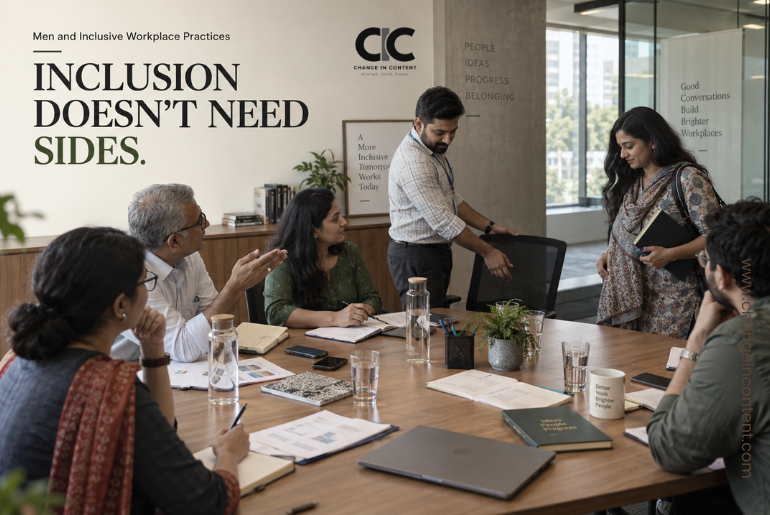
Change in Perspective: Maybe the Table Was Never Meant to Have Sides
We use phrases such as: women’s advancement; male allyship; gender-equity initiatives; men’s resistance. Useful terms. But sometimes the language makes me picture a long meeting table.
Women on one side. Men on the other. HR standing at the front trying to negotiate a settlement.
Real workplaces do not work like that.
- A man can benefit from flexibility and still hold a biased assumption about women.
- A woman can support gender equality and still believe fathers should prioritise work.
- A male manager can become an extraordinary sponsor.
- A female manager can reproduce an old workplace norm.
People are messy. That is exactly why inclusive workplace practices have to be better than stereotypes.
I want more women to work. Earn. Lead. Build companies. Return after career breaks. Stay when they want to stay. Have a fair shot at the opportunities for which they are capable.
I do not see any of that as requiring men to become smaller. In fact, some of the same changes could give men more room to become fuller versions of themselves too.
- To care.
- To parent.
- To ask for flexibility.
- To admit pressure.
- To lead without performing invulnerability.
- And to participate in gender equality without first being told that their only useful contribution is an apology.
Perhaps that is the proposition we should make more often.
Women do not gain because men lose. We gain when fewer people’s careers are being determined by rules attached to their gender.
That sounds like a workplace worth building together.
Editorial Note & Sources
The principal research discussed in this article was conducted in Australia and surveyed 241 employed Australian men. Its findings should not be treated as representative of Indian men. Change in Content uses the research as a framework for examining how organisations might engage men more thoughtfully in workplace inclusion, alongside Indian policy and labour-market context. The commentary and Indian workplace applications are the author’s.
Sources
The 100% Project — Men and Inclusive Workplace Practices: One-size Doesn’t Fit All, 2026. Primary research on men’s attitudes towards pay equity, gender quotas, flexible work and equal parental leave.
The 100% Project — Men and Gender Quotas: What’s Loss Got to Do With It? Research into perceived loss of opportunity, leadership identity and meritocracy in men’s reactions to gender quotas.
People Measures / The 100% Project — Engaging Men in Gender Equity. Discussion of visible allyship, shared benefits and men’s role in sustainable workplace change.
Government of India, Ministry of Labour & Employment. Sources on paternity leave in the private sector and the later advisory encouraging family-friendly measures, including paternity leave, parental leave and flexible working.
Red Shoe Movement — How Inclusive Workplaces Benefit Men. Background on parental leave, flexibility, wellbeing and men’s experience of inclusive policies.
Breath Beings — How Men Can Be Transformative Allies in Workplace Diversity. India-focused discussion of male allyship and avoiding saviour-style participation.
