The Brief
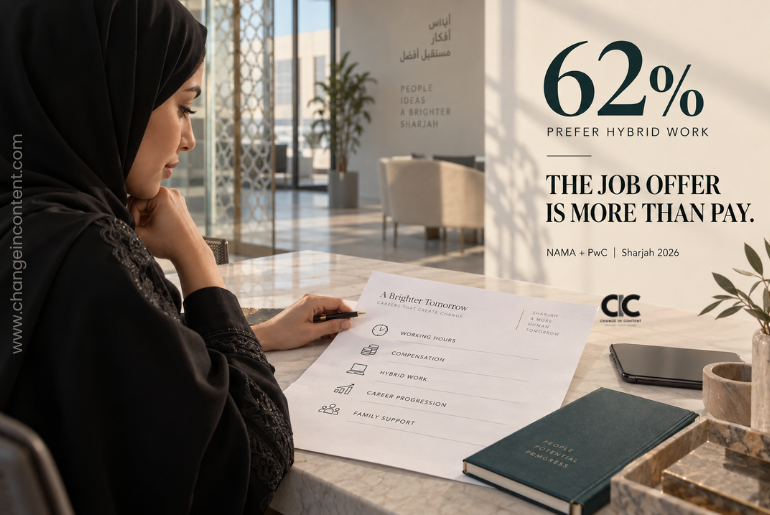
- 62% of Emirati women surveyed said they would prefer hybrid work arrangements. Only 29% currently recognise such flexibility as available in Sharjah’s private sector.
- Working hours were a key employment consideration for 76% of respondents, compared with 73% who cited compensation.
- The survey covered 691 Emirati women who live, work or are seeking private-sector employment in Sharjah.
- Career progression remains another important issue: 56% of surveyed women were in entry-level roles, while 33% were in middle management.
- The findings suggest private-sector employers may need to compete on the overall quality of the employment proposition, not salary alone.
Factors influencing Emirati women’s career decisions
Hybrid work has emerged as one of the strongest preferences shaping Emirati women’s career decisions in Sharjah.
A new study by NAMA Women Advancement, conducted with PwC Middle East, found that 62% of Emirati women surveyed would prefer hybrid working arrangements.
The research draws on responses from 691 Emirati women who live, work or are seeking employment in Sharjah’s private sector, supported by focus groups and stakeholder discussions.
The study looks beyond recruitment to understand what makes women stay, progress and see a future in private-sector employment.
Flexibility matters almost as much as pay
Working hours emerged as one of the strongest factors in job choice.
Around 76% of respondents identified working hours as an important consideration, compared with 73% who pointed to compensation. That puts flexibility firmly in the employment value proposition rather than treating it as a secondary perk.
Yet a gap remains between preference and perceived availability. While 62% said they would prefer hybrid work, only 29% recognised that such flexibility currently exists in Sharjah’s private sector.
For employers, that may represent either an implementation gap or a communication gap.
Progression also shapes whether women stay
The survey also highlights the importance of career pathways.
Among respondents, 56% were in entry-level roles, compared with 33% in middle management. PwC and NAMA argue that attracting women into the private sector now needs to be matched by clearer opportunities to progress.
The report identifies seven areas for employer action, including meaningful roles, compensation and career structures, flexibility, support during key life stages, mentorship, leadership accountability and retention.
The findings point to a broader shift in how women assess employment.
Salary still matters. But so do hours. Flexibility. Family support. Development. And whether the organisation offers a credible future.
The private sector is competing with more than another employer
Sharjah’s public sector continues to hold strong appeal among Emirati women, according to the report. That means private-sector employers are not only competing with one another. They are also competing with expectations around stability, flexibility and family support that have traditionally made public-sector work attractive.
Previous PwC research across the UAE has pointed in the same direction. In its 2024 Emiratisation survey, 91% of Emirati women said they preferred jobs offering flexible arrangements, compared with 82% of men.
The Sharjah findings therefore appear to reflect a wider labour-market preference rather than an isolated local trend.
What the survey tells employers
The research does not suggest that flexibility alone will solve retention. Its more useful message is that Emirati women are evaluating the whole employment experience.
A hybrid policy may help attract talent. But if career progression is unclear, compensation is uncompetitive, or support disappears during major life stages, flexibility alone will not build a long-term career.
For employers in Sharjah, that makes the question fairly practical: What combination of pay, working structure, progression and support makes a woman want to stay?
The latest survey gives them a clearer answer than before.
Change in Perspective: Choice is Becoming Part of the Job Offer
The interesting part of this story is not that women want flexibility. Many employees do. It is that flexibility now sits alongside salary, career growth and long-term security when Emirati women assess where to work.
For employers trying to attract and retain national female talent, the job itself is only part of the proposition.
How the work fits into a life is increasingly part of it too.
Editorial Note & Sources
This article reports findings from research conducted by NAMA Women Advancement and PwC Middle East among Emirati women who live, work or are seeking employment in Sharjah’s private sector. The survey reflects the preferences and experiences of its respondents and should not be interpreted as representing every Emirati woman in Sharjah or the UAE.
Sources
- PwC Middle East — Understanding the Perspectives of Emirati Women of Sharjah on the Emirate’s Private Sector: Primary source for survey methodology, hybrid-work preferences, working hours, compensation, progression and employer recommendations.
- NAMA Women Advancement — Retaining Emirati Women in Sharjah’s Private Sector: Background on the joint NAMA–PwC research programme and its focus on retention and progression.
- PwC Middle East — Emiratisation Survey 2024: Wider UAE context on Emirati women’s preference for flexible employment.