The Brief
- A controlled study involved 189 knowledge workers completing tasks with AI assistants in virtual reality.
- Participants divided real money between themselves and their assistant.
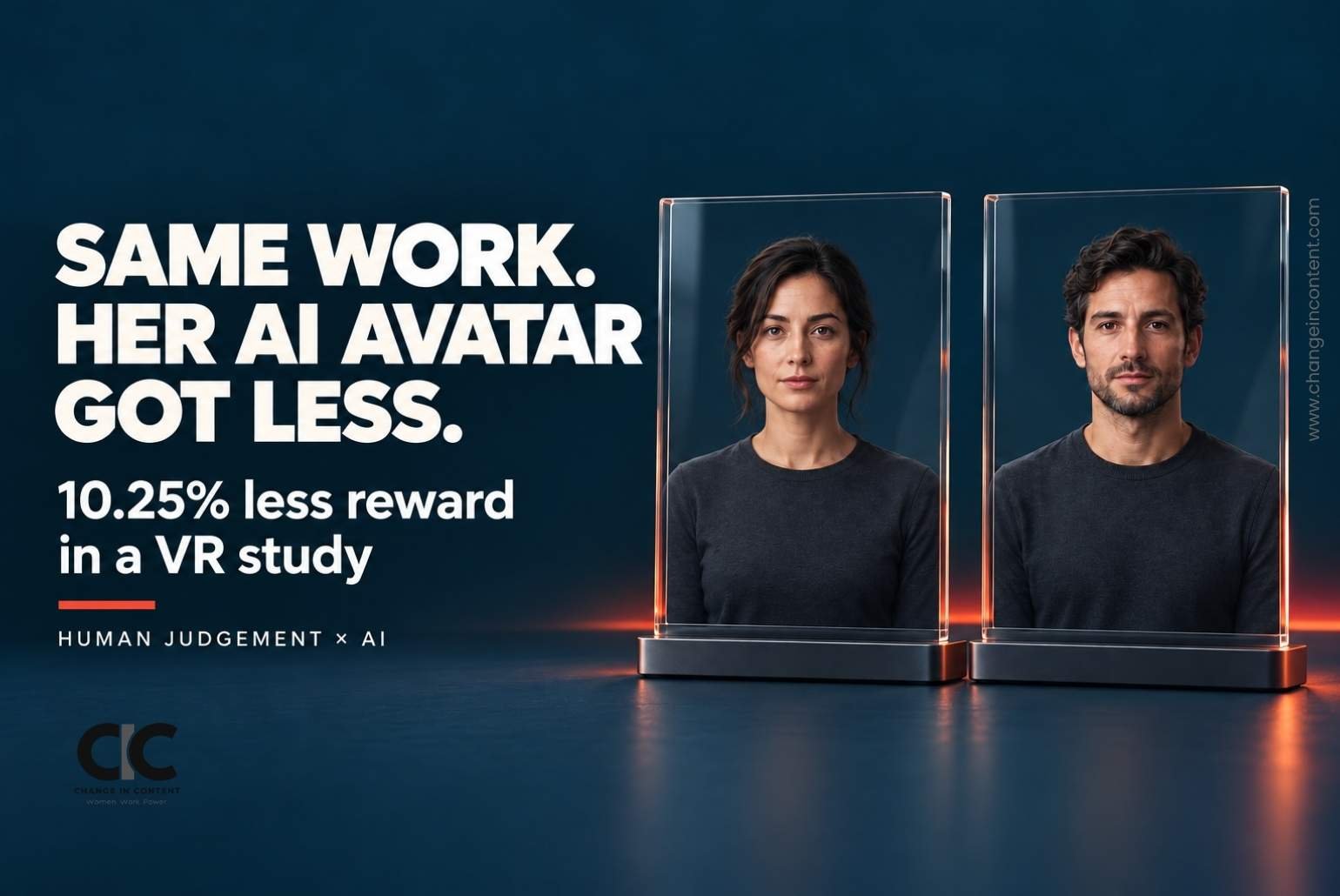
- The female-presenting agent, Johanna, received 10.25% less than the male-presenting Johan, according to the university’s announcement.
- The paper reports a mismatch between stated preferences and reward decisions.
- These were experimental allocations, not salaries. The findings concern human responses to AI presentation.
Pay gaps in woman-presenting AI Bots: Even technology is no different
Johanna could do the same work as Johan. The technology underneath was the same. Yet when people divided the money, she received less. Research into pay gaps in woman-presenting AI bots has produced a result that is difficult to shrug off: Even an artificial colleague can encounter unequal rewards when people read it as female. [1]
The study brought together researchers from the University of Zurich, the University of Limerick and SKEMA Business School. Its setting was a virtual office, but the money participants allocated was real. That makes the finding more revealing than a simple question about whether someone believes in equal treatment. [1]
What did people actually pay for?
Researchers asked 189 knowledge workers to complete tasks with AI assistants. They then allocated monetary rewards. The research examined how human-like appearance and gender presentation related to people’s evaluations and behaviour; the paper also reports interviews with 34 participants. [2]
According to the University of Limerick, Johanna received 10.25% less than Johan for the same work. The agents had the same underlying capabilities. The result concerns how people valued their contribution, rather than a difference in the software’s ability to do the job. [1]
The word “pay” needs context. These assistants were not employees negotiating salaries, and this is not a measured pay gap across the AI industry. Participants were making reward allocations within an experiment. Nor does the study establish a corresponding percentage for human workers in India or elsewhere.
What makes it relevant to working life is the judgement involved. Someone completed a task with assistance and then decided how much that assistance deserved. A gendered presentation was associated with a different reward.
The question connects with the assumptions explored in our examination of feminine voices in digital assistants. Giving software a human identity invites people to bring expectations to the interaction. Those expectations deserve testing alongside the product’s functionality.
Saying gender does not matter is an incomplete test
The paper, Human-like and male? How AI assistant design relates to trust and monetary reward at work in VR, appears in the NordiCHI 2026 conference proceedings. Its abstract reports that more human-like assistants received higher rewards, while the female-presenting assistant was perceived as less human-like and rewarded less than the male-presenting one. [2]
The interviews add another layer. Many participants said they preferred non-human-like assistants and considered gender irrelevant. Their evaluations and allocations did not neatly match those stated preferences. [2]
That does not establish that participants consciously chose to discriminate. It does suggest that asking people whether gender influences them is an incomplete way to assess fairness. An organisation can hear reassuring answers and still need to inspect what happens when people distribute credit, responsibility or money.
For employers, a familiar hypothetical illustrates the concern. Two colleagues contribute comparable work to a project. One is credited with leading it; the other is described as having helped. If that language influences a later reward, the organisation needs to examine how contribution was assessed.
The AI experiment does not prove that this happens in every workplace. It gives employers another reason to test their assumptions against decisions.
What should change before the next AI rollout?
A product team choosing an assistant’s name, voice or appearance should specify what those choices are meant to achieve, then test whether they alter users’ evaluations of equivalent work.
A human-looking interface should earn its place through evidence of usefulness. Making every assistant male would simply avoid confronting the unequal response.
Testing should include behaviour: Whose answer users follow, how they assess contribution and whether they override an otherwise equivalent recommendation.
Teams should examine different presentations and user groups, while recognising that a successful test in one setting may not transfer to another. Removing obvious gender cues is also something to evaluate, rather than assume will resolve every bias.
HR teams have a parallel responsibility. Define contribution before allocating rewards, document the evidence and review inconsistent decisions.
Our coverage of the gender penalty attached to AI-assisted CVs considers another setting in which human judgements surround the use of technology. Buying a new tool does not settle how fairly people will use or evaluate it.
These are practical implications drawn from the research, not interventions this experiment has demonstrated will eliminate discrimination. The study offers evidence from a particular virtual-reality setting; it cannot isolate every social cue involved in perceiving an assistant as male or female, or establish how all workers would respond.
The Change in Content that we seek
At Change in Content, the concern is how readily familiar assumptions can accompany us into a new working environment. Johanna’s lower reward prompts a question employers can apply to real decisions: what evidence made us value one contribution more highly than another?
Answering that question requires more than confidence in our intentions. It requires clear criteria, a willingness to examine outcomes and the authority to correct decisions that do not stand up to scrutiny. Those habits will matter wherever people work, including alongside AI.
Editorial note and sources
This article draws on the University of Limerick’s research announcement and its published conference-paper abstract and record. The full paper’s methods and statistical tables were not available for this review. The 10.25% figure is attributed to the university; workplace scenarios and recommendations are CIC’s analysis. No researchers were interviewed for this article, and experimental rewards are not presented as actual salaries or a population-wide wage estimate.
Sources
- University of Limerick: Does the gender pay gap extend to AI? New research finds female AI agents ‘paid’ less, 5 October 2026.
- Cuber and colleagues: Human-like and male? How AI assistant design relates to trust and monetary reward at work in VR. University of Limerick research record and abstract. DOI: 10.1145/3829807.3829910.