The Brief
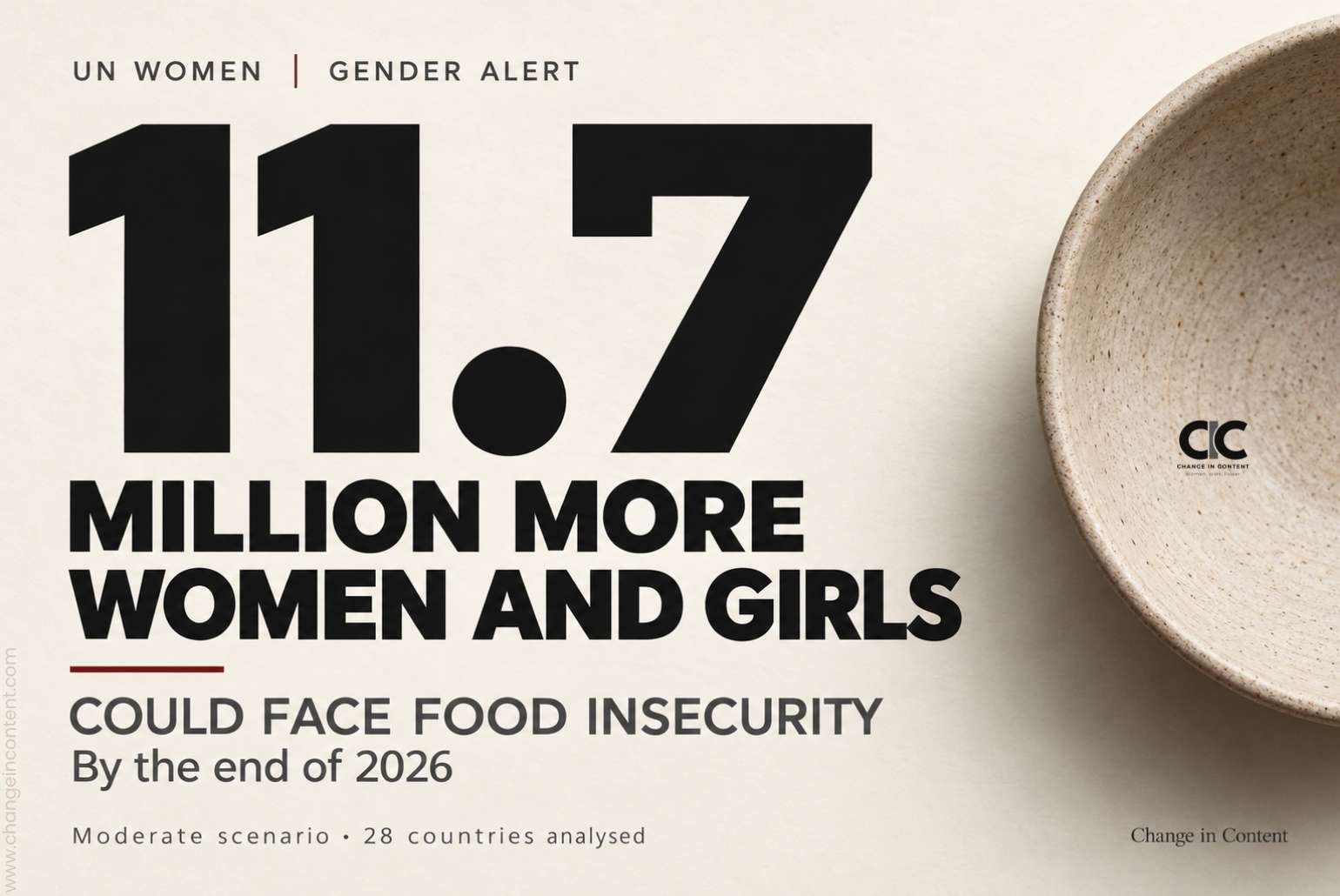
- Under UN Women’s moderate scenario, 11.7 million additional women and girls could face food insecurity by the end of 2026.
- Women and girls account for 53% of the estimated additional people affected across 28 countries.
- Higher food costs can coincide with lost earnings and increased unpaid work.
- These are conditional estimates. The analysis does not directly measure how food is shared within households.
Food security risks of the Middle East escalation and a bigger threat for women
The food security risks of the Middle East escalation extend well beyond its battlefields. A new UN Women analysis estimates that 11.7 million additional women and girls across 28 countries could become food insecure by the end of December 2026, as disruptions to trade put further pressure on food prices and livelihoods.
Presented on 2 October, Gender Alert: Food security risks of the Middle East escalation for women and girls examines how those pressures interact with inequalities that existed before the crisis. Its central finding concerns the resources people have when costs rise: earnings, savings, secure work and the ability to decide how household money is spent.
For women with limited access to those resources, a price increase leaves fewer choices about what to buy, what to cut and how to replace lost income.
What the estimate tells us
The headline figure comes from the report’s moderate scenario. Women and girls represent 53% of the projected 22 million additional people facing food insecurity in the countries studied. Their estimated share reaches 60% in Afghanistan. South Sudan faces an especially concentrated shock: the additional female caseload is equivalent to roughly one in seven of its women and girls.
The analysis is a risk estimate rather than a count of newly identified cases. It uses existing national data and models the female share because comparable food-security outcomes broken down by sex and age are unavailable across all 28 countries. Its moderate scenario assumes annual food inflation 2.75 percentage points above a no-crisis baseline.
The countries were selected for their exposure and vulnerabilities, so the findings should not be read as a representative global forecast. India is included, underlining the reach of the economic consequences beyond the immediate conflict zone. These methodological details appear in the full UN Women report.
The focus complements the wider question explored in our coverage of the costs of war for women and girls in Gaza: what happens to people’s ability to sustain everyday life as livelihoods and essential services come under pressure?
How a shipping disruption reaches the food budget
Food prices carry the cost of far more than the crop itself. Fuel is needed for machinery and transport. Fertiliser affects production costs. Ships, insurance and functioning trade routes help determine whether goods arrive affordably.
FAO warned in March that disruption through the Strait of Hormuz was affecting energy, fertiliser and agricultural markets together. It explained that more expensive inputs could lead farmers to use less fertiliser or change crops, putting subsequent harvests at risk. The World Food Programme has also described the additional expense of rerouting humanitarian deliveries.
Those pressures can reach a household through both its shopping bill and its earnings. A woman working in agriculture may pay more for food while the farm on which she depends faces higher costs or less work. A household relying on money sent home from abroad may have less to spend if that income weakens.
This helps explain why the effects spread across borders. Distance from the fighting offers limited protection against imported costs.
Why women can face a heavier burden
War harms people of every gender. The additional exposure described here arises from the conditions in which women earn, produce food and care for others.
FAO’s research on women in agrifood systems has documented less secure land rights and poorer access to credit and training, alongside more precarious working conditions. Those disadvantages matter when a farmer needs money for inputs or a worker needs savings to cover a period without earnings. Food can remain on sale while moving beyond someone’s means.
UN Women’s new analysis points to another constraint: fewer than one in five women in Iraq, Lebanon, Pakistan and Yemen have a bank or mobile-money account. Receiving money, saving independently or accessing financial support can therefore be more difficult when household budgets tighten.
Inside the home, scarcity can also increase women’s unpaid workload: finding affordable food and preparing substitutes can take longer. Evidence from previous crises shows women may reduce their own meals to feed others. The report is careful about this point: those household responses were not directly measured in this analysis. They are risks that food-security monitoring needs to examine.
That makes the issue relevant to work and economic power as well as hunger. Extra unpaid responsibilities can reduce the time available for paid work, while selling a productive asset to buy food can weaken future earning capacity. A response needs to consider what it takes for someone to obtain a meal today and remain able to support herself tomorrow.
Assistance must reach the person who needs it
UN Women calls for food and cash support alongside protection, nutrition and livelihood assistance. It also urges better evidence about individual experiences within households. (02 October 2026)
For agencies and donors, that means asking practical questions about delivery. Can a woman receive and use the assistance? Does collecting it require a journey she cannot safely make? Can support reach farmers before the planting opportunity passes?
The capacity of local responders matters here. Our reporting on global aid cuts and women’s organisations examines what is lost when services and community connections shrink. Funding decisions should consider whether assistance remains accessible to the people facing the greatest barriers.
The change in view
The report gives a concrete explanation for war’s unequal consequences. A rise in food costs meets households with different resources, and people within those households may have different power over what remains.
Preventing the projected harm requires attention to those differences while pursuing de-escalation and protecting access to food. Women’s earnings, assets and say in household decisions belong in that response. Whether a woman can feed herself should never depend on how much deprivation she can quietly absorb for everyone else.
Editorial note and sources
This article draws on UN Women’s October 2026 Gender Alert, its 2 October Geneva presentation and supporting FAO and WFP material, reviewed on 5 October. The figures are scenario-based estimates for 28 selected countries, not observed outcomes or a representative global forecast. The report combines country baselines using acute food insecurity or chronic undernourishment measures; food insecurity must not be relabelled as famine. CIC’s practical observations are editorial analysis, with no original interviews claimed.
Sources
- UN Women: Full Gender Alert.
- UN Geneva: Briefing of 2 October 2026.
- FAO: Food-security risks from disruption to the Strait of Hormuz.
- WFP: Why the Middle East conflict threatens record levels of hunger.
- FAO: Findings from The Status of Women in Agrifood Systems.