
The Brief
- Leadership opportunities begin taking shape long before a boardroom appointment. Early promotions and access to consequential assignments deserve closer scrutiny.
- Mentoring can help women navigate a workplace. Sponsorship requires someone influential to put their name forward for an opportunity.
- Promotion systems should recognise business contribution without confusing constant availability, personal familiarity or confidence with leadership ability.
- Flexibility, parental leave and career breaks need credible routes back to progression.
- Employers should measure who receives opportunities and decision-making authority, alongside representation.
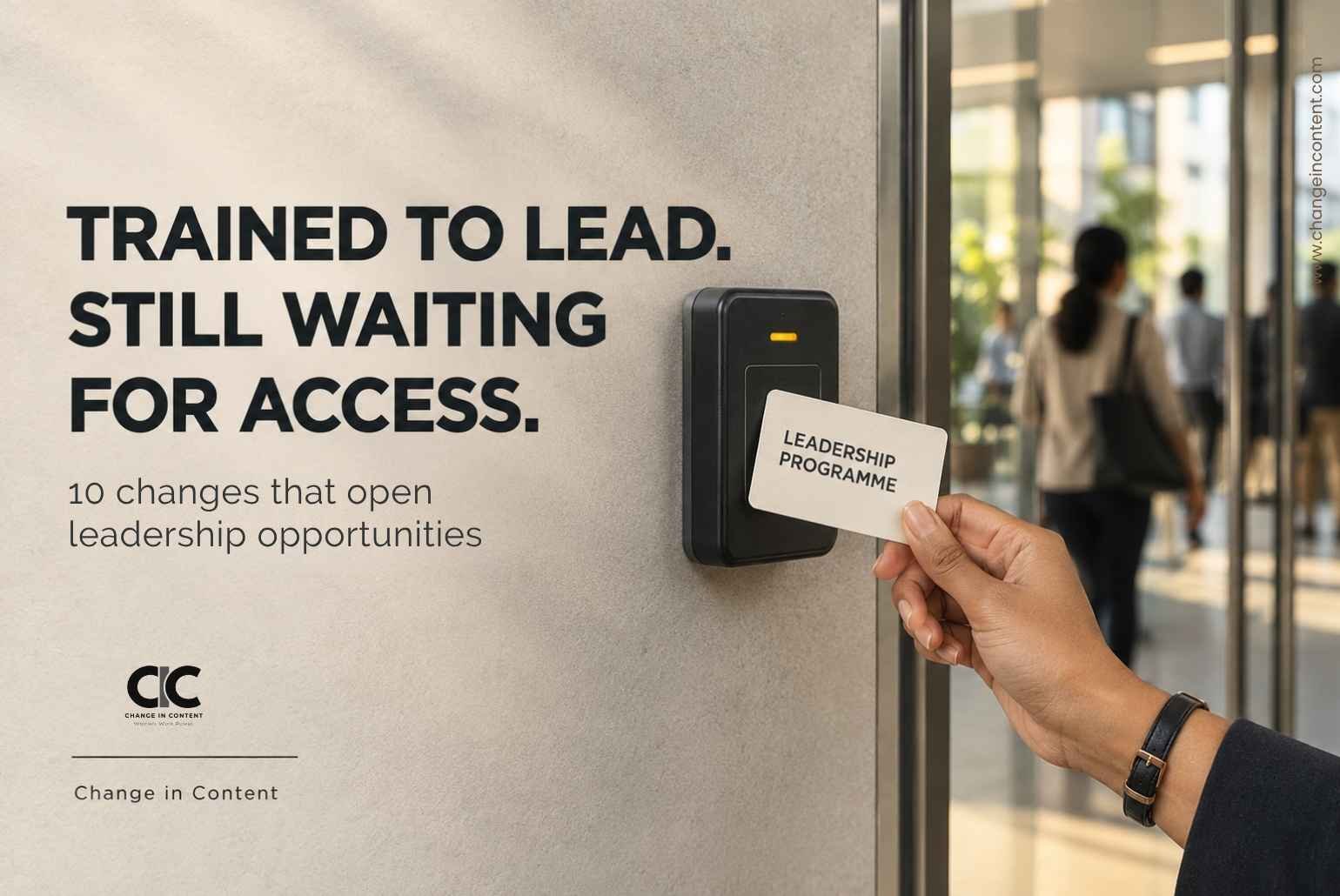
An organisation that wants more women into corporate leadership should be willing to answer a question before booking another confidence workshop: who gets trusted with the work that leads to promotion?
If the strategic account, budget responsibility and turnaround assignment keep circulating within the same familiar network, a training certificate will struggle to change the outcome.
Women can develop skills, pursue responsibility and negotiate their next move. Employers control whether those efforts lead anywhere. They decide whose potential deserves a chance, whose mistakes are forgivable and whose readiness requires another year of proof.
Research gives that argument substance. McKinsey’s Women in the Workplace 2025: India, Nigeria, and Kenya found that women represented 33% of entry-level employees and 24% of managers in its India sample. These are representation figures, rather than a calculation of individual promotion chances. Nevertheless, they direct attention towards an early career transition that boardroom debates can overlook.
The response needs to reach recruitment, everyday work allocation, education, care and accountability. These ten changes offer somewhere concrete to begin.
1. Examine the first promotion before blaming the leadership pipeline
By the time a company begins searching for a senior woman leader, years of earlier decisions have shaped the available candidates.
A first management role brings opportunities to supervise people, handle difficult conversations and take responsibility for delivery. Those experiences become evidence for subsequent appointments. Repeatedly overlooking someone at this stage can leave her facing a frustrating objection later: she lacks management experience.
HR leaders should examine who was eligible for the last promotion round, who was nominated, who was selected and what evidence supported the decisions. Include employees who were never encouraged to apply.
Smaller organisations can do this through a structured review of recent appointments. They do not need an expensive dashboard to discover that opportunities are being discussed privately before anyone else hears about them.
The question to ask: Are we identifying potential across the team, or repeatedly recognising the people who already have access to us?
2. Give women ownership of consequential work
An employee needs opportunities to demonstrate leadership before being expected to provide an impressive leadership record.
That could mean managing a client renewal, owning a product decision, supervising a plant improvement or controlling a project budget. The assignment should involve judgement and accountability, with enough authority and support to make success possible.
Kavita Vishwanath, identified in an October 2026 ETGCC interview as Toast’s SVP and country head, described how meeting customers changed her understanding of the business problems behind the software she built. Her account illustrates why exposure beyond a narrow job description can matter to a career. It is an individual experience, not proof that every customer-facing assignment produces advancement.
Managers should review who receives these opportunities. Women can ask for a specific responsibility rather than an undefined promise of development: ownership of a workstream, a budget or a business outcome.
Our examination of inclusive leaders and good managers raises a related concern: delivering results deserves scrutiny alongside how opportunities are distributed.
3. Stop rewarding helpfulness with an endless supply of extra work
Some work keeps an organisation functioning without doing much for the person’s promotion prospects. Someone coordinates the event, prepares the meeting notes, settles the disagreement and helps a colleague finish a presentation.
The problem arises when this work falls unevenly and contributes little to advancement.
Research published in the American Economic Review found that women were more likely than men to volunteer, be asked to volunteer and accept requests for tasks with low promotability. The study points towards expectations about who will say yes as an important explanation.
In a published interview with Conferences for Women, economist Linda Babcock also warned that simply advising women to refuse can expose them to backlash. Her emphasis was on changing how organisations allocate the work.
Rotate routine duties. Recognise substantial contributions to team functioning. Most importantly, protect time for the assignments used to judge progression. A woman should not have to complete two working days to assemble one promotion case.
4. Make sponsors put an opportunity behind the encouragement
A useful mentor can explain a difficult workplace. A sponsor can influence what happens within it.
Sponsorship might involve recommending someone to lead a strategic project, arguing for her inclusion in a succession discussion or introducing her to decision-makers who need her expertise. It requires action beyond a monthly conversation.
Formal programmes should therefore ask what opportunities became available, not merely how many meetings took place. Selection also needs attention. A programme restricted to employees already visible to senior executives may reproduce the access problem it was intended to address.
Employers can identify capable people through transparent criteria and bring different leaders into the process. Sponsors should understand the employee’s ambitions before promoting an opportunity on her behalf.
For women, a useful question is: Who has seen enough of my work to recommend me for the responsibility I want next? Building that relationship is more purposeful than collecting contacts.
5. Demand evidence when someone says she lacks leadership presence
“Not quite ready” can be a legitimate assessment. It should come with an explanation.
- If a candidate needs stronger financial judgement, specify the decisions she must learn to make.
- If communication is the concern, identify where it fell short.
- If a role requires managing conflict, explain what effective performance looks like.
Vague assessments such as “presence”, “fit” or “confidence” need particular scrutiny because candidates cannot act on them reliably. Selection panels should connect their conclusions to the requirements of the role and apply those requirements consistently.
It does not mean abandoning judgement. It means making judgement accountable.
CIC’s discussion of gender and emotional intelligence offers a useful companion question: how do workplace expectations influence the way a woman’s behaviour is interpreted?
A better development conversation: Here is the capability you need, the assignment that will help you demonstrate it and the date when we will review your progress.
6. Remove the career penalty attached to flexibility
A policy can promise flexibility while everyday decisions make using it feel risky.
Deloitte’s Women @ Work 2026 surveyed 7,500 women across 15 countries. Eight in ten respondents believed flexible working negatively affected career progression at their company. That is a measure of respondents’ perceptions, not an audited finding that every flexible worker received worse treatment. It is still a serious warning for employers relying on policy availability as evidence of support.
Examine who receives important assignments, information and promotion opportunities across working arrangements. Distinguish genuine operational requirements from habits such as treating late-night availability as evidence of commitment.
Where hours are reduced, adjust the workload. Where physical presence is necessary, explore predictable shifts and better notice. Encourage men to use available arrangements too.
A credible policy should allow an employee to explain how she will deliver the work without having to defend whether she remains ambitious.
7. Treat care and career breaks as part of workforce planning
Care responsibilities do not disappear when a woman becomes leadership material.
Deloitte’s 2026 research found that, among surveyed women who had taken a career break of at least three years for care, 23% returned to a role at a lower level and/or lower pay. The result does not establish why every individual accepted that role. It does raise a question about whether employers are making effective use of returning experience.
Assess returners against the requirements of the job. Identify skills that genuinely need updating, offer relevant support and explain how progression will work. A temporary placement with vague conversion prospects is a weak substitute for a credible return route.
For existing employees, predictable travel, emergency care arrangements and reliable transport can matter alongside formal leave. Partners and families have responsibilities here too; a leadership career cannot depend indefinitely on one person absorbing the household’s uncertainty.
Our reporting on Pramerica Life Insurance’s workplace support provides a related company example, while distinguishing stated policies from demonstrated impact.
8. Make educational institutions teach the decisions behind the title
Educational institutions can help women enter employment with a clearer understanding of how responsibility works.
Alongside subject expertise, students need practice in evaluating a budget, presenting a recommendation, negotiating resources and making decisions with incomplete information. These capabilities belong in substantive projects, with feedback on reasoning and results.
Institutions should also examine how project roles are assigned. If the same students repeatedly present while others organise and document, everyone graduates with a different kind of practice.
Rotate responsibilities. Build paid, supervised industry assignments where feasible. Ask employer partners what students will actually own and learn. Alumni networks can provide access to practitioners beyond the limited circle already available through family connections.
Employers should participate with meaningful work and feedback. A motivational speech is a small contribution compared with an internship that allows someone to demonstrate judgement.
9. Give women a usable career plan, with room for their own choices
Women deserve advice precise enough to act on.
Before accepting a stretch assignment, clarify its scope, the authority attached to it and what existing work will be reassigned. Ask how the contribution will be assessed and whether it connects to a plausible next role.
Keep a record of outcomes: costs reduced, risks resolved, customers retained, systems improved or people developed. This helps make a career discussion concrete without requiring someone to perform constant self-promotion.
Employers should make promotion criteria and development opportunities accessible. An employee should not need exceptional networking skills to discover how advancement works.
There must also be room to decline. Some women want specialist careers, different working arrangements or a pause in progression. A fair system makes leadership available without treating every woman as obliged to pursue it.
As our examination of gender parity in education in India underlines, educational participation needs to be considered alongside what follows in working life.
10. Judge leadership programmes by what women subsequently lead
Training can be valuable. Its connection to opportunity needs to be visible.
In a published interview with Harvard Business Impact, Amazon leader Lorna Tangirala described a programme addressing women’s representation in middle management in Customer Service India. She reported improvements in participants’ performance ratings and promotion rates. Because the account appears on the programme provider’s website without detailed comparative results, we should read it as a participant organisation’s assessment rather than independent proof of impact.
Employers commissioning programmes should ask what happens afterwards. Do participants gain responsibility? Are they considered for relevant vacancies? Do their managers support the changes the training encourages?
Track the substance of leadership: team size, budgets, decision rights and access to succession opportunities. Where possible, compare outcomes with a relevant baseline, recognising that participants may already have been selected for high potential.
A certificate records participation. The organisation still has to decide what it will trust the employee to do.
The Change in Content view on getting more women into corporate leadership
The next time a company says it cannot find enough women leaders, it should examine the opportunities it distributed over the previous 3 years.
- Who received the difficult assignment with executive backing?
- Who was encouraged to apply?
- Who kept the team functioning while someone else gained the experience needed for promotion?
Women should have access to development, honest feedback and demanding work. They should also be able to expect that the rules governing advancement are visible and defensible.
A company that keeps preparing women for leadership without giving them greater authority owes those women an explanation. The people controlling appointments, budgets and assignments have work to do. Their progress deserves to be measured too.
Editorial Note
This guide draws on published research and attributed interviews. McKinsey’s figures describe participating organisations, while Deloitte’s findings reflect surveyed women’s experiences and perceptions. Individual accounts illustrate possibilities rather than establish universal outcomes. Recommendations are Change in Content’s editorial interpretation; no original interviews were conducted for this article.
Principal sources
McKinsey’s India, Nigeria and Kenya research, Deloitte’s Women @ Work 2026, Babcock and colleagues’ research, Linda Babcock’s published interview, ETGCC’s interviews with women leaders and Lorna Tangirala’s interview.
