
The Brief
- DAY-NULM’s record extends beyond forming self-help groups to finance, training, enterprise support and market access.
- Government records show substantial expenditure, alongside shortfalls against some targets.
- Its implementation period ended on 30 September 2024; a subsequent urban livelihoods pilot covered 25 cities.
- Other programmes are creating work for women’s groups, but their coverage cannot be assumed to replace every earlier service.
- Fair scrutiny should recognise the work already done and establish who will fund, deliver and measure its continuation.
A women’s savings group does not become a functioning economic institution because someone adds its name to a government spreadsheet. Members have to build trust, maintain accounts, approach banks and find work. When we assess a livelihood scheme for women, I want that patient, practical work to remain visible.
My starting position is simple: India’s work on women’s livelihoods deserves scrutiny that is accurate enough to recognise achievement. Credit should reach the women themselves, community organisers, banks, local bodies, state administrations and the Centre. None should disappear merely because the argument of the day favours a more dramatic account.
That applies to criticism as much as celebration. A programme can build something valuable and still leave serious questions about how it will be sustained.
Start with what the editorial actually says
An Indian Express’s October 15 editorial argues that the urban livelihoods mission deserves continued support. It acknowledges the programme’s positive impact and credits self-help groups with strengthening women’s economic and social participation. It would be unfair to describe it as denying that work.
Where I would take the discussion further is in the account of what has already been built. Calls for investment in people, infrastructure, credit and markets should be accompanied by an examination of the investment and institutions that already exist.
We must also identify the programme correctly. DAY-NULM is the Deendayal Antyodaya Yojana–National Urban Livelihoods Mission, concerned with urban poverty. DAY-NRLM is the separate rural mission. The range of women-centric schemes in India makes precision essential: One programme’s reach cannot settle questions about another’s funding.
The record goes well beyond group formation
A Lok Sabha reply dated 2 April 2026 reports these DAY-NULM achievements for 1 April 2014 to 30 September 2024:
| Measure | Reported achievement |
| Self-help groups formed | 10,02,545 |
| Groups receiving revolving funds | 6,79,705 |
| SHG bank-linkage loans disbursed | 6,42,207 |
| Beneficiaries assisted to establish individual or group micro-enterprises | 9,81,899 |
| Skilled candidates placed | 8,43,299 |
These are different measures, not numbers to add into a single beneficiary total. Loans are not necessarily unique groups, and assistance to establish an enterprise does not prove that it remains profitable. The wider mission’s employment and enterprise figures should not all be labelled women-only.
Even with those qualifications, the record is substantial. It describes savings institutions supported with working resources, access to formal finance and help towards employment or enterprise. Reducing that to a registration exercise would erase much of the programme’s purpose and delivery.
Money was committed and used too. Adding the annual totals in the same reply gives ₹2,617.07 crore in central releases and ₹2,551.78 crore reported utilised across FY2020–21 to FY2024–25. These are five-year totals, not lifetime spending or a women-only allocation.
I would resist both the temptation to dismiss this spending and the temptation to treat it as a complete performance verdict. Expenditure tells us that resources moved. We still need to examine what they enabled, including the practical obstacles around loans for women entrepreneurs.
People and infrastructure were part of the design
The mission’s capacity-building guidelines provided for technical teams at state and city levels. They set a ceiling of 12% of total allocation for the capacity-building component, including technical support and training. That ceiling is a funding provision, not evidence that the full amount was spent.
Its social-mobilisation guidelines also provided ₹10,000 per SHG for formation, handholding, training, bank linkage and related work. Resource organisations were expected to support groups for two years. This support provision was separate from revolving-fund assistance.
These details deserve space in the debate. They show that human support was an explicit part of the model. They do not establish that every post was filled, every training session was useful, or every group received adequate attention.
The ministry’s January 2026 account also recorded 1,995 shelters with approximately 1.41 lakh beds under DAY-NULM by September 2024. These served the urban homeless; they should not be presented as women’s enterprise premises. They nevertheless demonstrate the wider mission’s investment in physical infrastructure.
The next question should be whether these institutions are functioning well and whether staff have the resources to do their jobs. Asking that question gives their work more weight.
Market access has a documented history
Efforts to connect groups with buyers also predate the present debate. MoHUA’s review of 2021, published in January 2022, reported e-commerce arrangements involving Amazon and Flipkart for more than 2,000 products made by 5,000 SHG members across 25 states and Union Territories. It also recorded the launch of the SonChiraiya brand to improve visibility.
These were concrete attempts to widen markets. Online listings alone cannot tell us sales volumes, margins, or repeat demand. But it would be inaccurate to suggest that market access had never received attention.
The same practical questions arise in digital tools for women entrepreneurs: can the seller manage fulfilment, payment, returns and customer relationships? Access becomes more valuable when someone helps her use it commercially.
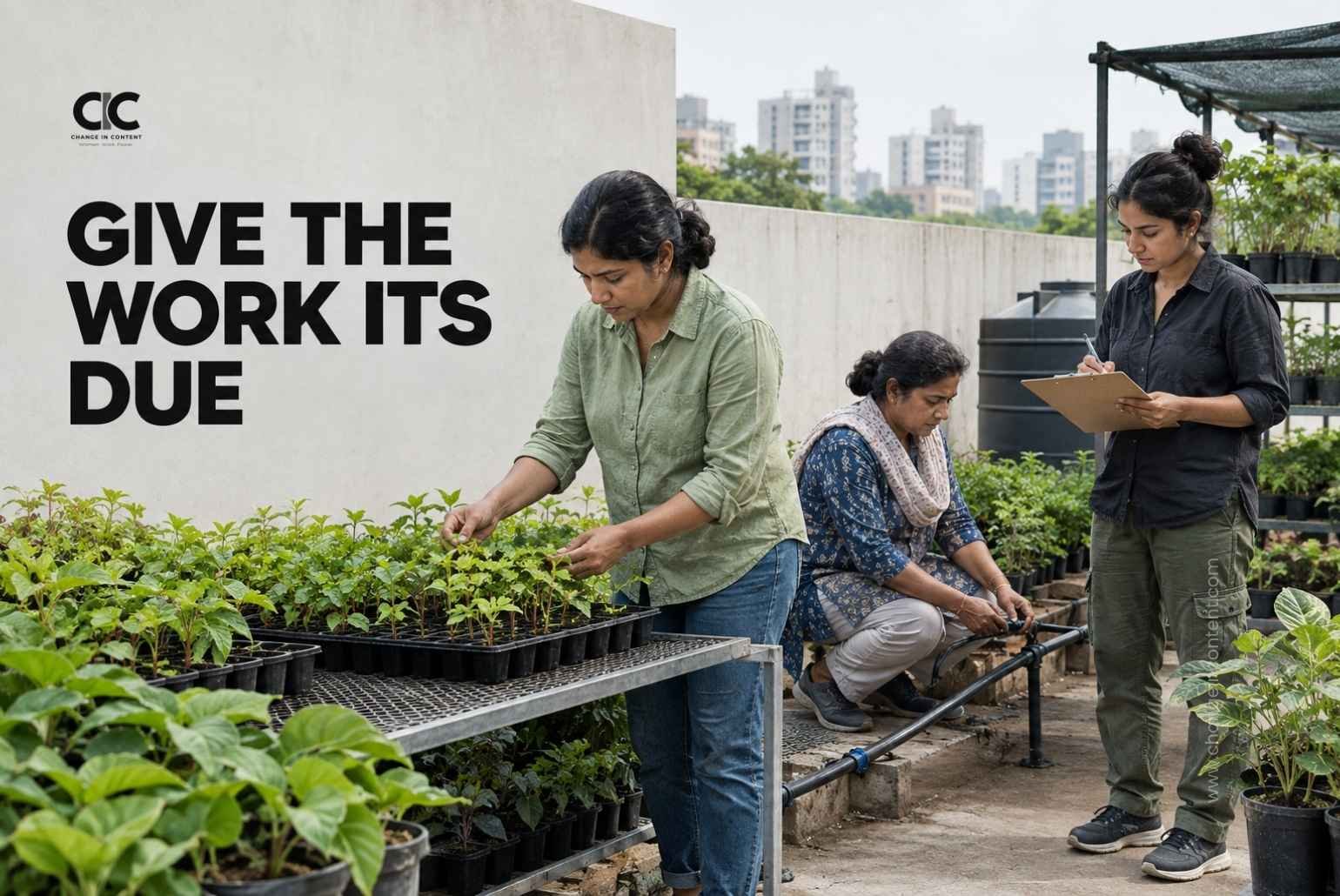
There is more recent evidence of women’s groups entering public-service work. On 5 February 2026, the government reported 6,067 AMRUT Mitra projects worth ₹376.95 crore approved, involving more than 38,000 SHG members. The initiative includes water management and water-quality work. These are project approvals, not a statement of wages paid.
A July 2026 reply separately recorded women’s SHG participation in tree planting and maintenance under AMRUT Mitra, with 2,958 such projects approved. That subset should not be added to the earlier total.
This is an important direction: groups can contribute to the services that cities need. A serious assessment should ask about contract terms, technical training, safety, remuneration and continuity, as well as participation.
Achievement makes continuity worth demanding
The ministry confirms that DAY-NULM’s implementation period ended on 30 September 2024. A subsequent pilot, Deendayal Jan Aajeevika–Shehari, began in 25 cities, focusing on six vulnerable occupational groups. A pilot is not proof of a fully funded national replacement.
The Indian Express’s October 14 reporting describes funding concerns raised by 5 states. It also carries the ministry’s position, attributed to sources, that no state demand was pending and that existing programmes were drawing on the groups and workforce. The same report attributes approximately ₹9,000 crore in combined Centre-state expenditure over the mission’s decade to ministry sources.
Those accounts need reconciliation. I have not independently inspected the state letters or a consolidated settlement statement. It would be premature to certify every reported demand as unpaid, or to declare the matter resolved.
There are performance questions too. The April parliamentary reply records training and placements below their respective targets and says the ministry does not maintain micro-enterprise survival data at one and three years.
These gaps justify better monitoring. They do not justify treating every supported business as unsuccessful. Equally, an assistance count cannot establish lasting financial independence.
The wider discussion about supporting women’s enterprises needs this discipline: establish what the evidence measures before deciding what it proves.
The Change We Need
As a publisher constantly talking about women’s issues, we feel that the Centre and states should publish a clear account of the transition. That must include particulars like what services continue, which authority pays for them, what liabilities are accepted and when payments will be made. Where another scheme takes over, women and field workers should know whom to approach.
The reporting should distinguish between funds released, expenditure, loans, functioning enterprises and earnings. A smaller set of reliable outcome measures would be more useful than an ever-longer list of activities. Independent follow-up with groups could show where the model works and where support needs to change.
Our journalism has a responsibility here too. We should challenge sweeping claims that nothing has been built, just as we should question claims that an allocation or enrolment figure proves the job is finished. Neither description does justice to women doing the work.
India has built institutions worth strengthening. Giving that achievement its due makes the case for protecting it more compelling. The women who saved together, learned new skills and built relationships with banks deserve both recognition and a dependable next chapter.
Editorial note
This opinion draws on parliamentary replies, official guidelines and government releases available by 16 October 2026. Contemporary funding claims are attributed to The Indian Express; the underlying state letters were not independently inspected. Administrative achievements are distinguished from income outcomes, and scheme provisions from actual expenditure. The five-year financial totals are CIC calculations from Annexure IV of Lok Sabha reply 6273. Historical figures retain their reference dates. No interviews or field visits are claimed.
Sources
- The Indian Express — Livelihood scheme for women deserves better, 15 October 2026.
- Lok Sabha, question 6273 — Beneficiaries under DAY-NULM, 2 April 2026, particularly Annexure IV.
- MoHUA — DAY-NULM Capacity Building and Training Guidelines.
- MoHUA — DAY-NULM Social Mobilisation and Institution Development Guidelines.
- MoHUA/PIB — Schemes for Urban Poor, 29 January 2026.
- MoHUA/PIB — Year-End Review 2021, published 4 January 2022.
- MoHUA/PIB — Funding Pattern for AMRUT, 5 February 2026.
- MoHUA/PIB — Ensuring Adequate Pedestrian Infrastructure, 27 July 2026.
- The Indian Express — States seek urgent funds to sustain women livelihood mission, 14 October 2026.
