
The Brief
- India’s gains in women’s education deserve recognition. They do not automatically translate into sustained employment.
- September 2026 data put female labour-force participation at 34.6% among those aged 15 and over, using current weekly status.
- That figure measures participation across an age group, not the employment rate of recent graduates.
- Care, travel, joining costs and job quality belong in the discussion alongside skills and recruitment.
- CIC proposes following women from qualification to joining, earnings and continued employment, with responsibility assigned at each stage.
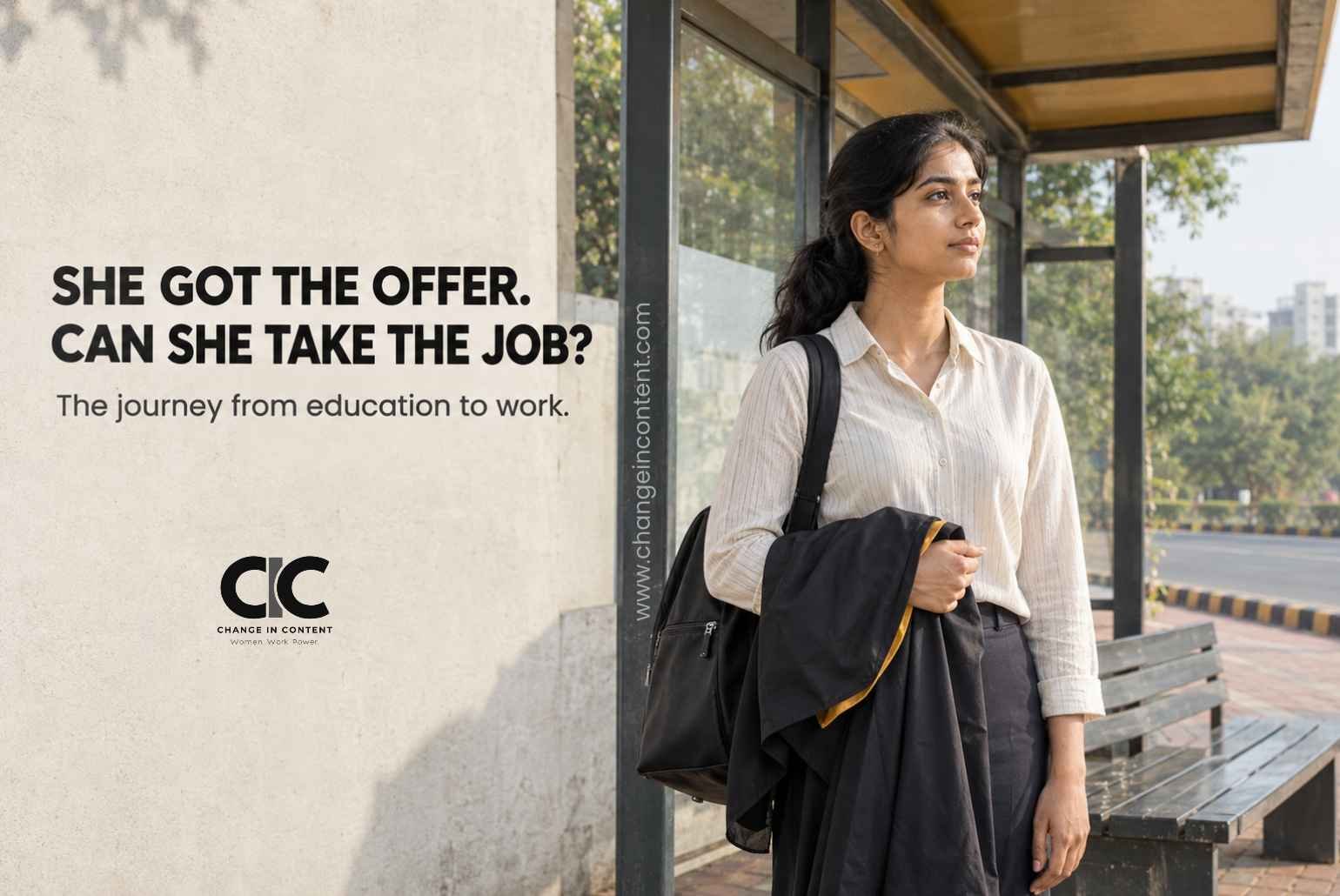
The offer letter says where to report on Monday. It says little about the bus home after the shift, the rent deposit due before the first salary or who will take over the work waiting at home. Those practical questions help explain India’s gap in education-to-work transitions: Getting selected and being able to take up a job can be different achievements.
Consider a hypothetical graduate offered work outside her town. She wants the role and has the required skills. But the hostel deposit is unaffordable, the shift ends after the last convenient bus, and her household still expects her to handle the same responsibilities. Describing her eventual refusal as a lack of ambition would tell us very little about the decision.
A recent report brings attention back to continuity in women’s employment. At Change in Content, that means asking what happens after education, after selection and after the first few months of work.
Start by giving educational progress its due
The Ministry of Education’s July 2026 release of AISHE 2023–24 recorded a female higher-education gross enrolment ratio of 31.2, up from 22.9 in 2014–15. Women’s share of STEM enrolment reached 44%, compared with 38.4% in 2014–15.
These are substantial gains. They reflect opportunities pursued by students, investment by families and institutions, and an expansion of access. Education also has value beyond a salary: knowledge, judgement and independence should never be dismissed because someone is currently outside paid employment.
But gender parity in education cannot answer a separate employment question. Enrolment measures participation in learning. It does not establish whether women receive suitable offers, join those roles, earn adequately or progress.
Read the employment figures without mixing the measures
The latest monthly PLFS release available for this article, published on 15 October, puts female labour-force participation at 34.6% in September 2026, up from 34.1% a year earlier. The female worker-population ratio was 32.8%.
Both concern people aged 15 and over and use current weekly status, based on the preceding seven days. Labour-force participation includes those employed and those unemployed under the survey definition; the worker-population ratio counts those employed.
Neither is a graduate placement rate. Nor should these weekly estimates be placed beside annual usual-status figures as though they form a directly comparable trend.
A different measure reveals the earlier youth gap. The ILO–Institute for Human Development India Employment Report 2024 estimated that 48.4% of women aged 15–29 were not in employment, education or training in 2022, compared with 9.8% of men. These are historical findings, not October 2026 estimates.
The category, commonly shortened to NEET, also needs careful language. It includes people with different circumstances and intentions. Someone providing unpaid care may fall within it while working hard every day. It cannot be read as a count of young people doing nothing, or as a count of graduates unable to find jobs.
India needs more precise evidence on the transition itself. A college’s placement announcement and a national participation rate leave many questions between them unanswered.
The first salary has costs before it arrives
Recruitment processes often require candidates to spend before they earn. Travel to interviews, temporary accommodation, documents and relocation all need money. An unpaid internship can make that hurdle higher. For someone without family financial support, even a promising opportunity may be difficult to accept.
These are reasons for employers and colleges to investigate joining costs, not assumptions that every woman faces the same barrier. A relocation advance, paid apprenticeship or predictable transport arrangement might help one candidate. Another may need a genuinely available local role.
The same care is needed when discussing women entering non-traditional livelihoods. Training a woman for a technical job achieves more when an employer offers real work, appropriate facilities and a credible progression route.
Another course is useful when it fills a demonstrated skill gap. It cannot create a vacancy, raise an inadequate wage or change an unsuitable shift. Employers should specify the missing capability before sending unsuccessful candidates back into training.
Remote work and entrepreneurship also deserve realistic treatment. Working from home still requires equipment, reliable connectivity, time and paid demand. A business requires customers and viable earnings. Neither should become a convenient answer to the absence of accessible jobs.
Support at home needs a timetable
India’s Time Use Survey 2024 found that, among participants aged 15–29, young women spent an average of 280 minutes a day on unpaid domestic services, compared with 87 minutes for young men. These are averages among people undertaking the activity, not all young people, and do not measure the separate category of caregiving.
That evidence gives families a practical starting point. When a daughter or partner starts work, who takes over the tasks she previously performed? Does the answer involve sharing them, or expecting her to finish them earlier and later?
Supporting a career includes protecting time for interviews, commuting, learning and rest. Redistributing unpaid household and care work requires specific responsibility, including the planning, rather than occasional assistance when asked.
Safety concerns deserve practical responses too. Employers, transport providers, local authorities and communities can examine routes, shift timings, accommodation and reporting arrangements. Restricting a woman’s choices may avoid an immediate family disagreement while leaving the underlying problem untouched.
Women should be able to make informed decisions about work, further study, care or a break. The purpose of better policy is to expand those choices. A woman’s worth is not determined by whether she currently earns.
What a workable plan would look like
There is already policy attention to these connections. NITI Aayog’s August 2026 report, Reimagining Skilling for Viksit Bharat@2047, recommends continuous guidance, stronger employer involvement and apprenticeships. It also identifies care, safety and mobility constraints. Recommendations, however, need to become services people can actually use.
Addressing the education-to-employment gap for women also requires enough suitable jobs. Transport and guidance cannot compensate for a shortage of paid opportunities. Local plans need employers willing to recruit, invest and offer viable wages.
Change in Content (CIC) proposes a local partnership between colleges, employers and district authorities, beginning with one graduating cohort. Follow participants who consent through offers, joining and subsequent employment. Include those who do not join, and record further study or a voluntary break separately from an unmet wish to work.
Table 1.1: Who Needs to Act, and How?
|
Who needs to act |
A practical commitment | What to check |
|
Colleges and training providers |
Provide career guidance before the final semester; verify roles, pay and learning value with employers. |
Offers, actual joining, earnings and employment at six and twelve months, disaggregated by gender. |
|
Employers |
State pay, location, shifts and requirements upfront; offer paid entry routes and address documented joining barriers. |
Why candidates decline, why new recruits leave, and whether women get assignments that develop their skills. |
|
Governments and local authorities |
Connect employment plans with transport, accommodation, care services and local job demand. |
Availability, affordability and use of those services, alongside employment outcomes. |
|
Families and communities |
Agree shared responsibilities and address practical concerns without taking decisions away from the woman. |
Whether she has the time and freedom to pursue the option she chooses. |
|
Women entering work |
Ask about take-home pay, duties, shifts, travel, training and progression; seek reliable advice where needed. |
Whether the role meets their goals and what support would make it workable. |
Tracking must be proportionate and confidential. Colleges should report how many graduates they could reach, so missing responses cannot quietly become success stories. Leaving one employer should also be distinguished from leaving employment altogether.
This extends the question of helping women stay in work beyond a hiring campaign. It gives each institution a task and a way to see whether its intervention helped.
Content has work to do here, too
A job advertisement should tell a candidate enough to make a decision. A college brochure should explain what its placement figure counts. And a government scheme explainer should make eligibility, costs, application steps and support contacts understandable.
Publishers can report the first year of a career alongside the appointment announcement.
- What made joining possible?
- Which difficulty was resolved, by whom and at what cost?
- What happened to the women who could not take the offer?
Regional-language information and honest accounts of ordinary careers can make unfamiliar work easier to understand. Stories should show women using judgement and skill, without turning every success into a tale of exceptional sacrifice or treating families as a single obstacle.
The Change We Need
India has good reason to celebrate more women learning. The next commitment is to make the route from learning to earning easier to use and easier to sustain.
- For colleges, that means looking beyond the placement photograph.
- For employers, beyond the accepted offer.
- For families, beyond saying they support her. Each needs to ask what their own decisions make possible.
A qualification belongs to the woman who earned it. The opportunity to use it should not depend on her solving every practical problem alone.
Editorial Note
This analysis uses official education, labour-force and time-use releases, the ILO–IHD employment report and NITI Aayog’s skilling report. Data years, age groups and statistical measures are identified and are not treated as a single graduate tracking study. Examples are hypothetical; the action plan is CIC’s editorial proposal. ORF’s linked commentary was identifiable through its indexed publication details and summary, but its full page could not be retrieved; no unseen tables or detailed findings from it are reproduced. Sources checked on 20 October 2026.
Sources
- Arpan Tulsyan, Observer Research Foundation — India’s Missing Human Capital: The Gender Gap in Education-to-Work Transitions, 17 October 2026
- Ministry of Education — AISHE 2022–23 and 2023–24 release, 8 July 2026
- MoSPI — PLFS Monthly Bulletin September 2026, release dated 15 October 2026
- ILO and Institute for Human Development — India Employment Report 2024
- MoSPI — Time Use in India 2024, including age-specific participant averages
- NITI Aayog — Reimagining Skilling for Viksit Bharat@2047, August 2026
