The Brief
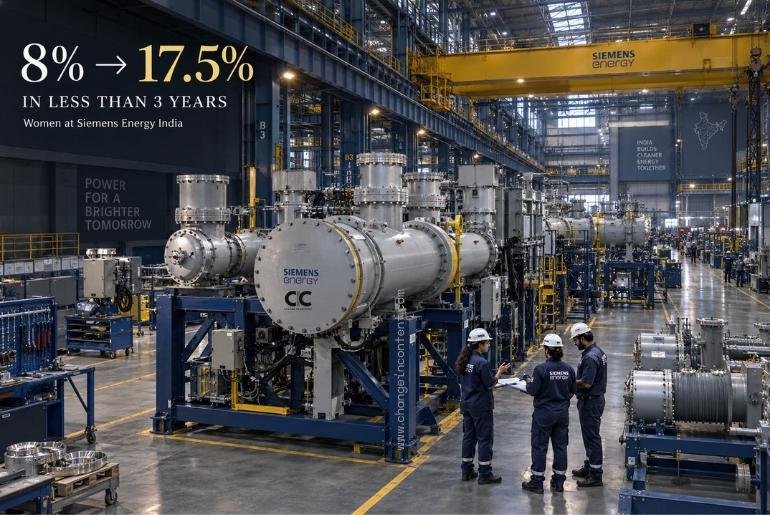
- Siemens Energy India says women’s representation has risen from 8% at the end of 2023 to 17.5% in 2026, more than doubling in under three years.
- The progression can be traced through company disclosures: women represented 14.6% of the workforce in FY2025, while an H1 FY2026 investor presentation reported 15.3% gender diversity.
- More than 60% of its latest intake of around 170 graduate engineers are women, according to the company’s Head of People & Culture. Women are now represented across all job families.
- Siemens Energy India has created an all-women production line at its gas-insulated switchgear facility in Chhatrapati Sambhajinagar and has brought women into blue-collar shop-floor roles at Kalwa.
- The company’s next challenge is harder than doubling the headline number: moving more women from entry into technical authority, supervision, P&L responsibility and leadership.
Women in Siemens Energy India
8%. Then 14.6%. Then 15.3%. Now 17.5%.
That sequence tells the Siemens Energy India story better than any diversity slogan could.
In less than three years, the company says it has more than doubled the share of women in its workforce, while bringing women into roles across engineering, manufacturing, operations and leadership.
For an energy-infrastructure business, the location of those women matters as much as the percentage. They are not appearing only in corporate functions.
- Women are working on production lines.
- Entering as graduate engineers.
- Moving into supervisory roles.
- Being prepared for larger assignments.
- And, increasingly, becoming visible inside the parts of an industrial company where technical and commercial decisions are made.
That is what makes the story useful.
The number did not double by waiting for the pipeline
Companies sometimes explain low female representation in engineering by pointing to the available talent pool. Siemens Energy India appears to have taken a more active approach.
Its FY2025 annual report says the company made 168 campus offers, with 56% going to women. The latest graduate-engineer intake has gone further: of approximately 170 engineers, more than 60% are women, according to Beena Dixit, Head of People & Culture (Organisation).
It is worth noting. A theoretically gender-neutral recruitment process does not necessarily produce a diverse technical pipeline.
Where a company recruits, who sees the opportunity, which candidates are encouraged to apply and whether young women can imagine themselves inside the workplace all influence the eventual number.
Siemens Energy India has also run dedicated recruitment activity for women professionals across locations including Gurugram, Thane, Chhatrapati Sambhajinagar, Vadodara, Bengaluru and Pune.
Inclusion here has involved looking for talent deliberately rather than waiting for representation to improve on its own.
Then came the more difficult move: The factory floor
Hiring women into an industrial company is one thing. Putting them into manufacturing and technical operations changes the picture. Siemens Energy India’s FY2025 annual report records the creation of an all-women production line at its Gas Insulated Switchgear factory in Chhatrapati Sambhajinagar.
The facility has since become a useful example of what operational inclusion looks like. A team of 22 women works on the line, led by a woman mechanical engineer. Women are also present across functions at the plant.
The company has expanded this approach elsewhere. Dixit says that 49 blue-collar women technicians have now been inducted into Kalwa shop-floor operations. These details matter because industrial representation can easily become concentrated in graduate schemes and office jobs while core operations remain predominantly male.
The more meaningful shift happens when the factory itself begins to look different.
Our reporting on women in electronics manufacturing has documented a similar transformation elsewhere in Indian industry: high female participation becomes possible when recruitment, transport, accommodation, safety and the production system itself are designed to make those jobs usable.
Sometimes inclusion is as practical as changing the equipment
There is a small detail from the Chhatrapati Sambhajinagar operation that says more than another policy statement could.
The women working there needed protective gloves. The plant discovered that suitable gloves in smaller sizes were not readily available.
So the equipment had to be sourced. That might sound trivial. It is actually a useful description of how exclusion can work.
A factory can declare itself open to women while its equipment, tools, uniforms, facilities or shift systems are still designed around the assumption that the worker will be male.
Then the employee is expected to adapt. A more inclusive workplace asks the opposite question: What needs to change in the workplace so that the worker can do the job properly?
That is a much more practical version of DEI.
Automation is changing who can do industrial work
Siemens Energy also points to digitisation and automation as part of this transition.
As manufacturing becomes more automated, some jobs that historically relied heavily on physical strength are changing.
The relevant competence increasingly becomes:
- technical understanding
- precision
- machine operation
- problem-solving
- digital fluency
- quality control
- and decision-making.
Dixit argues that this is helping make manufacturing environments more accessible to a wider talent pool. This is bigger than Siemens Energy.
India is simultaneously pursuing a manufacturing expansion and an energy transition. Grid modernisation, electrification, renewable integration and new infrastructure will require large numbers of technically capable workers.
Designing those roles around skills rather than inherited assumptions about who normally performs them could substantially expand the available workforce.
But Siemens Energy is also trying to avoid the “leaky bucket”
This is probably the most important part of the company’s approach.
Hiring women quickly can produce an impressive representation number. It can also produce an impressive number that disappears three years later.
Dixit described that risk as becoming a “leaky bucket”: recruiting women without creating the conditions that allow them to build lasting careers.
Siemens Energy India has therefore paired recruitment with interventions around maternity, caregiving leave, flexible work where roles permit it, crèche facilities, safety audits and gender-sensitisation. Its global framework also includes paid primary- and secondary-caregiver leave, family-care leave, flexible working and explicit commitments around equal pay.
The principle is familiar but often poorly executed. The recruitment number belongs to HR.
Whether a woman remains long enough to become the plant head, engineering leader or business leader belongs to the organisation.
The next number to watch is leadership
Women currently account for 20% of Siemens Energy India’s leadership team, according to Dixit. That is important because representation at entry level can rise much faster than representation at the top.
Siemens Energy India is attempting to build that next layer through programmes including SHinE, a six-month women’s development programme involving leadership exposure and engagement with senior executives; PANKH, which supports women through different career stages; and Astitva, aimed at preparing women for stretch roles and greater responsibility.
The company’s official H1 presentation also specifically identified SHinE alongside its gender-diversity progress.
There is one caveat worth keeping in mind. Leadership programmes work only if development is followed by authority.
A woman does not progress because she has attended another programme. She progresses when she gets the project.
- The difficult customer.
- The plant responsibility.
- The budget.
- The P&L role.
- The succession opportunity.
Visibility is valuable when it leads somewhere.
Accountability appears to sit unusually high
One feature of the Siemens Energy India approach deserves attention from other organisations. Its Inclusion & Diversity Council does not appear to operate as a side activity within HR.
According to Dixit, progress is reviewed quarterly with involvement from the CEO, CFO and Executive Management Committee. That changes the nature of the number.
If workforce diversity is reviewed only by the diversity team, it is easy for operational leaders to treat it as someone else’s target.
If business leadership reviews recruitment, retention and progression, the organisation has to answer more uncomfortable questions.
- Which function is not changing?
- Which plant is losing women?
- Where are women disappearing from succession?
- Why are technical roles improving but business roles not?
- Who owns the gap?
That is how representation becomes an operating metric rather than an annual-report paragraph.
Doubling is impressive. 17.5% is still a beginning.
An Inclusive Companies story should not turn into an award citation.
Siemens Energy India has moved quickly. Its 17.5% representation is substantially higher than where it stood in 2023.
The technical pipeline is particularly promising. Women already account for 1/5th of leadership. And a graduate-engineer class that is more than 60% female could materially change the workforce over time. But 17.5% also means more than four out of every five employees are still men.
The question is therefore no longer whether the company has made progress. It clearly has.
The more interesting question is whether the pipeline it has created can produce a second transition: from women entering energy to women holding technical and commercial power inside energy.
That will take longer than 3 years.
Change in Perspective: Change the Factory, Not the Woman
Perhaps the most useful lesson from Siemens Energy India is hidden in those undersized safety gloves.
For years, industrial workplaces often asked why more women did not come. But the workplace itself had been designed around a particular worker.
- The equipment.
- The shifts.
- The facilities.
- The recruitment routes.
- The career model.
- The people already visible in leadership.
Change enough of those conditions and the apparently fixed talent problem begins to move.
Siemens Energy India went from 8% women to 17.5% in less than three years.
That achievement deserves attention. Its more important contribution may be demonstrating that industrial gender representation is not something companies merely find in the labour market.
To a significant extent, it is something they design the conditions to create.
Editorial Note & Sources
The latest 17.5% workforce representation, 20% leadership representation, graduate-engineer intake and Kalwa technician figures were disclosed by Siemens Energy India’s Head of People & Culture, Beena Dixit, in a September 2026 interview. Change in Content cross-checked the direction of change against Siemens Energy India’s own statutory and investor disclosures: the company reported 14.6% women in FY2025 and 15.3% gender diversity in H1 FY2026. The story recognises the rapid improvement while treating representation as one measure of inclusion rather than proof of equal progression or outcomes.
Sources
- Siemens Energy India Limited: Annual Report 2025. Primary company disclosure reporting 14.6% women, 56% of campus offers going to women, female presence across all job families and the launch of an all-women production line at the GIS facility in Chhatrapati Sambhajinagar.
- Siemens Energy India Limited: H1 FY2026 Earnings Presentation and Earnings Call, May 2026. Primary company disclosure reporting 15.3% gender diversity, describing it as having doubled, and identifying SHinE as an ongoing women’s development programme.
- Siemens Energy: Inclusion & Diversity Framework. Primary corporate source for the company’s global policies on gender representation, flexible work, caregiver leave, pay equity and accountable leadership.
- People Matters: Interview with Beena Dixit, Head of People & Culture (Organisation), Siemens Energy India, 15 September 2026. Direct executive interview used for the latest India-specific figures not yet available in a statutory FY2026 report, including 17.5% workforce representation, 20% leadership representation and current graduate/technician numbers.