The Quick Read
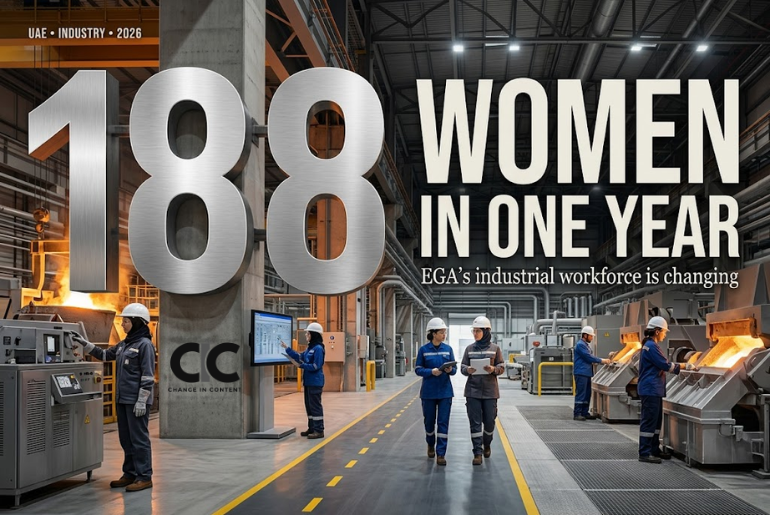
- Emirates Global Aluminium says more than 188 women have joined the company since Emirati Women’s Day 2025, including 79 UAE Nationals.
- EGA now employs 833 women in the UAE, including 462 UAE Nationals.
- More than 408 women hold operational roles, with Emirati women accounting for over 44% of women in operations.
- Women currently hold 25% of supervisory positions at EGA, up from 18% when the company set that target in 2021.
- EGA began opening its National Training programmes for frontline industrial roles to women in 2022. By 2025, women represented more than 40% of new National Trainees.
More women are entering EGA. Where they are working matters more.
A recruitment number becomes more interesting when it changes who occupies the factory floor.
Emirates Global Aluminium, the UAE’s largest industrial company outside oil and gas, says more than 188 women have joined its workforce since Emirati Women’s Day 2025. Of them, 79 are UAE Nationals. The company now employs 833 women in the UAE.
The stronger signal, however, is in operations.
More than 408 women at EGA now work in operational roles. That matters in an aluminium business spanning smelting, refining, engineering and other areas of heavy industry where female participation has traditionally been much lower than in corporate functions.
EGA’s June 2026 update showed that women already held one in four supervisory roles at the company. More than 60% of its women were then working in operational roles focused on engineering.
That moves the story beyond hiring alone.
The pipeline is becoming more industrial
EGA opened its long-running National Training programmes for frontline industrial operations to women in 2022.
In the first full year after that change, women accounted for around 20% of new joiners. By 2025, their share among new National Trainees had risen above 40%.
It is an important progression because manufacturing inclusion can become superficial when women are recruited mainly into support functions while production, engineering and technical pathways remain largely male.
EGA appears to be widening entry where industrial careers actually begin.
That resembles a shift Change in Content has been tracking elsewhere. At Syrma SGS, women formed 48% of the overall workforce in FY26, with female representation particularly strong among workers on the manufacturing floor.
Maruti Suzuki has also been increasing women’s presence in core shop-floor roles, including assembly, quality and powertrain operations.
Different industries and countries are involved, but the direction is similar: industrial inclusion becomes more meaningful when women move into the work that defines the business.
Emirates Global Aluminium is also taking the conversation beyond its own workforce
The company launched its Challenger Programme in 2023 to address common barriers facing women in industry.
The initiative now includes companies such as ADNOC, Ducab, EMSTEEL, ENEC, Strata, TAQA and TechnipFMC, alongside newer members Schneider Electric, RAK Ceramics, Veolia, Delta Plus and Knauf Group. Its areas of work include recruitment, STEM participation, workplace culture, retention and mentoring. That makes the programme worth watching.
One company can redesign its own recruitment pipeline. A network of large industrial employers can begin changing expectations across a labour market.
EGA has also set broader representation targets. Its 2024 sustainability report stated an ambition for women to hold 15% of all roles by the end of 2026, alongside the supervisory target it has already reached.
The Change: Industrial inclusion needs careers, not appearances
Adding 188 women in a year is encouraging.
The more consequential question will be what happens to them next.
- Do women entering technical training become operators and engineers?
- Do operators move into supervision?
- Do supervisors move into plant and business leadership?
- Does retention hold as the numbers rise?
Those are the measures that eventually tell us whether inclusion has become part of an industrial company’s operating model.
EGA’s latest figures suggest that women are becoming more visible in precisely the part of heavy industry where they have historically been least visible.
For manufacturing, that is useful progress. The factory floor is becoming a career destination for a wider workforce.
Editorial Note
This news report is based on information issued by Emirates Global Aluminium for Emirati Women’s Day 2026, together with official EGA media releases and company disclosures. Workforce figures are company-reported and have not been independently audited by Change in Content. The article does not constitute an endorsement of EGA’s employment practices or diversity programme.
Sources
Emirates Global Aluminium — International Women in Engineering Day, June 2026: EGA reported that women hold 25% of supervisory positions and that more than 60% of its female workforce work in operational engineering-focused roles.
Emirates Global Aluminium — Challenger Programme, July 2026: Official update on EGA’s industry-wide gender-diversity initiative.
EGA-issued Emirati Women’s Day 2026 press release, reproduced by AL Circle: Contains the latest figures of 188 new women hires, 79 UAE Nationals, 833 women in the UAE workforce and 408+ women in operational roles.