
The Quick Read
- Women in India’s gig economy are not sharing equally in the country’s platform-work boom. India’s platform workforce grew from an estimated 7.7 million in 2020 to 12 million in 2024–25 and is projected to reach 23.5 million by 2029–30. Women remain particularly scarce in location-based jobs such as ride-hailing and delivery.
- One study cited in a new ILO-NCAER policy brief found women made up less than 1% of urban two-wheeler delivery drivers. The problem extends beyond recruitment to mobility, safety, care responsibilities, digital skills and access to capital.
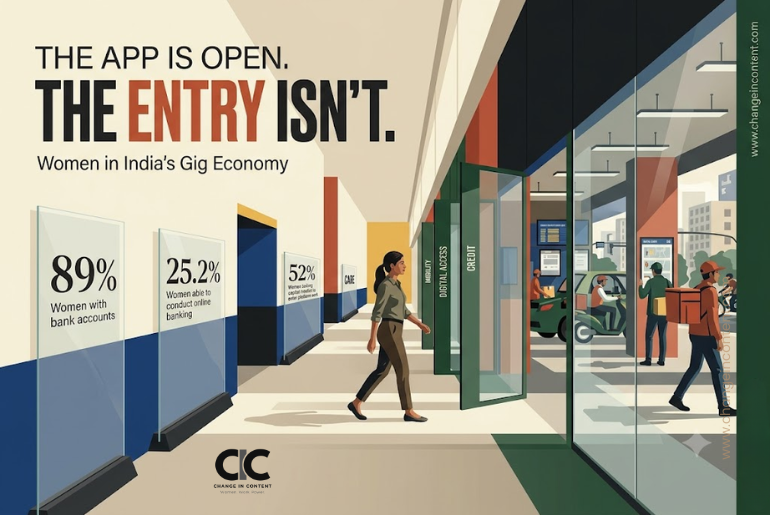
- India has virtually closed the gender gap in basic bank-account ownership: around 89% of women and 88% of men had an account in 2024. But account ownership is not the same as digital financial independence.
- Only 25.2% of women could conduct online banking, according to the data cited in the policy brief, compared with 47.1% of men. Among rural women, the figure fell to 17.1%.
- 52% of women lacked the capital needed to enter platform work, compared with 40% of men. Women accounted for only 22.9% of outstanding individual bank credit in March 2023 and received just 18% of the value of sanctioned digital-NBFC loans.
- The opportunity now is to use platform earnings themselves as financial evidence. Digital income trails could help women build credit profiles without relying as heavily on property or conventional collateral, provided that privacy, consent, and worker protections are built in.
The gig economy was supposed to make work easier to enter
No CV sent into a corporate abyss. No office commute five days a week. And no waiting for somebody to create a conventional vacancy.
Open an app. Get verified. Accept work. Earn.
That simplicity has always been part of the appeal of platform employment.
For women in India’s gig economy, however, the route can become complicated long before the first customer appears on the screen.
- Does she own the phone?
- Can she operate the bank account attached to it?
- Does she have a vehicle?
- Can she finance one?
- Can she work after dark?
- Can she travel across the city?
- Can she leave home when demand peaks?
- Can she absorb a week of weak earnings?
- Can she afford an accident?
- Does the platform’s algorithm punish the hours she cannot work?
Suddenly, a supposedly low-barrier form of employment turns out to have quite a few barriers.
That matters because India’s platform economy is becoming too large to treat as a labour-market sideshow. The number of workers increased from roughly 7.7 million in 2020 to 12 million in 2024–25, and NITI Aayog has projected that there will be 23.5 million platform workers by 2029–30.
If women remain concentrated at the edges of that expansion, India could build one of its newest labour markets using some of its oldest inequalities.
First, the good news: Women have bank accounts
This part of India’s financial-inclusion story deserves credit.
In 2014, about 43% of women aged 15 and above had an account at a bank or similar financial institution. By 2024, that figure had risen to approximately 89%. Men were at 88%. A once substantial gender gap has essentially disappeared at this basic level. That achievement changes the nature of the problem.
A decade ago, policy could reasonably ask whether women were inside the banking system. Today the question is more demanding: What can they actually do once they are inside it?
The answer is considerably less equal. Only 25.2% of women were able to perform online banking transactions in the 2022–23 data cited in the new ILO-NCAER brief. Among men, it was 47.1%.
A broader measure combining internet searching, email and online banking placed women at 18%, against 30.1% for men. In rural India, only 17.1% of women could perform online banking.
That gap is highly relevant to platform work because the job itself is digitally mediated.
Work arrives through a device. Ratings live there. Payouts arrive digitally. Identity verification may happen digitally. Loans and insurance are increasingly sold digitally. Customer interaction and navigation may also be digital.
A bank account can therefore exist without granting a woman full entry into the economic system that is growing around it.
Our recent examination of women and India’s digital policy reached a similar conclusion from a different angle. India has built formidable digital infrastructure, but individual control over devices, financial tools and advanced digital functions remains much more uneven.
The latest evidence from the gig economy shows where that difference can begin to affect someone’s livelihood.
Women in India’s gig economy: A bank account cannot buy the bike
Consider delivery work.
The app may be free to download. The work is not free to enter. But a worker may need a two-wheeler, a smartphone, data connection, insurance, fuel and enough working capital to survive until income becomes dependable.
The ILO-NCAER brief cites evidence that 52% of women lack the capital needed for the investments required to enter platform work, compared with 40% of men. That one number helps explain why apparent flexibility can be misleading.
You can tell a woman she is free to become a delivery partner. If she cannot finance the vehicle required to make deliveries, the freedom remains theoretical.
Credit data deepens the problem.
Women accounted for only 22.9% of outstanding bank credit to individuals in March 2023, according to RBI data cited by the brief. They received just 18% of the total sanctioned loan value from digital NBFCs in the evidence the researchers examined.
Then comes collateral.
Women are less likely to own land and property in their own names, which can weaken access to conventional secured lending. Someone can therefore possess the skills and willingness to work while lacking the asset required to enter a transport-heavy segment of the gig economy.
The labour-market barrier has become a balance-sheet barrier.
And the phone may not really be hers either
There is another trap in headline measures of digital access. A household can own a smartphone without every adult in the household having independent access to one.
Change in Content’s earlier analysis of women and the future of digital work in India showed why device ownership matters: shared access can limit privacy, responsiveness, authentication, job searching and the ability to manage money independently.
The latest policy brief adds a financial dimension.
Women’s access may be mediated through another family member. A banking-linked mobile connection may not be registered in the woman’s own name. Concerns around digital fraud, stalking and safety can also reduce trust in financial platforms.
This sounds mundane compared with the language of the “future of work”. It is also exactly how exclusion works.
A platform worker cannot afford to borrow her husband’s phone whenever an order appears.
Digital work rewards immediacy. The person with independent control over the device begins with an advantage before algorithms even enter the conversation.
The visible gig economy is still heavily male
Spend 20 minutes at a busy quick-commerce dark store or restaurant cluster during peak delivery hours and the gender imbalance is difficult to miss. The research confirms the observation.
A study cited in the ILO-NCAER brief found women represented less than 1% of two-wheeler delivery drivers in urban India.
That does not mean women are absent from all platform work. They are more visible in areas such as beauty, domestic services, care-related services, remote work, online selling and other segments where occupational patterns often resemble those of the offline economy.
Earlier NITI Aayog research noted that digital platforms may widen women’s choices while continuing to reproduce gendered occupational segregation. This deserves attention.
Technology can change how work is assigned without changing who society expects to perform it.
- Men deliver. Women provide beauty services.
- Men drive. Women perform care work.
The interface becomes new. The occupational map can remain surprisingly familiar.
A genuinely inclusive gig economy would give women a realistic chance to enter both traditionally female-dominated platform sectors and higher-earning mobility, logistics, technical and professional segments.
“Flexible work” can have some rather inflexible peak hours
Flexibility is the gig economy’s best sales pitch to women. There is good reason for that.
Women carrying disproportionate caregiving responsibilities may value the ability to choose work that fits around school schedules, household duties, elder care, or other demands. NITI Aayog has previously recognised that platform work can help women combine paid employment with household responsibilities.
But there is a difference between choosing when to log in and being equally able to earn whenever you log in.
Platform demand has rhythms.
- Food delivery peaks around meal times.
- Ride-hailing can become more lucrative at night.
- Weekend and late-evening demand can matter.
- Incentives may reward particular shifts, volume or availability.
A woman who avoids late-night work because of safety concerns or who logs off when care duties begin may formally have complete scheduling flexibility while missing some of the best-earning windows.
An algorithm does not need to know someone’s gender to produce a gendered outcome. It only needs to reward a pattern of availability that men are more able to supply.
The new ILO Convention on decent work in the platform economy recognises the importance of automated systems in determining working conditions. It requires greater transparency into how such systems monitor, evaluate, and make decisions affecting workers.
For women, algorithmic transparency should include a very practical question: do incentive structures unintentionally penalise workers whose caregiving or safety constraints limit when and where they can work?
That would be worth measuring.
Financial exclusion does not stop once she gets the gig
Suppose a woman overcomes all of this.
She secures the device. Gets the vehicle. Learns the app. Starts earning.
The financial problem does not disappear.
Gig earnings can be volatile. A worker may have a strong week followed by a weak one. Illness, an accident, vehicle repair or an unexpected care responsibility can abruptly stop income.
Traditional salaried employees may receive paid leave, employer insurance or other benefits.
Many gig workers do not have the same cushion.
The ILO-NCAER brief therefore argues for a broader concept of financial inclusion covering start-up finance, short-term credit, savings, micro-insurance and financial-planning tools rather than simply extending more loans. That approach makes sense.
A woman does not become financially included because an institution agrees to lend her money.
She becomes more financially resilient when she can enter the workforce, withstand shocks, invest in building earning capacity, and accumulate assets from her earnings.
Our earlier piece on what women want from digital work argued that flexibility is valuable only when it comes with enough stability, dignity and progression to build a livelihood.
The financing problem makes that argument concrete.
The gig economy might also contain part of the solution
Here is where the new report becomes more interesting than a catalogue of problems.
Platform work creates data. Every completed trip, delivery or appointment leaves an earnings record.
That history could become financially useful.
Someone who does not own property may still have six months of regular platform income. Someone without a conventional salary slip may have hundreds of completed transactions demonstrating cash flow.
The ILO-NCAER brief argues that these digital income trails could help lenders assess workers through cash-flow-based lending rather than relying as heavily on conventional collateral.
For women, that could be significant. The work that currently leaves them financially precarious could eventually help establish the financial profile needed to improve their position.
There is a catch.
Platform earnings data is not presently part of the financial information available through India’s Account Aggregator framework, and platform aggregators cannot simply feed worker data into it under the existing structure. The brief suggests exploring ways of making relevant financial profiles portable, with safeguards for consent and worker data.
That last part cannot become a footnote.
There is a thin line between using work data to improve access to finance and turning every worker’s activity into another form of financial surveillance.
Workers should know what is shared, with whom, for what purpose and for how long.
Financial inclusion should increase agency. It should not require surrendering it.
What would getting more women into platform work actually require?
The solution is bigger than another recruitment drive featuring photographs of female delivery partners.
Make entry assets easier to finance
Women interested in mobility, logistics, and other asset-intensive platform work need access to affordable vehicle financing, leasing, shared-asset models, and working capital.
Credit assessment should make greater use of cash-flow evidence where appropriate, rather than over-relying on property ownership.
Teach digital finance as a work skill
Knowing how to receive an OTP is no longer sufficient financial literacy.
Women entering platform work need practical capability around:
- UPI and online banking
- Digital fraud
- Credit costs
- Insurance
- Tax records
- Income tracking
- Loan comparisons
- Savings
- Financial grievance systems
This training should form part of onboarding, particularly for first-time digital workers.
Design platforms around women’s actual working constraints
Safety tools, transparent incentive structures, accessible local support, toilets and rest facilities, emergency mechanisms and grievance redressal can materially change whether location-based platform work is viable for women.
NITI Aayog has previously suggested measures including accessible local support offices, partnerships for rest facilities and technology-enabled safety measures.
Stop treating care as the worker’s private scheduling problem
If women disproportionately carry unpaid work, pure “log in whenever you want” flexibility does not necessarily equal opportunity.
Platform design could explore incentives that do not make night-time or uninterrupted availability the main route to viable earnings.
Public investment in childcare remains part of the larger answer.
Give women somewhere to progress
A platform economy that recruits women only into low-value tasks is not much of an inclusion victory.
Women need routes from frontline platform work into trainer roles, supervision, fleet management, quality assurance, operations, platform support, entrepreneurship and ownership.
The platform should be an entry point. It does not have to become a ceiling.
There is also a bigger policy moment here
In June 2026, the International Labour Conference adopted Convention No. 193 on decent work in the platform economy, the first international labour standard devoted specifically to platform work. It covers issues including discrimination, safety and health, remuneration, social security and transparency in algorithmic systems.
India’s platform economy is therefore expanding at the same moment that governments worldwide are asking a more sophisticated question about gig work: Not merely how many jobs platforms create.
What kind of jobs are being created, for whom, on what terms and with what ability to build a life from them?
For India, gender needs to be inside that discussion from the beginning.
23.5 million platform workers by the end of the decade would be a remarkable labour-market transformation. If their gender composition simply reproduces today’s disparities at twice the scale, growth will have amplified an old problem.
The Change: Don’t count the account. Follow the agency.
Perhaps the most revealing number in this entire story is 89%. That is the share of Indian women who had a bank account in 2024. By one important measure, financial inclusion worked.
Now look further.
- Who can bank online?
- Who owns the phone?
- Who can borrow?
- Who owns the bike?
- Who can work at 10 pm?
- Who controls the income?
- Who can withstand a bad week?
- Who can use six months of platform earnings to qualify for better credit and buy a better asset?
Those questions get closer to economic participation than an account-opening statistic ever could.
India’s gig economy still has enormous potential for women. Flexible, digitally mediated work can expand access to income, particularly for women who conventional workplaces have poorly served.
But flexibility alone cannot carry the weight we keep placing on it. Women need the digital capability to use the platform, the financial capacity to enter it, the physical freedom to perform the work, protection once they are there and enough financial infrastructure to turn a series of gigs into something larger.
India has already demonstrated that it can bring women into the banking system at scale. The next achievement would be more ambitious.
Help them use that system to enter the new economy on their own terms.
Editorial Note
This DEI Insights article draws on the August 2026 ILO-NCAER policy brief, Advancing Women’s Digital Financial Inclusion in the Platform Economy, as well as official and institutional research from the International Labour Organisation, NCAER, and NITI Aayog. The term “gig economy” can encompass very different forms of platform and freelance work; participation rates therefore vary substantially across sectors and datasets. The less-than-1% figure cited in this article refers specifically to women among two-wheeler delivery drivers in an urban Indian study cited by the policy brief. It should not be interpreted as women’s share of India’s entire gig workforce. Recommendations are presented as policy and workplace analysis, not financial advice.
Sources
- National Council of Applied Economic Research: Building Inclusive Economies: Gender, Financial Inclusion, and the Platform Workforce
- International Labour Organisation: Digital Labour Platforms
- International Labour Organisation: Opportunities and Challenges for Decent Work in the Platform Economy in Asia and the Pacific
International Labour Organisation: Decent Work in the Platform Economy Convention, 2026 (No. 193) - NITI Aayog: India’s Booming Gig and Platform Economy
