The Quick Read
- Dairy Conclaves Uttar Pradesh are being organised as part of the Dairy Development Department’s 50th anniversary, with programmes covering all 75 districts and divisional-level events across the state.
- The conclaves are intended to raise awareness of government dairy and animal husbandry schemes, scientific livestock management, improved breeds, technology, and investment opportunities.
- Uttar Pradesh’s dairy strategy includes the Nand Baba Dugdh Mission, which supports dairy development, indigenous cattle and milk production. The Centre has confirmed several schemes operating under the mission.
- The women’s opportunity is particularly important because rural women already provide substantial labour in agriculture and livestock. At the same time, much of their work often remains unpaid or is absorbed into family enterprises.
- The test will therefore be whether dairy development helps more women move from being counted as workers to becoming paid producers, members, entrepreneurs and decision-makers.
Dairy Conclaves in Uttar Pradesh
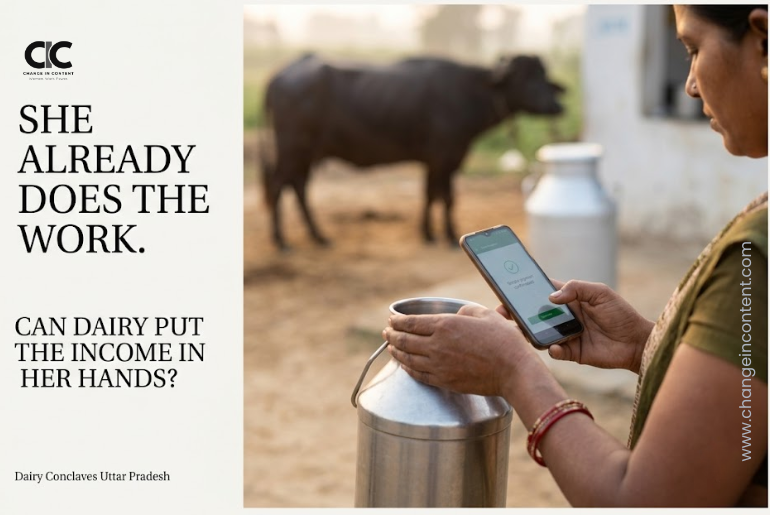
A rural woman wakes before sunrise. She feeds the cattle. Cleans the shed. Cuts fodder. Milks the animals. Carries the milk. Keeps track of the calf. Does the housework. And somewhere inside India’s labour statistics, she may appear as employed.
The question is whether the money from all that work appears in her hands. That is what makes the current Dairy Conclaves Uttar Pradesh initiative particularly interesting from a women-and-work perspective.
The Uttar Pradesh government has been holding dairy conclaves across the state to mark the Dairy Development Department’s 50th anniversary. A district-level Dairy Conclave 2026 was held in all 75 districts on 5 August, while the broader series has also included divisional programmes in Meerut and Agra, bringing together farmers, livestock rearers, entrepreneurs, officials and sector specialists.
The stated goals are practical: improve awareness of government schemes, introduce farmers to modern dairy technology and scientific livestock management, strengthen dairy investment and improve rural incomes. Those objectives matter for everyone involved in the dairy economy.
For rural women, they could matter even more.
Why dairy is an important women’s employment story
India’s recent rise in female employment has been driven heavily by rural women. But Change in Content has repeatedly argued that the headline needs unpacking. Our analysis of women in agricultural employment in India found that women have accounted for much of the recent expansion in the rural workforce. At the same time, agriculture has absorbed a particularly large share of those workers.
The difficulty is the type of employment.
A woman working on a family farm or caring for livestock can be economically productive while receiving no separate wage. She can contribute to household income without controlling it. She can spend hours working every day and still be described as “helping”. That is why our subsequent examination of women moving from unpaid family work towards self-employment argued that the next stage of progress has to be about income, ownership, recognition and control rather than employment classification alone.
Dairy offers an unusually practical route towards that transition.
Milk is produced regularly. One can measure it. It has a price. And it enters a supply chain. Payments can be made directly. Producer groups can be formed. Women can become members rather than invisible contributors to a family enterprise.
That is where dairy policy can become women’s economic policy.
What Uttar Pradesh is trying to build
The state already has a substantial dairy-development programme.
Under the Nand Baba Dugdh Mission, Uttar Pradesh has introduced schemes intended to improve indigenous cattle, milk production and dairy infrastructure. The Union government confirmed in March 2026 that the state is implementing measures including the Nandini Krishak Samriddhi Yojana and Mini Nandini Krishak Samriddhi Yojana, which provide support for setting up dairy units using indigenous cattle.
The wider dairy-conclave programme adds another layer: information.
That sounds mundane until one considers how schemes actually reach rural households.
- A subsidy that a woman does not know exists cannot empower her.
- A livestock management technique she never receives training in cannot increase productivity.
- A dairy cooperative that lists only the male household head may leave her labour visible but her economic identity invisible.
- A bank-linked dairy scheme that never reaches women directly may increase family income without increasing women’s agency.
The conclaves therefore have the potential to become useful only if the information travels all the way to the women doing the work.
Uttar Pradesh already has evidence that women can own more of the dairy value chain
There are precedents.
The National Dairy Development Board has supported milk producer companies with strong women’s participation, including Balinee Milk Producer Company in Bundelkhand. NDDB reported that several producer companies created under its wider model had all-women membership and women serving as producer-directors.
Balinee itself pools milk directly from producers across districts, including Jhansi, Banda, Chitrakoot, Hamirpur, and Jalaun, and provides feed, breeding, and veterinary support services.
That represents a fundamentally different position for a rural woman.
She is no longer simply the person who milks the animal. She can become:
- a registered producer,
- a shareholder,
- a supplier,
- a recipient of payment,
- a member of an organisation,
- and potentially a participant in governance.
That is the progression worth building.
The opportunity is bigger than milk
The real economic value of dairy does not end with the sale of raw milk.
A stronger rural dairy ecosystem can create work around:
- feed and fodder,
- veterinary services,
- milk collection,
- testing,
- transport,
- cold chains,
- processing,
- packaging,
- ghee,
- paneer,
- yoghurt,
- local brands,
- digital payments,
- and dairy enterprises.
Uttar Pradesh’s investment strategy itself identifies opportunities across commercial dairy farms, micro-dairies, processing facilities, cold-chain infrastructure and associated businesses.
Women should be present across that chain. Otherwise, we risk repeating a familiar economic pattern: women provide much of the labour at the beginning of the value chain while more profitable activities move elsewhere.
A stronger dairy policy should help women move closer to where value is captured.
What should happen after the conclaves?
The events themselves are useful. The follow-through will matter more.
- How many women attended?
- How many subsequently accessed schemes?
- How many dairy units were registered in women’s names?
- How many women joined producer organisations?
- How many received direct payments?
- How many accessed formal credit?
- How many received livestock or veterinary training?
- How many women-led enterprises moved into processing?
Those numbers would tell us whether the conclaves strengthened women’s economic position or merely increased awareness around the household dairy economy.
Because awareness is the beginning. Agency is the outcome.
The Change in Content Perspective: Pay the woman who is already doing the work
There is good reason to welcome the Dairy Conclaves Uttar Pradesh initiative.
Rural economies need stronger income sources. Farm households need diversification. Dairy productivity can improve. Farmers need technology, veterinary services, financing and better market connections. And Uttar Pradesh has enough scale for better dairy systems to create meaningful economic value.
For women, however, the opportunity should be framed more ambitiously. Many rural women do not need to be persuaded to participate in the dairy economy.
They are already there. They feed the animal, maintain it, milk it, and manage much of the daily care. The policy opportunity is to ensure that the woman who does the work also becomes visible in the transaction.
- Put her name on the producer record.
- Put the payment in her account.
- Give her access to credit.
- Train her directly.
- Bring her into the cooperative.
- Help her move into processing and entrepreneurship.
- Give her a voice in the producer organisation.
That is how dairy development can become a form of women’s empowerment without requiring a slogan.
The cow was already in the courtyard. The woman was already working. What can change now is who receives the income, recognition and opportunity that the work creates.
Editorial Note and Disclaimer
This Policy Pulse report draws on official information from the Government of Uttar Pradesh, the Government of India, Invest UP and the National Dairy Development Board. Change in Content has added an editorial women-and-work lens to examine how dairy development could strengthen income, recognition and agency for rural women. References to future outcomes are analytical and should not be interpreted as evidence that every current dairy programme already delivers these outcomes.
Sources
- Government of Uttar Pradesh, Information & Public Relations Department: Official material on the state’s dairy conclave programme, Nand Baba Dugdh Mission and dairy-sector development.
- Ministry of Fisheries, Animal Husbandry & Dairying, Government of India: March 2026 parliamentary response detailing Uttar Pradesh’s Nand Baba Dugdh Mission and associated schemes.
- Invest UP: Official overview of Uttar Pradesh’s dairy sector and investment opportunities across dairy farming, processing, cold chains and related infrastructure.
- National Dairy Development Board: Reporting on milk producer companies, including women-led models and Balinee Milk Producer Company in Uttar Pradesh.