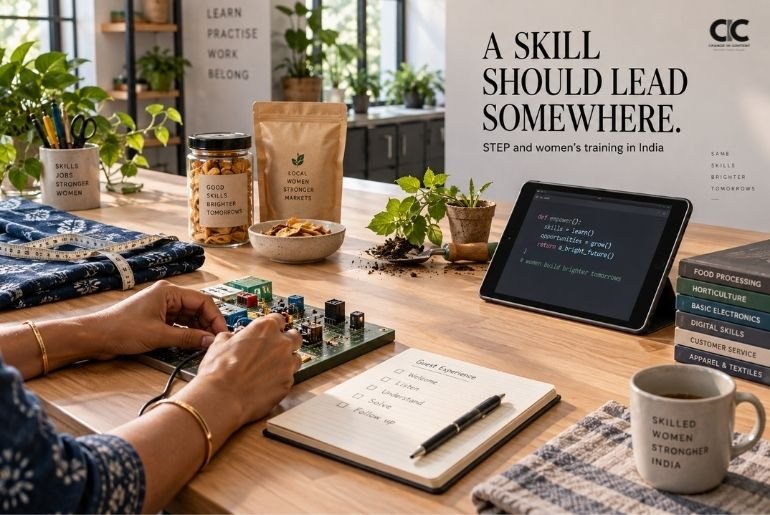
The Brief
- STEP stands for Support to Training and Employment Programme for Women. The Ministry of Women and Child Development launched it in 1986–87 as a Central Sector Scheme to improve women’s employability and self-employment opportunities.
- Under the revised framework, women aged 16 years and above could be trained across sectors including agriculture, food processing, handicrafts, tailoring, IT-enabled services, jewellery, tourism and hospitality.
- STEP did not operate primarily as a direct cash benefit to individual women. The government provided grants to eligible institutions and organisations, including NGOs, that implemented approved training projects.
- Official portals still retain STEP information in 2026. Yet, the current Government employment and skilling listings place greater emphasis on programmes such as PMKVY, Jan Shikshan Sansthan, NAVYA, AI Career for Women and other Skill India initiatives.
- Women searching for training today should therefore verify current enrolment routes and active schemes on official ministry or Skill India portals, rather than assume that an older STEP application process remains open.
The STEP Scheme 2026
A government scheme can remain alive on the internet long after the policy landscape around it has changed. That is precisely why STEP needs explaining carefully in 2026.
The Support to Training and Employment Programme for Women, better known as STEP, was created decades ago to address a problem that remains familiar today: women may want to work, but lack access to recognised skills, market linkages, credit or pathways into paid employment.
The Ministry of Women and Child Development launched STEP in 1986–87. Its basic proposition was straightforward.
Train women. Improve their employability. Help them earn. And, where appropriate, help them become self-employed or entrepreneurs.
That objective still sounds remarkably current. The delivery system around it, however, needs more explanation.
What exactly was the STEP Scheme?
STEP was designed as a government-supported training and livelihood programme for women. Its objective was not education in the conventional school or college sense. It focused on practical skills that could help women move towards wage employment, self-employment or entrepreneurship.
The Ministry’s revised guidelines allowed training across a wide range of sectors, including agriculture, horticulture, food processing, handlooms, handicrafts, tailoring, embroidery, computer and IT-enabled services, gems and jewellery, travel, tourism and hospitality.
The scheme also recognised that employability does not depend only on technical skill.
Training could therefore include workplace-oriented capabilities such as spoken English and other soft skills. That made STEP broader than a traditional vocational course.
The intended outcome was not merely that a woman finished training. It was that the training should lead somewhere.
Who was STEP meant for?
The revised scheme was intended for women aged 16 and above across India.
Earlier versions of STEP had a particularly strong focus on marginalised and economically vulnerable women, including poor rural women, urban poor women, wage labourers, unpaid workers, female-headed households, migrant women, tribal communities and other disadvantaged groups.
It is worth noting that STEP was built around a different idea of women’s employment from many modern corporate-skilling programmes.
The scheme was not primarily about preparing graduates for office jobs. It was designed around women whose route into earning might begin through:
- local production
- agriculture
- handicrafts
- small enterprise
- services
- cooperatives
- or wage work.
For many women, especially outside formal white-collar employment, that remains an important route into economic independence.
Did women apply directly for STEP?
This is where many scheme summaries become confusing.
STEP was not generally designed as a programme in which an individual woman filled out a central online form and received money or training directly from the Ministry.
Government assistance was provided to eligible institutions and organisations, including NGOs, which submitted projects and delivered approved training.
Under the revised framework described by the Ministry in 2015, a project could run for up to 18 months, while individual training courses were generally shorter. Approved projects could receive government support covering up to 90% of project cost, subject to prescribed limits.
So the woman was the beneficiary. The implementing organisation was usually the route through which training reached her. That distinction matters enormously for anyone searching “STEP Scheme 2026 apply online”.
What did STEP actually pay for?
Under the revised 2014 framework described by the Government, financial assistance could support training as well as food and travel costs.
For example, the notified ceiling for a three-month course was:
- training cost up to ₹14,000 per beneficiary;
- food and travel up to ₹4,000;
- for a combined ceiling of ₹18,000.
For a 6-month course, the combined ceiling could reach ₹28,000 per beneficiary under the then-applicable framework. These were project-cost ceilings, not necessarily cash payments handed directly to every participant.
That is another distinction worth making clear. STEP was designed as funded programme delivery, not a universal stipend scheme.
The original idea went beyond training
One of the more interesting aspects of STEP was that its earlier framework did not treat skill training as sufficient on its own.
The scheme also envisaged support around:
- Access to credit
- Organisation of women into viable groups
- Market linkages
- Employment linkages
- Health
- Literacy
- Legal awareness
- And support services.
That approach was sensible. Training someone to stitch, process food, use a computer or operate machinery does not automatically create a livelihood.
Someone still needs a buyer. An employer. Credit. Transport. Equipment. Market information. Or a route into formal work.
This continues to be one of the biggest weaknesses in skilling programmes generally.
Change in Content recently examined this in our article on women in formal jobs after skilling, where the central question was not how many women were trained but how many ultimately reached stable, formal employment.
STEP’s original design at least recognised that training and livelihood are not the same thing.
So, is STEP still active in 2026?
This is the part readers need to understand carefully. Official government websites still carry STEP documentation.
The National Portal of India has both a STEP information page and a revised guidelines page, with the latter reviewed in July 2026. But this should not automatically be interpreted as evidence that STEP is currently accepting new projects or individual enrolments in the same form as it did under the 2014–16 framework.
When we look at the Government’s current employment-generation and women-focused programme listings, STEP is not among the principal active programmes highlighted for 2026.
Instead, the Directorate General of Employment points towards a newer skilling landscape that includes:
Pradhan Mantri Kaushal Vikas Yojana 4.0, Jan Shikshan Sansthan, NAVYA, AI Career for Women, Skill India training infrastructure, and other women-focused employment and entrepreneurship schemes.
Recent Ministry of Skill Development reporting similarly identifies PMKVY, JSS, the National Apprenticeship Promotion Scheme and ITI-based training as the major current Skill India channels.
That is why Change in Content would not advise a reader to rely on an old STEP application format without first confirming current availability with an official ministry source.
Where can women look for government-backed skilling now?
For a woman actually searching for training in 2026, this is probably the more useful question.
PMKVY 4.0
The Pradhan Mantri Kaushal Vikas Yojana remains one of the country’s major short-term skilling programmes.
Its current version includes industry-aligned training across traditional and emerging fields, including AI, robotics, drones, semiconductors, renewable energy and other newer job categories.
Government reporting says women and other under-represented groups receive specific support within parts of the programme, including transport provisions in applicable cases.
Jan Shikshan Sansthan
JSS is particularly relevant for people with limited formal education, school dropouts and underserved groups.
Women form a very large share of participants.
As of 2026, the Government reported 294 functional Jan Shikshan Sansthans, with women accounting for around 83% of the programme’s priority beneficiary profile. Its strength is local, community-based vocational training rather than highly formal classroom education.
NAVYA
NAVYA (Nurturing Aspirations through Vocational Training for Young Adolescent Girls) was launched in 2025.
It targets girls aged 16–18 in aspirational districts and includes training in traditional and newer fields, including digital marketing, cybersecurity, AI-enabled services and green jobs, alongside financial literacy and life skills.
AI Career for Women
The Government has also listed AI Career for Women, launched in 2025, as a programme aimed at young women and girls in rural undergraduate colleges, with training focused on AI-linked economic opportunities.
These programmes show how the policy language has evolved. STEP emerged in an era when women’s livelihood training was strongly associated with agriculture, crafts, food processing and traditional self-employment.
Those routes still matter. But women entering work in 2026 also need access to AI, digital services, green jobs, advanced manufacturing, electronics, formal apprenticeships, technology-enabled entrepreneurship, and emerging sectors that did not exist when STEP began.
What has not changed since STEP began?
One thing. Training still has to convert into income.
India has expanded its skilling infrastructure enormously. But the success of any scheme should eventually be judged by what happens after certification.
- Did the woman find work?
- Did she earn more?
- Did she enter a better job?
- Could she remain employed?
- Did her business find customers?
- Did the training match actual demand?
- Could she access credit or equipment?
- Was the work safe and sustainable?
That is why our recent guide to employment-generation schemes for women in India separates skilling from actual employment outcomes. India now has multiple programmes capable of opening a route into work. The important test is whether that route leads somewhere economically meaningful.
STEP understood part of that problem almost forty years ago.
The policy ecosystem around it has changed. The challenge has not disappeared.
Closing thoughts: Skills are valuable only when they travel
STEP was built around a straightforward idea: give women skills that allow them to earn.
That remains worth preserving. But in 2026, “women’s skilling” should mean much more than teaching women whatever course happens to be locally available.
Training should connect to real demand. It should reach sectors with growth. Women should be able to move beyond occupational stereotypes. And somebody should still be asking what happened six months after the certificate was handed over.
- A skill is valuable.
- A skill that becomes income is more valuable.
- A skill that becomes a durable career, enterprise or source of economic choice is the outcome that really matters.
That is where the spirit behind STEP remains relevant, even as India’s skilling architecture moves on.
FAQs
Q: What is the STEP Scheme?
A: STEP stands for Support to Training and Employment Programme for Women. It was launched by the Ministry of Women and Child Development in 1986–87 to improve women’s employability and support self-employment and entrepreneurship through skill training.
Q: Who was eligible for STEP?
A: Under the revised framework, STEP was intended for women aged 16 years and above across India. Earlier programme design placed particular emphasis on poor, marginalised and assetless rural and urban women.
Q: What kind of training did STEP provide?
A: Training could cover areas such as agriculture, horticulture, food processing, handicrafts, handlooms, tailoring, computer and IT-enabled services, gems and jewellery, hospitality, tourism and workplace skills such as spoken English.
Q: Can women apply directly for the STEP Scheme in 2026?
A: Women should not assume that older STEP application procedures remain currently open. STEP was typically implemented through approved institutions and NGOs rather than direct individual applications. Current Government employment listings emphasise newer skilling programmes, so applicants should verify availability through official Government portals before applying.
Q: Which current government schemes can women explore for skill training?
A: Depending on age, location and eligibility, current options include programmes under PMKVY 4.0, Jan Shikshan Sansthan, NAVYA, AI Career for Women, apprenticeships and ITI-based Skill India programmes.
Editorial Note & Sources
Several non-government scheme websites continue to describe STEP as though it is a currently accessible standalone scheme. Official Government portals still host STEP information and historic guidelines, but current 2026 Government employment and skilling listings do not prominently identify STEP as one of the main active training programmes. Change in Content therefore treats STEP as an established government programme whose original design remains documented, while advising readers to verify current implementation or enrolment status before acting on older application information.
Sources
- Ministry of Women and Child Development / Press Information Bureau: Support to Training and Employment Programme for Women. Official explanation of STEP’s objectives, eligibility, sectors, funding structure and revised guidelines.
- National Portal of India: Support to Training and Employment Programme for Women. Official Government portal entry describing STEP and its target groups.
- National Portal of India: Revised STEP Guidelines and Application Format. Official Government portal record of the scheme guidelines, reviewed in July 2026.
- Directorate General of Employment, Ministry of Labour & Employment: Employment Generation Schemes/Programmes of Government of India. Current official listing of employment and women-focused programmes, including PMKVY, Mission Shakti, NAVYA and AI Career for Women.
- Ministry of Skill Development & Entrepreneurship: Skill India Mission, 2026. Current official overview of PMKVY, Jan Shikshan Sansthan, apprenticeships and ITI-based training.