
The Brief
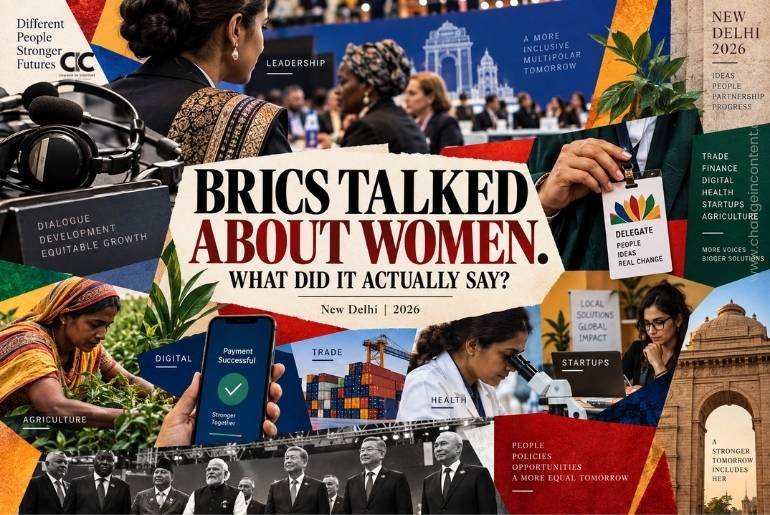
- The BRICS Summit 2026 New Delhi Declaration recognises women as leaders, decision-makers and contributors to economic growth and social transformation, extending the bloc’s emphasis on women-led development.
- In an unusual intervention on global representation, the declaration explicitly notes that no woman has ever served as Secretary-General of the United Nations and calls for emerging and developing countries to receive greater representation in global decision-making institutions.
- India’s Commerce Minister Piyush Goyal pushed BRICS members to widen credit, market and international-trade opportunities for women-led enterprises, including participation in BRICS exhibitions and trade fairs and further work on a proposed Women’s Advancement Fund.
- The BRICS Women’s Business Alliance brought around 200 women business leaders together in New Delhi, while its Women-Led Development Summit covered STEM, women’s health, agriculture, finance, digital inclusion and women-led startups.
- Earlier in India’s 2026 presidency, the BRICS Women Ministers’ Track adopted its first-ever joint statement, while backing a Digital Repository and Digital Capacity-Building Guidelines for women-led development.
BRICS Summit 2026 and the women’s story
For most of this week, the biggest BRICS headlines have been about wars, tariffs, currencies, trade and global power.
Look slightly away from the main photograph, though, and another story has been developing in New Delhi. Women.
Not as a ceremonial side conversation. They have appeared in discussions about who gets to make global decisions, who trades across borders, who gets financed, who builds startups, who participates in digital economies, how women’s health is addressed and whether economic growth can really be described as inclusive when women remain outside its most powerful structures.
The BRICS Summit 2026 has not solved any of those questions. But under India’s presidency, women-led development has moved through several parts of the BRICS machinery rather than appearing in one isolated session.
That makes it worth documenting properly.
The New Delhi Declaration moves women closer to the language of power
The strongest statement came from the leaders themselves.
The New Delhi Declaration adopted at the 18th BRICS Summit recognises women as leaders and decision-makers, alongside their role in economic growth and social transformation.
The language is important because international development documents have historically spoken about women most comfortably as people who need:
- support
- protection
- education
- healthcare
- finance
All legitimate needs.
Women-led development changes the direction of that sentence. It asks what happens when women are also understood as the people setting priorities, allocating resources, building businesses and making decisions.
Change in Content has followed this evolution through India’s BRICS presidency. When India convened the BRICS Women’s Working Group preparatory meeting in June, the conversation was already moving towards practical cooperation, including knowledge sharing and digital capacity building.
By September, that language had travelled to the leaders’ declaration.
One sentence in the declaration deserves particular attention
Amid sections on the UN, conflict and global governance, BRICS made a striking observation.
No woman has ever been elected Secretary-General of the United Nations.
The declaration also notes how few people from Latin America and the Caribbean, Africa and Asia have occupied the position and calls for more meaningful representation of emerging and developing countries across international decision-making institutions.
This places gender representation alongside the broader Global South argument.
BRICS has spent years asking:
- Who gets to make global rules?
- Who controls international institutions?
- Whose interests are reflected?
The 2026 declaration effectively adds another question: Who gets to lead them?
That matters because the discussion about women’s representation is often separated from the discussion about global institutional reform.
Here, they intersect.
A more representative world order cannot only mean moving power between countries while leaving the gender composition of that power untouched.
Yet the leaders’ table itself tells another story
There was extensive female participation around the BRICS ecosystem this year. But the principal representatives listed for the 11 BRICS member countries at the New Delhi leaders’ meeting were men, including Narendra Modi, Xi Jinping, Vladimir Putin, Cyril Ramaphosa, Masoud Pezeshkian, Abdel Fattah el-Sisi, Abiy Ahmed and Prabowo Subianto, alongside male representatives for Brazil and the UAE.
That is not a criticism of the summit organisers. Governments send the leaders they have. It is simply part of the representation picture.
Women were visible in the business alliance, ministerial tracks, specialist panels, international organisations and invited delegations. They were much less visible in the photograph representing sovereign political power.
Among the wider international and outreach participation, there were notable women, including Uganda’s Vice-President Jessica Alupo and Asian Infrastructure Investment Bank President Zou Jiayi. WTO Director-General Ngozi Okonjo-Iweala was also among international institutional leaders associated with the New Delhi gathering.
The distinction is useful. Women can have strong participation around an institution while remaining scarce at its highest decision-making level. Both facts should be recorded.
The BRICS Women’s Business Alliance became one of the main vehicles
A significant part of the women’s agenda was carried through the BRICS Women’s Business Alliance, established in 2020 to strengthen women’s economic participation and entrepreneurship across member economies.
India took over the WBA presidency in January 2026. Its flagship Women-Led Development Summit was held in New Delhi on 9 September, ahead of the leaders’ summit.
It was not one broad panel called “women’s empowerment”. The programme moved through distinctly economic subjects.
- Women in STEM and digital technologies.
- Women-led agriculture and food systems.
- Women’s health.
- Financial and digital inclusion.
- Startup finance and innovation ecosystems.
- Cross-border business.
That matters because it treats women’s participation as something embedded in economic architecture rather than a separate social agenda.
Prime Minister Narendra Modi later highlighted the alliance at the BRICS Business Forum, saying it was an important part of BRICS’ vision and noting that around 200 women business leaders participated in its India meeting.
His formulation was straightforward: BRICS wanted women entrepreneurs to lead the growth story.
Avarna Jain’s emphasis was on building across borders
Avarna Jain, Global Chairperson of the BRICS Women’s Business Alliance in 2026, framed the New Delhi gathering around a similar idea.
Not simply creating more women-owned firms. Creating more opportunities for women to lead, build and grow across BRICS markets.
During the Women-Led Development Summit, the Alliance also launched two knowledge publications: one on digital public infrastructure and women-led development, and another examining women’s economic empowerment and resilience across BRICS economies.
Digital infrastructure is especially important here.
Payments. Identity. Documentation. Marketplaces. Credit histories. Digital public services.
For a woman running a smaller enterprise, these can determine whether crossing a border commercially is realistic or merely theoretically possible.
The conversation therefore moved beyond celebrating women entrepreneurs to asking what infrastructure lets them operate at larger scale.
Piyush Goyal turned the discussion towards trade
Commerce and Industry Minister Piyush Goyal made perhaps the most commercially specific intervention.
At the WBA conference, he described three barriers facing entrepreneurs trying to enter international markets: credit, buyers and markets, and predictable trading rules.
He urged BRICS governments to improve access across all three for women entrepreneurs. That is a useful framing because the problem facing many women-owned businesses is no longer simply starting.
- It is the next transaction.
- The larger customer.
- Working capital.
- Export documentation.
- Distribution.
- International buyers.
India’s own startup numbers illustrate why this question has become relevant.
Goyal told the BRICS Business Forum that more than 45% of India’s 250,000 recognised startups have at least one woman partner or director. He also said roughly two-thirds of small loans made over the last decade had gone to women entrepreneurs.
The first figure needs to be read carefully. Having at least one woman director or partner does not automatically make an enterprise women-led.
We made that distinction in our National Startup Day 2026 analysis, where the same startup data showed growing female presence but also the need to distinguish participation from actual ownership and control.
Still, the scale explains why women-led trade has moved onto the BRICS agenda.
The next step could be a Women’s Advancement Fund
Among the more concrete proposals is a BRICS Women’s Advancement Fund.
India has urged member countries to turn the idea into an operational initiative rather than leave it at the exploratory stage. The proposal emerged from earlier BRICS trade discussions under the Jaipur Consensus and sits alongside work on finance for smaller exporters and digital trade documentation.
The exact design will matter.
- Who qualifies?
- What kind of finance?
- Loans, guarantees, grants or blended capital?
- Who manages the fund?
- Can micro and small women-owned firms access it?
- Does it finance businesses already able to export, or help new businesses become export-ready?
Those details are still ahead. But the direction is notable.
Women entrepreneurs are being discussed not simply as recipients of microfinance but as potential participants in cross-border commerce.
That is a more ambitious economic frame.
Trade fairs sound minor. They are not.
Goyal has also repeatedly urged BRICS countries to ensure women-led enterprises participate in exhibitions, buyer-seller meets, trade fairs and business delegations.
This may sound less important than a fund. But for small businesses, it can be extremely practical.
A founder can have a good product and still lack:
- a foreign buyer,
- a distribution contact,
- market information,
- an export partner,
- knowledge of a country’s regulations,
- or access to the networks where commercial deals begin.
International business often starts through visibility and relationships before it reaches finance. So representation at trade platforms is not merely symbolic visibility. It can be market access.
Finance was only one part of the women’s agenda
The WBA agenda deliberately moved beyond capital.
Agriculture received its own discussion, with women leaders from government, industry and international BRICS organisations examining women’s role in building resilient food systems.
Women’s health was treated as an economic and access issue, with a session focused on connecting primary care, technology and underserved communities.
Digital and financial inclusion discussions asked how countries move beyond basic access towards meaningful participation.
And the startup session explicitly considered venture finance, gender-lens investing, policy reform, mentorship and cross-border innovation networks for women-led businesses.
This breadth is important. There is no single women’s economy.
- The farmer.
- The technology founder.
- The healthcare worker.
- The small exporter.
- The scientist.
- The rural entrepreneur.
- The executive.
They require very different interventions.
A serious women-led development agenda has to be able to hold all of those economies at once.
The women’s track had already done groundwork in July
The September discussions were not created during summit week.
Earlier in India’s BRICS presidency, ministers and officials met in Kochi for the BRICS Women Working Group and Women Ministers’ Meeting. That process produced the first-ever joint statement under the BRICS Women Ministers’ Track.
Members also welcomed Indian proposals for a BRICS Digital Repository and Digital Capacity-Building Guidelines, intended to share practices and strengthen cooperation across member countries. India also used the ministerial process to showcase grassroots women leaders.
At the Kochi meeting, the country presented women-led Panchayati Raj as a model for local governance, including the experience of elected women representatives working at village level.
It helps explain the architecture of India’s BRICS women’s agenda in 2026. It has moved across three levels:
- women in communities,
- women building businesses,
- and women making decisions.
What India is trying to export is partly a model
There is also a clear Indian policy story underneath the summit.
Goyal cited nearly 300 million women’s bank accounts, about 100 million rural women organised into more than nine million self-help groups, and the Lakhpati Didi programme while explaining India’s approach to women’s economic participation.
India proposes that financial inclusion, digital public infrastructure, community organisation, entrepreneurship and market access can reinforce one another. Whether every component travels easily to another BRICS country is a different question.
Brazil is not India. The UAE is not Ethiopia. China is not South Africa.
Women in each economy operate inside different financial systems, labour markets, laws and social structures.
So the most useful BRICS cooperation will probably not be copying schemes. It will be identifying which underlying mechanisms can travel.
Digital identity. Low-cost payments. Access to formal accounts. Credit assessment without traditional collateral. Business networks. Export access. Skills. Data.
Those are more portable ideas.
And what does the BRICS Summit 2026 leave us with?
A large international summit produces declarations easily. Implementation is harder. But there are several things worth carrying forward from New Delhi.
- The first is conceptual: Women are being described as economic actors and decision-makers, not only beneficiaries.
- The second is institutional: There is now a Women Ministers’ Track, a Women’s Business Alliance, specialist working groups and a growing set of proposals through which that idea can be pursued.
- The third is commercial: Women-led enterprises are being connected explicitly to trade, finance, digital infrastructure and international markets.
- And the fourth is about representation itself: A declaration that asks international institutions to become more representative while explicitly observing that the UN has never had a woman Secretary-General creates an important benchmark.
It also creates a question BRICS can ask of itself over time: How many women occupy its own most powerful tables?
That question need not diminish what happened in New Delhi. It is simply the next measure of whether women-led development is travelling from agenda to authority.
Change in Perspective: From a Women’s Track to the Main Track
Perhaps the most useful thing about the BRICS Summit 2026 is that there is no single “women’s issue” to summarise.
Women appeared in conversations about trade. Finance. Startups. Health. Agriculture. Technology. Global institutions. Political decision-making.
That is closer to reality.
Women are not a sector. Their participation runs through every sector.
The real test for BRICS will therefore not be how many women’s meetings it organises next year. It will be whether the ideas developed in those meetings begin appearing naturally inside finance agreements, trade platforms, technology cooperation, development-bank decisions, business delegations and leadership appointments.
- A Women’s Business Alliance matters.
- A Women Ministers’ Track matters.
- A proposed fund matters.
So does a sentence recognising women as decision-makers.
But the longer-term ambition should be simpler: eventually, women-led development should not need a side room because women are already present wherever development is being decided.
FAQs
Q: What did the BRICS Summit 2026 say about women?
A: The New Delhi Declaration recognised women as leaders, decision-makers and contributors to economic growth and social transformation. The wider 2026 BRICS programme also addressed women’s entrepreneurship, finance, digital inclusion, health, agriculture and leadership.
Q: What is the BRICS Women’s Business Alliance?
A: The BRICS Women’s Business Alliance was established in 2020 to promote women’s entrepreneurship and economic participation across BRICS countries. India assumed the WBA presidency in 2026, with FICCI serving as the official secretariat for its India activities.
Q: What is the proposed BRICS Women’s Advancement Fund?
A: It is a proposal intended to strengthen financial support for women entrepreneurs and women-led businesses across BRICS economies. India has urged members to move from exploring the idea towards creating a concrete mechanism; its final structure and operating rules are not yet settled.
Q: How were women represented at the BRICS Summit?
A: Women had substantial participation through the Women’s Business Alliance, Women Ministers’ Track, sectoral panels, business delegations and some international and outreach delegations. The principal representatives listed for the 11 BRICS member countries at the leaders’ summit, however, were men.
Editorial Note & Sources
This article is an original Change in Content synthesis of women-related developments across India’s 2026 BRICS presidency and the New Delhi summit week. It distinguishes between commitments already adopted, such as the New Delhi Declaration and Women Ministers’ joint statement, and proposals that remain under development, including the Women’s Advancement Fund.
Primary and supporting sources include the New Delhi Declaration coverage; official Government of India releases on the BRICS Business Forum and Women’s Business Alliance; the BRICS Women’s Business Alliance programme; the Women Ministers’ Track; and official/member-government information on summit participation.
