
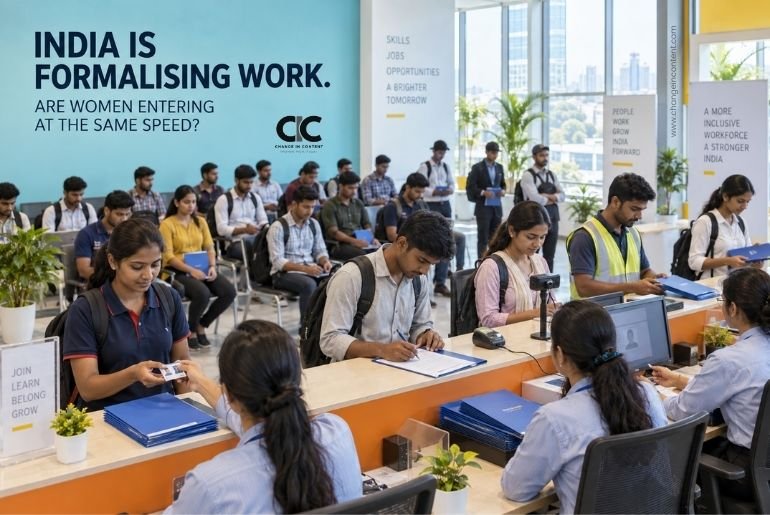
The Brief
- Quess Corp’s Pulse Report FY2026 says women account for only 25% of India’s flexi workforce, below their share of the wider workforce used in the report’s comparison.
- Within Quess’s own deployed workforce, women account for around 17%, or approximately 82,000 workers, according to the report.
- Women’s representation varies sharply by sector: the report puts it at 32% in IT/ITeS, 20% in FMCG, 18% in retail and 17% in logistics, but only 9% in telecom and still lower in some other sectors.
- The report cites rapid EPFO formalisation. However, its 69.03-lakh April–July 2025 figure reflects an earlier data cut; subsequent official EPFO releases report higher revised provisional monthly totals for the same period.
- The central issue is therefore not whether formal employment is growing. It is whether women are entering the sectors, shifts and frontline roles where that growth is taking place.
Millions of new EPFO members, but women in formal employment remain 25%
India is adding workers to formal payrolls at an extraordinary scale. That is good news.
Provident fund registrations are growing. Staffing companies are moving workers from informal arrangements into payroll-linked employment. More young people are entering jobs that come with documented wages and social-security coverage. Yet one part of that expansion remains noticeably uneven. Women are not entering at the same rate.
Quess Corp’s latest Pulse Report FY2026 places women at only 25% of the flexi workforce. Within Quess’s own large deployed workforce, their share is lower still: around 17%.
For Change in Content, the important question is not simply why that percentage is low. It is this: What kinds of formal jobs are expanding, and are women getting realistic access to them?
First, what does “formal employment” mean here?
The report uses several datasets that measure different parts of India’s labour market.
EPFO membership is one. A worker entering an establishment covered by the Employees’ Provident Fund Organisation gains access to a formal payroll-linked social-security system. That is an important marker of formalisation. But an EPFO net addition is not identical to one brand-new job.
The monthly payroll number includes new subscribers as well as people who exited EPFO-covered employment and later rejoined. EPFO itself distinguishes between these categories in its releases.
For July 2025, for example, EPFO reported:
- 9.79 lakh new subscribers;
- 21.04 lakh net payroll additions;
- and 16.43 lakh people who had exited earlier and rejoined covered establishments.
So “net EPFO additions” is a valuable formalisation measure. It should not be casually translated into “new jobs created”. That distinction matters in any serious employment story.
The 69-lakh headline also needs a footnote
Quess’s report cites 69.03 lakh net EPFO additions between April and July 2025. That number has subsequently circulated in coverage of the report. But official EPFO releases published later report monthly net additions of:
- 19.14 lakh in April;
- 20.06 lakh in May;
- 21.89 lakh in June;
- and 21.04 lakh in July.
Those figures total roughly 82.1 lakh.
EPFO data is provisional and gets revised as employee records are updated. The difference therefore appears to reflect different vintages of the payroll data rather than two competing realities.
That is why we would describe the Quess figure as the figure used in its report, not as the latest definitive total for those months.
The broader point remains intact: India’s formal payroll base is expanding rapidly.
Yet only 1 in 4 flexi workers is a woman
The gender number is more difficult to dismiss. Women account for approximately 25% of the flexi workforce in the benchmark cited by Quess. It is particularly interesting because flexi staffing might appear, in theory, to offer several advantages for women.
It can provide:
- a route into formal employment;
- shorter entry barriers than some permanent hiring processes;
- employment closer to home;
- fixed-term opportunities;
- and payroll-linked benefits such as EPF and ESI.
In some circumstances, it can also provide a route back into employment after a career interruption. Yet women remain a minority.
We explored exactly this paradox in our earlier piece on women in flexi staffing in India, where the 25% figure was already visible in Indian Staffing Federation data.
The latest Quess report suggests the gap remains unresolved.
The sector mix explains part of it
One of the most useful things in the report is that it does not leave us with one national percentage. It shows where women are actually present.
Within Quess’s workforce, female representation is reported at:
- 32% in IT/ITeS;
- 26% in HHO;
- 22% in EMPI;
- 20% in FMCG;
- 18% in retail;
- and 17% in logistics.
It drops to around:
- 9% in telecom;
- 6% in agriculture;
- and 5% in public enterprises within the company’s reported sectoral deployment.
These are not simply diversity numbers. They tell us something about the geography of formal job growth.
Many of India’s fastest-scaling flexi jobs sit in logistics; warehousing; delivery-linked operations; sales; manufacturing; field service; retail operations; telecom; and other frontline functions.
Those are also areas where women frequently remain underrepresented.
So the challenge is not only getting more women onto payroll. It is opening the parts of the payroll where hiring is actually accelerating.
That is why “flexibility” alone does not solve the problem
The word flexi can be misleading.
Flexible staffing does not necessarily mean flexible working hours.
- A warehouse role can be a flexi-staffing job while still requiring a fixed late shift.
- A retail associate may be formally employed through a staffing company but still need to travel home after closing time.
- A logistics job may offer payroll coverage while requiring mobility across unfamiliar areas.
- A field-sales position can be formally structured yet require extensive local travel.
Those practical details matter enormously. If women face greater constraints around late transport, personal safety, caregiving or relocation, then a job can be formally available without being equally usable. That is why representation differs so much by sector.
Formalisation changes the employment relationship. It does not automatically change every condition surrounding the job.
The women who are entering are strikingly young
Quess’s internal data contains another useful clue.
Among its female workforce:
- 35% are aged 21–25;
- 27% are aged 25–30;
- and another 12% are between 18 and 21.
That means a large majority of its women workers are young.
There is an optimistic reading here. Young women are entering formal work. They are getting UANs. They are gaining documented employment histories. And they are entering sectors from which previous generations of women may have been largely absent.
Quess says it created around 26,000 new UANs during H1 FY26, moving workers previously outside the system into formal social-security coverage. That matters.
A first formal job can change the trajectory of a working life.
But the next question is what happens at 30, 35 and 40
The youthful workforce profile creates another question that the headline percentage cannot answer.
- Do these women stay?
- Do they move into supervisory roles?
- Do they transition into permanent employment?
- What happens after marriage?
- After childbirth?
- When care responsibilities increase?
- When a frontline worker becomes eligible to become a team leader?
A labour market can become very successful at bringing young women into entry-level work and still lose them before those careers mature.
That is why our reporting on women in formal jobs after skilling focused on conversion rather than training numbers alone. A formal first job is valuable. A durable career is more valuable.
Formalisation should therefore be read as the beginning of the journey. Not the end.
The report’s 33.7% LFPR figure also needs context
Quess cites a female labour-force participation rate of 33.7%. Again, this is a genuine official figure, but the reference period matters. It comes from the July–September 2025 PLFS, using Current Weekly Status for people aged 15 and above.
It should therefore not be read as the definitive female LFPR for September 2026. Nor should the 33.7% LFPR and 25% flexi-workforce share be treated as directly equivalent statistics.
They measure different things.
LFPR asks what proportion of women in the population are working or seeking/available for work. The 25% flexi number asks what proportion of workers in that employment segment are women.
Different denominator. Different question.
The comparison is still useful as an indication that women are less represented in flexi staffing than in the broader workforce. But precision matters.
India has already shown that sectoral representation can move quickly
Low representation in frontline work is not inevitable. India’s electronics-manufacturing expansion provides a useful counterexample.
Women now form a very large share of direct workers in parts of mobile-phone manufacturing, particularly where companies have designed transport, accommodation, food, safety and recruitment around the workforce they are trying to attract.
Our recent report on women in electronics manufacturing documented female representation approaching 70% of direct workers in that particular segment.
The lesson is not that every sector can or should replicate one industry’s gender ratio. It is that workforce composition can respond strongly to job design.
- If logistics wants more women, ask about transport.
- If manufacturing wants more women, ask about shifts, facilities and accommodation.
- If field sales wants more women, examine mobility and safety.
- If frontline retail wants women to remain, look at scheduling and progression.
Representation often becomes less mysterious when employers study the actual job.
Formality also has a quality dimension
There is a reason increasing formal employment matters particularly for women.
Formal work can bring documented wages, social security, provident fund contributions, ESI coverage and greater visibility inside labour protections. Women remain more likely than men to work informally according to recent Indian research.
An Economic Advisory Council to the Prime Minister working paper found women were 4.8 percentage points more likely than men to be in informal employment, after controlling for other factors in its model. Our earlier report examined what that means for job security and protection.
So increasing women’s share of formal employment is not merely about putting another percentage on a diversity dashboard. It affects the type of economic security attached to work.
25% should therefore be treated as an opportunity number
It would be easy to read the Quess report pessimistically.
Formal work is growing. Women are still underrepresented. End of story.
But there is another reading. If the flexi-staffing workforce keeps expanding, every new deployment cycle is an opportunity to alter its composition.
Quess’s own FY2026 report describes India’s staffing ecosystem as continuing to grow across sectors and geographies, with Tier-2 and Tier-3 cities becoming increasingly important deployment centres. That can matter for women.
- Work closer to home can reduce migration barriers.
- New industrial clusters can design transport properly from the beginning.
- Employers can widen sourcing.
- Staffing firms can track where women drop out between application and joining.
- And sectors with very low representation can stop treating the existing workforce mix as fixed.
The 25% is therefore not merely evidence of a gap. It tells employers where there is room to build.
Change in Perspective: Formalisation is Only Fully Inclusive When Women Enter It Too
India’s employment story is changing.
More workers are becoming visible on payrolls. More people are entering provident-fund coverage. And more young workers are gaining formal employment histories. That is substantial progress.
The Quess report asks us to look at who is entering that system. Women remain only a quarter of the flexi workforce. That matters because many of the jobs being formalised today will become the career foundations, supervisory pipelines and skilled workforces of tomorrow.
The goal should not be to slow formalisation until gender representation catches up. It should be the opposite. Use the speed of formalisation to accelerate inclusion.
- Every new warehouse.
- Every new retail network.
- Every manufacturing line.
- Every field-sales team.
- Every staffing contract.
- Every new UAN.
They are all opportunities to design the next workforce differently from the last one.
India is creating a larger formal economy. Women should have a larger place inside it.
Editorial Note & Sources
Quess Corp’s Pulse Report FY2026 combines company workforce data with external datasets including EPFO and PLFS. Some figures in the report refer to earlier periods and should not be read as the latest September 2026 national indicators. In particular, the report’s 69.03-lakh EPFO figure reflects the data vintage used by Quess; subsequent official EPFO releases provide revised provisional monthly figures. The 33.7% female LFPR cited in the report refers to Current Weekly Status in the July–September 2025 PLFS and is not directly comparable with women’s 25% share of the flexi workforce.
Sources
- Quess Corp: Pulse Report FY2026: India’s Workforce Landscape. Primary report for the 25% female share of flexi staffing, Quess workforce composition, sectoral participation, age distribution and formalisation discussion.
- Employees’ Provident Fund Organisation / Ministry of Labour & Employment: EPFO Payroll Data, April–July 2025. Primary official source for revised provisional payroll additions, new subscribers and rejoining members.
- Ministry of Statistics & Programme Implementation: PLFS Quarterly Bulletin, July–September 2025. Primary source for the Current Weekly Status labour-force indicators underlying the report’s female LFPR context.
- Indian Staffing Federation: Staffing Industry Research. Official industry source for the scale and continuing growth of formal flexi staffing in India.
