The Brief
- Finland’s Ministry of Social Affairs and Health has introduced a new gender-neutral job demand assessment model for organisations. The framework is voluntary.
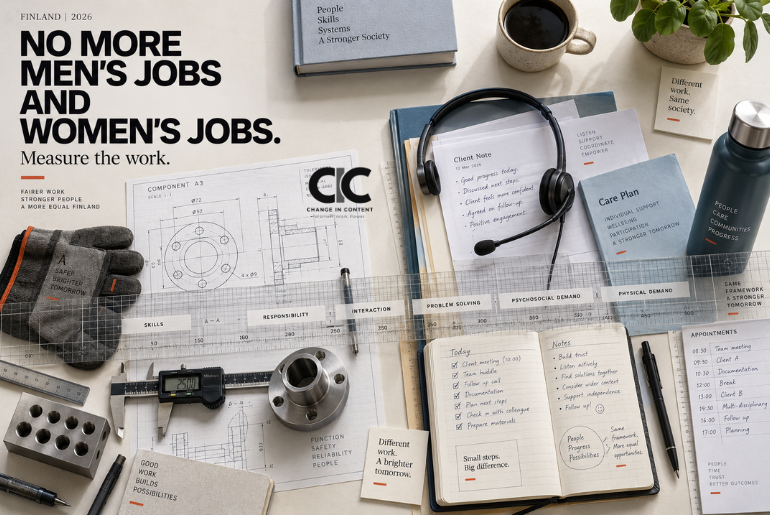
- It assesses work across six dimensions: skills; responsibility and impact; interaction; problem solving and independence; psychosocial demands; and physical demands.
- The objective is to make it easier to identify two very different jobs that nevertheless demand comparable levels of skill, responsibility and effort.
- The model responds to the EU Pay Transparency Directive, which requires member states to make gender-neutral analytical tools available for assessing work of equal value. The Directive explicitly warns against undervaluing relevant soft skills.
- Finland remains highly gender-segregated by occupation, and average earnings still differ substantially. Preliminary Statistics Finland data for 2025 put average monthly earnings for full-time employees at €4,507 for men and €3,838 for women.
- The Finnish experiment is useful beyond Finland because it changes the question from “Are these people doing the same job?” to “Are these jobs demanding comparable levels of value?”
Job Demand Assessment Model Finland
A nurse and an electrician may spend their days doing completely different things.
A finance specialist and an HR specialist may rarely perform the same task.
And a care worker and a maintenance technician may work in entirely different environments.
So how do we decide what each job is worth?
For decades, one of the weaknesses in conversations about equal pay has been that they become much easier when two people perform the same job.
Same designation. Same responsibility. And same employer. But different salary.
The unfairness is visible. The harder question begins when women and men are concentrated in different professions altogether.
Finland has now introduced a framework intended to make that question easier to answer.
The Job Demand Assessment Model Finland developed compares jobs by what they actually require, rather than whether their titles or day-to-day tasks look similar.
Behind the technical framework is a surprisingly simple idea: A job should not become more or less valuable because society has historically thought of it as men’s work or women’s work.
What has Finland introduced?
On 3 September 2026, Finland’s Ministry of Social Affairs and Health published a new gender-neutral model for evaluating the demands of different jobs.
The model was developed for organisations with support from external experts and a tripartite steering group representing the Finnish labour-market system. It is intended particularly for employers that do not already have a sufficiently developed job-assessment process.
It is not mandatory. Instead, Finland is making a common analytical tool available so organisations can assess the value of work more consistently and build more gender-neutral pay structures.
The immediate policy background is the European Union’s Pay Transparency Directive.
Article 4 of that Directive requires EU member states to ensure employers can access analytical tools or methodologies for evaluating equal work and work of equal value using objective, gender-neutral criteria.
Finland’s model is its practical response to that idea.
Six questions instead of one job title
The model evaluates work through six broad areas:
- Skills
- Responsibility and impact
- Interaction
- Problem solving and independence
- Psychosocial demands
- Physical demands
That list is the heart of the policy.
Instead of asking whether two employees perform similar work, an organisation can examine how demanding each role actually is.
- A job may require significant technical knowledge. Another may require constant judgement involving people.
- One may involve physical strain. Another may involve sustained emotional pressure.
- One employee may operate expensive machinery. Another may make decisions affecting the health or welfare of vulnerable people.
The work is different. Its value may still be comparable. That is precisely what “work of equal value” is intended to capture.
Why is a separate model necessary?
Because work is not always valued from a blank page.
Occupations arrive carrying history.
Some jobs have traditionally been associated with men. Examples are:
Construction. Engineering. Maintenance. Transport. Technical operations.
Others have been associated more heavily with women. Examples are:
Nursing. Care. Teaching. Administrative support. Human resources. Customer service.
Finland itself acknowledges that occupational segregation remains a major contributor to its gender pay gap. Government research has described Finnish working life as strongly gender-segregated, both between industries and within occupations and job functions.
That matters because once women and men work in different jobs, traditional “equal pay for the same job” comparisons become less useful. The issue becomes how different work is valued.
Change in Content has explored the same mechanism through job segregation and the way gender continues to shape occupational choices. Men and women need not be paid differently inside one role for labour markets to produce very different earnings overall.
The hierarchy may already have been built between occupations.
Not all demands have historically been equally visible
That is where the Finnish model becomes particularly interesting.
Imagine two jobs.
Job A
The employee:
- uses specialised technical equipment;
- works in a physically demanding environment;
- carries responsibility for machinery;
- solves operational problems independently.
Job B
The employee:
- deals continuously with distressed people;
- manages conflict;
- makes decisions affecting someone’s welfare;
- communicates complex information;
- coordinates several responsibilities simultaneously;
- works under constant emotional and psychological pressure.
Most organisations can describe the demands of Job A easily.
Job B may be described with much softer language.
“People skills.”
“Good communication.”
“Patience.”
“Empathy.”
Yet these are still skills. And this particular problem is explicitly recognised in the EU Pay Transparency Directive. It requires job evaluation to use objective, gender-neutral criteria and adds an unusually specific instruction: relevant soft skills must not be undervalued.
That sentence deserves attention. Because skills become economically consequential partly through how organisations choose to name them.
When a skill becomes a personality trait, its value can disappear
Consider emotional regulation.
- A nurse dealing with frightened relatives requires it.
- A teacher managing thirty children requires it.
- A social worker dealing with vulnerable families requires it.
- A customer-service employee handling hostility requires it.
- An HR professional managing conflict requires it.
If the same capability appeared in a senior executive profile, it might be called:
- stakeholder management.
- conflict resolution.
- leadership maturity.
- complex communication.
The language changes. Sometimes the economic value changes with it.
A longstanding problem in female-dominated work is that abilities socially associated with women can be interpreted as natural attributes rather than acquired professional skills.
- Women are “good with people”.
- Women are “caring”.
- Women are “patient”.
Once something is considered natural, it becomes easier to overlook the expertise required to perform it well. Our earlier discussion of pink-collar jobs explored this connection between gendered occupations, perceived skill and pay.
Finland’s model tries to make some of that hidden demand visible.
Psychosocial demand is a particularly important addition
Among the six Finnish assessment dimensions, psychosocial demands stand out.
Physical demand has always been relatively easy to understand.
Heavy lifting. Dangerous environments. Heat. Noise. Repetitive movement. Long periods of standing.
Those are legitimate workplace demands.
Psychosocial demands are sometimes harder to see. They can include the pressure created by:
continual emotional interaction;
- responsibility for vulnerable people;
- exposure to distress;
- conflict;
- time pressure;
- interpersonal complexity;
- or repeated emotionally difficult situations.
It does not mean a psychologically demanding job should automatically be paid more. The value of the model lies in requiring the organisation to count the demand at all.
Once organisations analyse work systematically, they have a better basis for deciding whether the pay structure makes sense.
Finland has a gender-equality reputation. It still has a pay gap.
This policy also reminds us that countries considered relatively advanced on gender equality can still retain deeply embedded labour-market inequalities.
Statistics Finland’s preliminary 2025 figures show average monthly earnings among full-time wage and salary earners of €4,507 for men and €3,838 for women.
That is not an “equal pay for the same work” figure. It is the overall average earnings difference, which reflects many factors including occupations, sectors, seniority, working patterns and job structures. The distinction is crucial.
As our own guide to equal pay and the gender pay gap explains, an organisation can comply with equal-pay requirements for comparable employees and still have a sizeable overall gender pay gap if women and men occupy different parts of its employment structure.
Finland’s problem is therefore not simply: Does a woman engineer earn less than a man engineer?
It is also: How does the labour market value a female-dominated occupation compared with a male-dominated occupation requiring a similar level of skill, responsibility and effort?
That is a much harder question.
What does “work of equal value” actually mean?
The concept can sound abstract until we separate it from “equal work”.
Equal work
2 employees perform the same or substantially similar role. Hence, comparing them is relatively straightforward.
Work of equal value
The jobs themselves may be different. But when objectively assessed, they can require comparable levels of skills, effort, responsibility, working conditions, and other relevant demands.
The EU Pay Transparency Directive requires employers’ pay structures to enable this kind of comparison.
Finland’s model goes further by operationalising that concept and breaking workplace demand into six dimensions.
That moves equal-pay analysis beyond matching job titles. And that is where its international relevance lies.
The HR specialist and finance specialist example is useful
Yle gives a simple example.
A specialist in human resources and a specialist in finance may perform entirely different daily tasks. Yet their roles might require similar levels of expertise, judgement, responsibility, independence and organisational impact.
If one role is paid much more than the other, the question becomes: Why?
There may be a perfectly legitimate explanation.
One job might require a scarce technical qualification. One may control greater financial risk. Market demand may differ.
The point of objective evaluation is not to predetermine that the salaries must be identical.
It is to make the reason for the difference visible and defensible.
A gender-neutral assessment system should not flatten every job into the same salary. It should make unexplained differences harder to hide behind tradition.
The model is not designed to declare every pay gap discriminatory
Here is what deserves emphasis.
A modern job-evaluation system should not begin with the assumption that every occupational pay difference is unfair.
Jobs can command different salaries for legitimate reasons.
- Skills may be scarce.
- Market conditions differ.
- Responsibility can vary.
- Working conditions matter.
- Required qualifications can differ considerably.
An objective assessment asks employers to identify those reasons.
That makes it closer to evidence than ideology.
If a higher-paying job genuinely requires substantially greater responsibility, expertise or difficulty, the assessment should show that.
But if two jobs score similarly across meaningful criteria and one has historically been valued less largely because it sits in a female-dominated occupation, employers have something worth investigating.
That is a much more productive gender-equality conversation.
Why job titles can mislead
Organisations are full of inherited hierarchies.
Assistant. Coordinator. Officer. Executive. Specialist. Engineer. Manager. Advisor. Technician.
The title itself begins signalling importance. But titles are not neutral measures of workload.
An employee called a “coordinator” may manage complex schedules, multiple stakeholders and significant operational risk. A “manager” elsewhere might have very limited supervisory responsibility.
That is why evaluating the work itself matters.
The Finnish model gives organisations a common framework to strip job titles of some prestige and examine them against actual requirements.
- What must this person know?
- What decisions do they make?
- What happens if they get something wrong?
- How independently must they operate?
- How difficult are their interactions?
- What physical or psychological demands does the role carry?
Those questions are much harder to answer with historical stereotypes.
Pay transparency makes job valuation more important
Finland’s initiative does not exist in isolation. It sits beside the EU Pay Transparency Directive, which creates stronger rights for workers to understand how pay is determined.
Among other measures, workers will be able to request information about average pay levels, broken down by sex, for categories of employees performing the same work or work of equal value.
That creates an obvious organisational challenge. Before employers can disclose pay for work of equal value, they need a defensible way to determine which jobs actually fall into that category.
That is where job evaluation becomes the infrastructure underneath pay transparency.
Transparency without job valuation tells employees what people earn. Job valuation helps explain whether those earnings make sense.
Finland is still completing its national implementation of the EU rules, and Yle reports that the legislative process has been delayed, with new rules now expected around the beginning of 2027.
The assessment model, however, is already available.
The model is voluntary. That may be its immediate weakness.
Finland has not required every employer to adopt this particular framework. Organisations may use it voluntarily, particularly when they do not already possess a suitable evaluation system. That makes sense operationally.
Large organisations often have sophisticated classification and pay structures already. A single government model may not fit every industry. But voluntary adoption creates the usual policy question: Will the employers most in need of better assessment be the ones most likely to use it?
That remains to be seen. Its immediate value may therefore be partly norm-setting.
The Finnish government has formally articulated what a modern gender-neutral job assessment should examine. Employers elsewhere can study the logic even if they never use the exact Finnish framework.
Could India learn something from this?
The lesson for India is not that we need to import Finland’s six-factor template word for word.
Our labour market is much larger, more informal, more fragmented, and regulated very differently. The useful lesson is the underlying method.
India has many occupations where women’s work is heavily concentrated: Teaching, nursing, care work, domestic work, textiles, clerical roles, front-line services, community work.
And it has many male-heavy occupations: construction, engineering, transport, technical maintenance, manufacturing, and infrastructure.
The question is not whether every female-dominated occupation should be paid the same as every male-dominated one. The question is whether the system accurately measures the skill and responsibility embedded in the work.
Our newly published workplace guide to gender equality concepts distinguishes equal pay from the wider gender pay gap. It explains why gender-neutral analysis has to investigate structures rather than simply compare individual men and women.
Finland provides a practical example of what that principle can look like.
Employers do not need legislation to ask six better questions
That may be the most transferable part of this policy.
Any organisation reviewing compensation could ask:
What skills does the work require?
Not merely formal degrees. But also:
- Technical knowledge.
- Communication.
- Judgement.
- Experience.
- Emotional capability.
- Coordination.
What responsibility and impact does the employee carry?
- Money?
- People?
- Safety?
- Customers?
- Operations?
- Reputation?
- Health?
How demanding is the interaction?
- Is communication routine?
- High-stakes?
- Conflict-heavy?
- Emotionally difficult?
How much independent problem-solving is required?
- Does the employee follow a process?
- Or constantly interpret, adapt and decide?
What psychological demands exist?
- Pressure.
- Emotional labour.
- Concentration.
- Distressing situations.
- Conflicting expectations.
What physical demands exist?
- Strength.
- Repetition.
- Danger.
- Environment.
- Working posture.
- Travel.
Once those questions are answered consistently, an organisation can compare roles that previously looked incomparable. That is the Finnish model’s central contribution.
No more men’s jobs and women’s jobs?
The phrase is deliberately provocative. Finland has not eliminated occupational segregation by publishing a 32-page model.
Nurses will not suddenly become engineers. Engineers will not suddenly become care workers. Nor is there anything inherently wrong with an occupation being predominantly female or male if people genuinely choose it.
The problem appears when gender becomes a proxy for value.
- When care is worth less because women have traditionally provided it.
- When technical capability is assumed masculine.
- When emotional skill is taken for granted.
- When physical effort is measured, but psychological effort disappears.
- When two jobs receive different economic status without anyone being able to explain why.
The Finnish model doesn’t tell people which careers to choose. It tries to make gender less relevant to how the resulting work is valued. That is a much better objective.
Change in Perspective: Value the Work Before You Value the Worker
There is something appealingly ordinary about Finland’s approach. It does not begin with slogans. It begins with a form.
- What skills does this job require?
- What responsibility?
- What problems?
- What interaction?
- What psychological demands?
- What physical demands?
Answer those questions. Then compare.
That sounds almost too simple for a problem as persistent as the gender pay gap. But sometimes structural bias survives precisely because nobody has forced an organisation to explain the assumptions built into its structures.
- A nurse’s work does not become less skilled because nursing is associated with women.
- A technician’s work does not become more valuable merely because the occupation has historically been male.
- And a man’s work does not deserve less recognition because a gender-neutral system is introduced.
The objective is not to move value from one gender to another. It is to attach value more accurately to the work itself. That is why Finland’s new model deserves attention well beyond Finland.
“No more men’s jobs and women’s jobs” does not mean every profession must reach a perfect 50:50 split. It can mean something much simpler.
Let people choose the work. Then value the work without the gender attached.
Editorial Note & Sources
Finland’s new job demand assessment model is a voluntary framework, not a mandatory national pay-setting system. It does not require differently titled jobs to pay the same. Its purpose is to help organisations assess whether different jobs may constitute work of equal value using gender-neutral criteria. Pay differences can still be legitimate where objective differences in skills, responsibility, demands, or other relevant factors exist.
Sources
- Finland’s Ministry of Social Affairs and Health — Job Demand Assessment Model, 3 September 2026: Primary publication explaining the voluntary gender-neutral model, its purpose and connection with the EU Pay Transparency Directive.
- Yle News — “No more ‘men’s’ and ‘women’s’ jobs, ministry says”, 4 September 2026: English-language reporting on the six evaluation criteria, policy rationale and implementation context.
- European Union — Directive (EU) 2023/970: Primary legal basis for gender-neutral job evaluation, pay transparency and the principle of equal pay for equal work or work of equal value.
- Statistics Finland — Gender Equality Indicators / Earnings Statistics: Latest available earnings and labour-market figures by sex.
- Finnish Government — Occupational Structures and the Gender Pay Gap: Background on the role of persistent occupational segregation in Finland’s gender pay gap.