
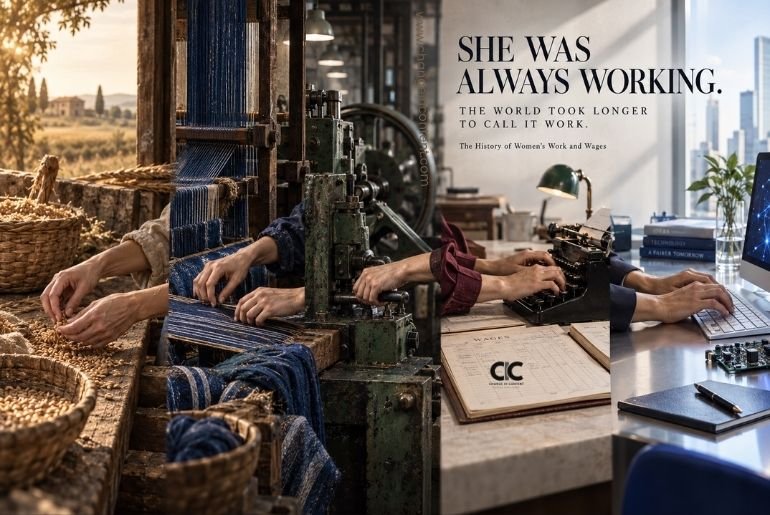
The Brief
- There is no single point at which women “entered” work. For centuries, women produced food, textiles, goods, care and income through farms, households, markets and family businesses, much of it poorly captured in historical labour statistics. Claudia Goldin’s archival work showed that even 19th-century US censuses substantially undercounted married women’s economic activity.
- Industrialisation did not produce a simple upward march in women’s employment. Goldin found a U-shaped historical pattern: participation could fall as economies moved from family agriculture towards industry, then rise again with education, services and white-collar work.
- The idea of equal pay developed slowly into law. The ILO adopted its Equal Remuneration Convention in 1951, establishing the principle of equal pay for work of equal value. It now has 175 ratifications.
- India placed equal pay for equal work for men and women in Article 39(d) of the Constitution, enacted the Equal Remuneration Act in 1976, and now prohibits gender discrimination in wages for the same or similar work under the Code on Wages, which largely came into force in November 2025.
- The unfinished story is no longer only about whether women work. Globally, women comprised 40.1% of employment in 2025 but 30.5% of managers; female employees earned on average 78 cents annually for every dollar earned by male employees.
History of women’s work and wages: Let’s bust some myths
Before the office came the field.
Before the factory clock came the household.
And before payroll software, annual appraisals and salary bands, there were crops to harvest, cloth to spin, animals to tend, meals to prepare, goods to sell, children to raise and family enterprises to keep alive.
Women were there.
That is an important place to begin any history of women’s work and wages, because the phrase “women entered the workforce” is historically convenient and often wrong.
Women did not suddenly discover work when factories began hiring them. They had always worked.
What changed was where the work happened, who could see it, whether anyone recorded it, and whether a wage was attached to the person doing it.
That distinction runs through almost everything that followed.
Long before the payslip, women were producing economic value
In agrarian economies, the boundaries we now draw between “home” and “work” barely existed.
A household was often also a unit of production.
People farmed. Processed food. Made textiles. Kept animals. Produced goods. Ran shops and boarding houses.
Women participated extensively in this activity, but historical records frequently identified them principally through their household relationships rather than their economic work.
Claudia Goldin spent decades reconstructing that missing history. Her research, which earned her the 2023 Nobel Memorial Prize in Economic Sciences, used more than 200 years of data to show how badly conventional accounts could underestimate women’s economic participation.
When Goldin corrected US data for women working on farms, in boarding houses and in family businesses, the picture changed dramatically.
For white married women in 1890, for example, the corrected employment estimate was around 5 times the figure recorded by the census methodology of the period. It is an old statistical problem with a surprisingly modern echo.
If a woman milks cattle, sorts produce, keeps accounts and works beside her husband on a family farm but receives no separate wage, what exactly is she?
Worker? Farmer? Helper? Homemaker? History often chose the last word.
The economy had already received the labour. The woman did not necessarily receive the occupational identity.
Then the factory separated work from home
Industrialisation changed more than machinery. It changed the geography of earning.
Production increasingly moved from farms, workshops and homes into mills and factories.
Work acquired a location. A clock. A supervisor. And, increasingly, a cash wage.
For young unmarried women, early industrialisation could create new employment opportunities. Textile mills and manufacturing employed large numbers of women in several industrialising economies. But this did not produce a simple linear rise in female employment.
Goldin’s great historical contribution was showing that women’s labour-force participation followed something closer to a U-shape.
As economies moved away from family agriculture and household production towards industrial work, married women’s recorded participation often fell. Later, as education expanded and service-sector and white-collar work grew, it rose again.
That is one of economic history’s useful warnings.
Economic growth alone does not automatically produce gender equality at work.
The type of economy matters. The jobs it creates matter. Social norms around those jobs matter. And whether work can be combined with the rest of life matters.
India had women in industry much earlier than we sometimes remember
India’s own labour history is often narrated through male industrial workers.
The archive is broader.
An International Labour Review study published in 1931 documented women’s employment in plantations, factories and mines from the mid-19th century onwards and examined wages, hours, working conditions, health and labour legislation affecting them.
That history sits alongside the much larger world of women’s agricultural and household labour.
Women planted. Harvested. Processed. Carried. Spun. Sold. Worked in family trades. Provided domestic labour. And entered emerging industries. Still, as elsewhere, paid industrial employment was only one part of women’s economic contribution.
That problem has not disappeared completely.
Our own recent reporting on women in agricultural employment found a modern version of the same difficulty: women can be economically active on family farms and household enterprises without receiving a distinct wage or controlling the resulting income.
Different century. Familiar measurement problem.
A wage made work more visible. It did not make it equal.
The growth of wage employment gave women’s work a number.
That was progress. But the number was often lower.
Women were frequently regarded as secondary earners rather than people whose wages needed to support an independent life.
Different occupations became coded as suitable for women and men.
Domestic service. Textiles. Teaching. Nursing. Clerical work. Care.
Men concentrated elsewhere.
Once occupations become gendered, wages can follow. That is why the history of the gender pay gap cannot be reduced to one employer paying a woman less than a man sitting beside her.
Part of it is about which jobs societies decided women should do, and how highly those jobs were valued. That question eventually gave rise to a much more sophisticated principle than “same job, same pay”: equal pay for work of equal value.
The International Labour Organisation put that principle into Convention No. 100 in 1951. It requires remuneration to be free from sex discrimination and explicitly allows for objective appraisal of jobs based on the work performed.
75 years later, that principle still matters because two different jobs can demand comparable skill, effort and responsibility while being paid very differently.
History teaches us that occupational value is not always neutral.
The world wars changed the picture, but not permanently
War repeatedly disrupted assumptions about what women could do.
When large numbers of men entered military service, women moved into factories, transport, agriculture, administration and other work previously imagined as predominantly male.
The familiar image is Rosie the Riveter in the United States. But the wider phenomenon was international.
Women demonstrated competence in jobs from which they had often been excluded before necessity intervened.
Then peace returned. In many places, pressure returned too.
Men came home. Women were encouraged, or expected, to step aside.
That became a recurring feature of women’s labour-market history: a supposed limitation could disappear remarkably quickly when the economy needed women.
The limitation then sometimes reappeared when the emergency ended.
That tells us something important about occupational stereotypes. They can look permanent until demand makes them inconvenient.
The post-war revolution was quieter, and more consequential
The more enduring transformation came after the factories of wartime mobilisation.
- Education expanded.
- High-school and university enrolment rose.
- Office work grew.
- Healthcare expanded.
- Professional services expanded.
- Technology changed clerical work.
- Household technology reduced some, though certainly not all, domestic labour.
- And more married women began remaining economically active.
In the United States, women’s labour-force participation rose dramatically through the middle decades of the 20th century. Brookings’ historical account notes that by 1970 around 40% of married women were in the labour force, compared with very low participation earlier in the century.
The larger shift, however, was psychological. Women increasingly began planning for careers, rather than treating paid employment as something likely to end at marriage.
That altered educational decisions. Women trained for medicine. Law. Management. Academia. Science.
Professions requiring years of investment suddenly made more sense when a woman expected to remain in the labour market long enough to earn a return on that education.
Goldin’s research also shows how access to contraception strengthened women’s ability to plan education, marriage, fertility and career timing.
That change is hard to capture in a single employment statistic. Expectations themselves became economic infrastructure.
Law slowly caught up with what women were already doing
Labour markets rarely reform through economics alone. Legal rights matter.
The ILO’s first International Labour Conference in 1919 adopted a maternity-protection convention, making women’s conditions of work part of the international labour agenda from the organisation’s beginning.
In 1951 came Convention No. 100 on equal remuneration.
In 1958, the ILO adopted Convention No. 111 on discrimination in employment and occupation.
India’s constitutional language arrived remarkably early.
Article 39 asks the State to direct policy towards both an adequate means of livelihood for men and women equally and equal pay for equal work for both men and women.
In 1976, India enacted the Equal Remuneration Act, requiring equal remuneration for men and women doing the same or similar work and prohibiting discrimination in recruitment in covered circumstances.
That Act has now been folded into the Code on Wages, 2019, whose relevant provisions came into force in November 2025. Section 3 prohibits gender discrimination by the same employer in wages for the same or similar work.
The law did not invent women’s economic value. It gradually began recognising rights around it. That is a different story.
Then women entered professions. The pay gap changed shape.
By the late 20th century, women in many economies were no longer concentrated only in a narrow set of occupations. They became doctors. Lawyers. Accountants. Managers. Academics. Scientists. Bankers. Engineers. Executives.
Women’s educational attainment rose enormously. And the earnings gap narrowed.
In the United States, for example, women working full-time earned 62.3% of men’s median weekly earnings in 1979. By 2024, the figure was 83%. That is considerable progress over one working lifetime. It also shows how stubborn the remaining distance can become.
Once explicit barriers fall and women enter professions in large numbers, the causes of earnings inequality become harder to see.
Career interruptions. Hours. Bonus structures. Promotion timing. Occupational segregation. Who gets the lucrative client, who travels, who stays late, who becomes partner, and who steps back when a child arrives.
That is where the history begins to sound much more contemporary.
The motherhood question changed the debate
Earlier generations of economists could explain much of women’s lower earnings through differences in education and work experience.
As women closed education gaps, that explanation weakened.
Goldin’s work helped show that in many high-income labour markets, today’s earnings gaps often widen, particularly around parenthood and in occupations that disproportionately reward long, unpredictable hours.
We have explored this through Claudia Goldin’s work on “greedy jobs”.
A highly paid job may not simply pay for skill. It may pay disproportionately for availability.
- A lawyer who can take a client call at 11 pm.
- A senior executive who can travel tomorrow.
- A surgeon able to accept unpredictable schedules.
- A dealmaker who can stay until the work is finished.
If one adult in a household has to remain flexible for children, ageing parents and domestic life, then another adult can afford to be inflexible for work.
Historically, that division has fallen much more heavily on women. The pay gap therefore became tangled with a time gap.
And behind the paid-work revolution, the unpaid shift barely disappeared
This may be the most persistent thread in the entire story.
Women entered paid work. But much of women’s old work did not vanish.
- Meals still needed cooking.
- Children still needed care.
- Homes still required upkeep.
- Older people still needed support.
The economy gained women’s paid labour without fully redistributing the unpaid labour women had historically performed.
Globally, the ILO estimates that 708 million women were outside the labour force in 2023 because of care responsibilities, compared with 40 million men. UN Women says women still spend more than 2.5 times as many hours as men on unpaid care work globally.
India’s Time Use Survey 2024 shows the same imbalance clearly. Among people actually performing unpaid domestic services, women spent 289 minutes a day, compared with 88 minutes for men.
That is why our recent piece on redistributing women’s unpaid care work argued that the next workplace revolution cannot happen entirely inside workplaces.
Some of the remaining history has to be written at home.
India’s own story is entering another phase
There is significant movement underway in India.
The latest annual PLFS places female labour-force participation among people aged 15 and above at 40.0% in 2025, compared with 33.9% in 2022. Male participation remained substantially higher at 79.1%.
The rise in women’s participation is important. But, as we explained recently in Why Do Fewer Women Work in India?, the number needs to be read alongside the kinds of work women are entering.
Rural women participate at much higher rates than urban women.
Self-employment is significant. Agriculture remains important.
A substantial share of women work in household enterprises.
Formal salaried work remains much less evenly distributed.
The Indian story therefore resembles the longer historical story in one important way: counting women at work is necessary. Understanding the economic value, security and agency attached to that work is the harder task.
Today, the question is no longer simply whether women can work
The answer to that was available centuries ago.
- Women did work.
- Then they worked in factories.
- Then offices.
- Then professions.
- Then boardrooms.
Today women are writing code, running banks, operating machinery, building companies, managing investment capital, conducting scientific research and developing artificial intelligence.
The frontier keeps moving. What remains remarkably familiar are the questions behind it.
- Who gets paid?
- How much?
- Who owns the business?
- Who controls the income?
- Whose work counts?
- Who reaches management?
- Whose career bends around care?
- Which occupations are considered valuable?
- And who gets to define an “ideal worker”?
The vocabulary has become modern. The underlying questions are old.
We have made more progress than nostalgia for the past allows us to remember
Historical perspective can become misleading in another direction too. There is a tendency to look backwards and imagine society as more orderly before women entered demanding careers.
That “order” depended on enormous quantities of women’s work. It simply kept much of that work outside the wage economy.
- Cooking was work.
- Childcare was work.
- Agriculture was work.
- Maintaining a household was work.
- Supporting a family enterprise was work.
- Community care was work.
But when work happens without a separate wage, it disappears easily from narratives about economic history.
Women’s move into paid employment therefore did not create the problem of balancing work and family. It exposed how much work had always been required to make paid work possible. That is an important difference.
And we are still discovering what a wage does not measure
A wage tells us something important. It tells us that labour has been bought. But it cannot tell us everything about economic power.
- A woman can earn and still lack control over household money.
- She can run a family business without owning it.
- She can be self-employed but make almost no profit.
- She can have a high salary but leave before leadership because the organisation rewards 24-hour availability.
- She can earn equally at one grade while most senior grades remain male.
- She can receive equal pay for the same job while women-dominated work elsewhere remains systematically undervalued.
That is why modern labour-market analysis has moved beyond asking only: Are women working?
It increasingly asks: What work? What pay? Security? What authority? What ownership? And what future?
In 2026, progress and inequality now coexist at an enormous scale
Globally, women accounted for 40.1% of employment in 2025. They held 30.5% of managerial positions, up from 26.9% a decade earlier. Among employees, women’s annual earnings averaged 78 cents for every dollar earned by male employees.
When total labour income is considered, incorporating both lower employment and lower average earnings, women collectively received only 52.4% of men’s labour income globally in 2025.
Again, these are broad averages. They do not mean every woman is paid 78% of a man beside her doing the same job. They capture a much larger economic pattern.
- Women work less often in paid employment.
- They are concentrated differently across occupations.
- They work different numbers of paid hours.
- They reach management less often.
- And even among workers, average earnings remain lower.
The history of women’s wages has therefore not ended with equal-pay law.
The story moved upstream. Into education. Care. Job design. Occupational value. Leadership. Time. Capital. And power.
What history tells us about the future of women’s work
After 2 centuries of evidence, perhaps we can discard a few myths.
Economic growth alone will not close every gender gap. Goldin’s historical U-curve demolished that comfortable assumption long ago.
Education alone will not do it either. Women have made extraordinary educational gains while leadership and earnings differences persist.
Hiring alone will not do it. Neither will asking women to negotiate harder. Or giving them flexibility while leaving all the care with them. Or celebrating female entrepreneurship without asking whether the enterprise has capital, markets and scale.
The history suggests something less dramatic and more demanding. Women’s economic progress accelerates when several institutions change together.
Jobs. Families. Schools. Technology. Law. Transport. Care systems. Credit. Social expectations. And workplaces.
That is why progress sometimes comes in bursts rather than smooth lines.
A new industry emerges. A legal barrier falls. Education expands.
Birth control changes family planning. Technology changes physical work. Childcare becomes available. Employers change recruitment.
Suddenly a career that seemed unusual for women becomes ordinary. Then, remarkably quickly, society forgets that it was ever unusual.
Change in Perspective: The most important change was not that women began working
They already were.
The deeper transformation was that, over generations, women increasingly acquired the right to call that work theirs.
- Their occupation.
- Their wage.
- Their bank account.
- Their profession.
- Their business.
- Their career.
- Their promotion.
- Their decision.
That journey is nowhere near complete. But history gives us a useful defence against two lazy conclusions.
The first is that nothing has changed. A tremendous amount has.
The second is that progress will now happen automatically. It never did.
Every major expansion in women’s economic participation came because something else moved with it: technology, education, law, family structure, social expectations or the nature of the jobs themselves.
Women have travelled from invisible work to work that is increasingly impossible to overlook.
The next chapter is not about proving that women can contribute to the economy. History settled that question a very long time ago.
It is about something more interesting: what happens to economies when women can participate without having to discount the value of their work, surrender ownership of their time or choose between earning and the rest of life?
We are still writing that chapter. And unlike much of the history above, we get to see this one happen.
FAQs
Q: When did women start working?
A: There is no historical point at which women suddenly began to work. Women have long participated in agriculture, household production, trade, crafts, domestic service and family enterprises. What changed over time was whether that work was formally recorded, paid and recognised as employment. Goldin’s historical research showed that women’s economic activity was substantially undercounted in early labour statistics.
Q: Why did women’s workforce participation fall during industrialisation in some countries?
A: Moving production from farms and family enterprises into factories separated paid employment from the household. This made participation harder for many married women who remained responsible for family and domestic work. Claudia Goldin documented a U-shaped historical relationship in which women’s participation initially fell during industrialisation before increasing with services, education and changing social norms.
Q: When did equal pay become an international principle?
A: The ILO adopted the Equal Remuneration Convention, 1951 (No. 100), establishing the principle of equal remuneration for men and women for work of equal value. The Convention entered into force in 1953 and now has 175 ratifications.
Q: When did India introduce equal-pay protection?
A: India’s Constitution includes equal pay for equal work for men and women in Article 39(d). The Equal Remuneration Act followed in 1976. Its wage-discrimination framework has since been incorporated into the Code on Wages, 2019, whose main provisions took effect in November 2025.
Q: Where do women stand in the global workforce today?
A: In 2025, women represented 40.1% of global employment and 30.5% of managers. Female employees earned, on average, 78 cents annually for every dollar earned by male employees. These averages reflect differences across occupations, participation, hours and other factors and are not a same-job pay comparison.
Editorial Note & Sources
A global history of women’s work cannot be compressed into one universal chronology. Women’s experiences differed enormously across countries, classes, races, castes, occupations and economic systems. Historical labour statistics are also particularly prone to undercounting women’s unpaid and family work. This article therefore uses selected developments to explain broad structural shifts rather than suggesting that women everywhere followed the same path at the same time.
Sources
- Royal Swedish Academy of Sciences / Nobel Prize: Claudia Goldin, Economic Sciences 2023. Primary scholarly summary of more than 200 years of research on women’s labour-market participation, the historical U-shaped pattern, education, marriage, contraception and earnings.
- International Labour Organisation: “Woman Labour in India”, International Labour Review, 1931. Historical ILO analysis of women’s employment in Indian factories, plantations and mines from the 19th century onwards, including working conditions and wages.
- International Labour Organisation: Equal Remuneration Convention, 1951 (No. 100). Primary international legal source establishing equal remuneration for work of equal value.
- Legislative Department, Government of India: Constitution of India, Article 39. Primary constitutional source for equal livelihood rights and equal pay for equal work for men and women.
- India Code: Equal Remuneration Act, 1976 and Code on Wages, 2019. Primary legal sources for India’s equal-remuneration framework and its current wage provisions.
- Ministry of Statistics and Programme Implementation: PLFS Annual Report 2025. Primary source for current female and male labour-force participation in India.
- International Labour Organisation / ILOSTAT: Global labour-income and management data, 2025–26. Current source for women’s share of global employment, management and employee earnings.
- International Labour Organisation: The impact of care responsibilities on women’s labour-force participation. Primary source for the estimate that 708 million women were outside the labour force because of care responsibilities in 2023.
- Janet L. Yellen / Brookings Institution: The History of Women’s Work and Wages. Historical synthesis used to contextualise the expansion of married women’s employment, education and professional work in the 20th-century United States.
