
The Brief
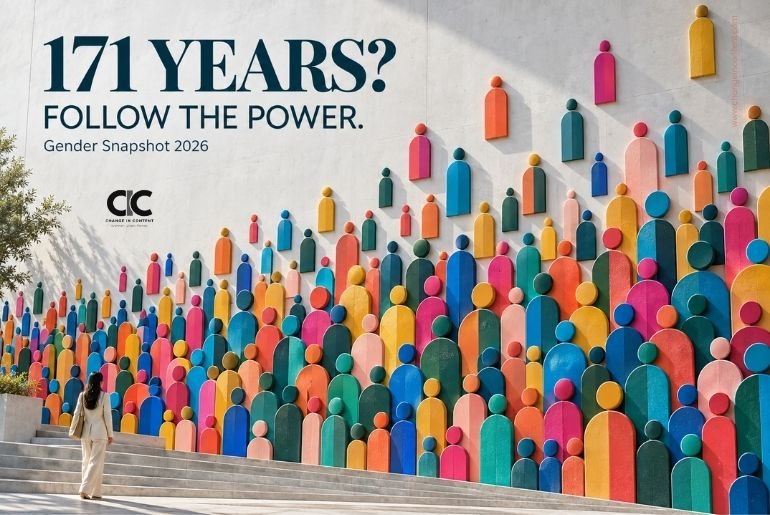
- The Gender Snapshot 2026, published by UN Women and UN DESA, says not one SDG 5 target is on track for 2030. At the current rate of progress, it estimates that achieving SDG 5 would take 171 years.
- Women hold 27.4% of national parliamentary seats, up from 22.3% in 2015. But local-government representation has stalled at 35.6%, women’s cabinet representation has fallen to 22.4%, and the share of women Speakers of Parliament recorded its first decline in 21 years.
- In a 2026 UN Women survey, 32% of national gender equality mechanisms reported losing institutional power over the previous two years; 23% reported budget cuts and 9% lost an autonomous budget.
- Among people aged 25–54, 63.9% of women were in the labour force in 2026, compared with 92% of men. Women held 30.5% of managerial positions in 2025, but female managers earned less per hour than male managers in 66 of 83 countries and areas with available data.
- Women account for only around 22% of AI professionals globally and fewer than 14% of senior AI leaders. The report warns that today’s technology economy risks carrying existing gender gaps into tomorrow’s institutions.
The Gender Snapshot 2026 is Out
The Gender Snapshot 2026 is only 40 pages long. It somehow makes 2030 feel both very close and extraordinarily far away.
4 years.
That is all that remains before the deadline governments gave themselves to achieve the Sustainable Development Goals.
Now place another number beside it. 171 years.
That is how long the report estimates it could take to achieve SDG 5, the goal dedicated to gender equality and the empowerment of women and girls, if progress continues at its present rate.
There is plenty in the report that could produce alarming headlines.
- Nearly 1 in 3 women has experienced partner or sexual violence during her lifetime.
- Women and girls still perform 2.5 times as many hours of unpaid domestic and care work as men.
- Women hold less than 1/3rd of managerial positions.
- Women account for roughly 1/5th of AI professionals.
- More than a billion women and girls could remain food insecure in 2030.
But reading those numbers one after another risks missing what makes this edition especially important.
The report is really about power.
Who has it. Who still does not. And what happens when the institutions that are supposed to move equality forward begin losing some of their own.
Before anything else: 171 years is not a countdown
Nobody should read this report and mark 2197 in the calendar as the year women finally become equal.
That is not what the number means.
The Gender Snapshot assesses progress against the targets and indicators of Sustainable Development Goal 5. Based on the current trajectory, not one of those targets is on track, and the estimated pace would take 171 years to achieve the goal.
The number can change.
Faster progress makes it shorter. Regression makes it longer.
That also explains why readers who saw the 120 years in the World Economic Forum’s Global Gender Gap Report this week should not compare the two as though one organisation has done the arithmetic incorrectly.
The WEF figure relates to its own Gender Gap Index across economic opportunity, education, health and political empowerment. The UN’s 171-year estimate concerns the different framework and indicators sitting under SDG 5.
Both are really measurements of pace. And both are telling us that the pace remains inadequate.
The Gender Snapshot 2026 changes the question from representation to power
There is progress in political representation.
- Women held 27.4% of national parliamentary seats in 2026, up from 22.3% in 2015.
- 28 countries had a woman Head of State or Government at the beginning of 2026, up from 20 in 2020.
Stop there, and the line moves upwards. Look one level deeper, and the picture becomes much less comfortable.
- Women’s share of national cabinet positions has fallen from 23.3% in 2024 to 22.4% in 2026.
- Women hold 35.6% of seats in local governments, but that figure has barely moved since 2023.
- Only 54 women were serving as parliamentary Speakers at the beginning of 2026, 19.9% of the total. Their share dropped by almost four percentage points in one year, the first decline in 21 years.
Then look at which responsibilities women receive once they become ministers.
Women chair more than two-thirds of parliamentary committees concerned with gender equality, but fewer than one in five defence committees and just 17.2% of finance committees.
At cabinet level, men continue to dominate finance, defence, foreign affairs, justice and home-affairs portfolios.
Presence and authority are clearly not identical.
We examined the first signs of this reversal just before the report appeared in our story on women’s leadership losing ground globally. The completed Gender Snapshot now shows that the problem reaches well beyond a handful of political percentages.
The justice system reveals the same pattern
Here is one of the report’s more surprising findings.
Women actually constitute 51.2% of judges, and 57.5% of registrars in the data analysed. Then the hierarchy narrows.
Women are only 29% of prosecutors. And among 175 Chief Justices across the apex judicial institutions covered, 144 are men, and 31 are women. Fewer than 1 in 5 Chief Justices is a woman.
This pattern is increasingly familiar.
- Women enter an institution.
- They become visible.
- They sometimes reach parity at large.
- Then representation falls as the positions acquire greater authority.
The report finds a similar gap inside public administration. Women were underrepresented relative to their population share in public-service positions in 62.1% of countries and areas with data. At lower administrative levels, gender disparity appeared in 13.8% of countries. At senior management levels, it appeared in 71.1%.
The glass ceiling is often discussed as though it belongs primarily to corporations. The Gender Snapshot 2026 finds versions of it in governments, courts and public institutions too.
One of the report’s most important findings is about institutions nobody sees
National gender equality mechanisms do not make many headlines. They may be ministries, commissions, directorates, specialist units or other state institutions responsible for ensuring that gender equality enters laws, budgets and government programmes.
They are part of the machinery behind the promise. And some of that machinery is weakening.
In UN Women’s 2026 survey, 32% of national gender equality mechanisms said their institutional power had eroded over the previous two years. The reported changes included staff downsizing, weaker influence over decisions, reduced or eliminated units, lower institutional status and reassignment of mandates.
Almost 1 in 4 reported lower operating budgets. 9% lost an autonomous budget.
This might be the most consequential finding that receives the least public attention.
- A country can retain the department.
- Keep the name on the door.
- Maintain the commitment on paper.
- And slowly remove its ability to do very much.
That is a different form of regression from repealing a law. It is quieter.
Money is disappearing too
The institutional problem is accompanied by a funding problem.
Bilateral allocable official development assistance with gender-equality objectives fell 13% between 2023 and 2024, reaching its lowest volume since 2021.
Funding for women’s rights organisations fell 28% over the same period. And these organisations had historically received less than 1% of development assistance directed towards gender equality in the first place.
Only 15% of funding allocated to gender-equality projects was associated with women’s leadership initiatives.
Money does not guarantee equality. But budgets tell us what institutions are capable of attempting.
There is little use in giving an organisation responsibility for changing a system while steadily reducing its capacity to act.
Work is improving. The gap follows women upwards.
For Change in Content readers, the employment section deserves particular attention.
Between 2015 and 2026, women’s labour-force participation increased in 128 of 186 countries, and the gender participation gap narrowed in 135.
That is real progress. But among people aged 25–54, only 63.9% of women were participating in the labour force in 2026, compared with 92% of men. And getting into the labour market does not settle the question.
Women held 30.5% of managerial positions globally in 2025, up from 26.9% a decade earlier. Yet in 66 of 83 countries and areas with comparable data between 2020 and 2025, female managers earned less per hour than male managers.
That is a useful correction to one persistent assumption: promotion does not automatically end inequality.
- A woman can acquire the title and still encounter the pay gap.
- She can reach management and remain underrepresented in the rooms above it.
- She can enter formal work and still carry disproportionately more unpaid work outside it.
The report itself puts the point plainly in substance: getting women into leadership is necessary, but the systems governing pay, assets and workplace power have to change as well.
The care gap barely needs introducing anymore. That is part of the problem.
Women and girls still spend 2.5 times as many hours as men on unpaid domestic and care work.
There is something troubling about how familiar that statistic has become. We read it. Nod. Move to the next number. Still, time is one of the mechanisms through which every other gap operates.
- Time affects whether someone works.
- Whether she trains.
- Travels.
- Networks.
- Accepts the promotion.
- Starts the business.
- Stays late.
- Runs for office.
- Learns AI.
- Or has enough uninterrupted hours to build expertise.
Our recent guide to redistributing women’s unpaid care work looked at this problem in India through the Time Use Survey. The Gender Snapshot reminds us that the underlying imbalance is global.
Time is not merely another gender statistic. It is a resource from which many of the other statistics are made.
Then there is the economy being built for tomorrow
Some gaps in the Gender Snapshot are very old. AI is not one of them.
- Women comprise only around 22% of AI professionals globally and fewer than 14% of senior AI leaders.
- The report also cites global studies covering more than 140,000 people, suggesting women are around 20% less likely than men to use generative AI tools.
- Further upstream, women represented only 31.4% of researchers globally in 2023.
- Between 2020 and 2025, women outnumbered men among graduates from tertiary STEM programmes in only 8 of 118 countries examined.
- And only about a quarter of ministerial portfolios covering research, science, innovation and technology are held by women.
That is where the Gender Snapshot becomes a report about the future rather than simply a report card on the past.
The world’s AI systems, digital infrastructure and emerging technology regulation are being designed now. The gender composition of the people building and governing them will not correct itself later merely because somebody finally notices the imbalance.
Our recent analysis of women and the AI jobs boom explored this opportunity gap precisely. The Gender Snapshot broadens the issue from employment into research, entrepreneurship, capital and technology governance.
Entrepreneurship has its own narrowing gate
There is another number worth watching.
The global share of start-ups with at least one woman or non-binary founder fell from 19.9% in 2015 to 18.1% in 2024. Those founders raised 37.5% less capital than start-ups founded exclusively by men, according to evidence cited in the report.
It matters because entrepreneurship is sometimes presented as the escape hatch from organisational inequality.
Cannot break the corporate ceiling?
- Build your own company.
- Except building a company requires capital.
- Networks.
- Technology.
- Customers.
- Time.
- And access to another set of decision-makers.
Leaving one structure does not necessarily mean leaving every structural gap behind.
And yet, this is not a report in which nothing got better
It would be easy to read 171 years and conclude that the past decade produced little. The report does not support that conclusion.
Between 2019 and 2024, 99 legal reforms across 47 countries removed discriminatory provisions or strengthened gender-equality frameworks. Many concerned employment, equal pay, recruitment, ownership and inheritance.
Maternal mortality fell by almost 40% between 2000 and 2023.
Skilled birth attendance rose from 60.7% to 87.2% between 2000 and 2025.
Women’s financial access has changed dramatically in lower- and middle-income economies too. The share of women holding a financial account rose from 50% in 2014 to 73% in 2024.
Women have gained more parliamentary seats. More have entered management.
Labour-force gaps narrowed in most countries for which the report tracks the decade.
Even the data infrastructure has improved: availability of SDG 5 data has risen from 19.3% in 2019 to 56.6% since 2015, allowing far more countries to measure areas including local-government representation and discriminatory legal frameworks.
Progress exists. The report’s warning is that progress is neither fast enough nor secure enough to be left on autopilot.
Compare that with what we were writing a year ago
Our 2025 Gender Snapshot analysis concentrated heavily on poverty, hunger, unpaid care and the risk of missing the 2030 deadline. Those problems have not disappeared. But this year’s report gives the discussion a different centre of gravity.
Leadership. Institutions. Budgets. Decision-making.
The shift is useful. We have spent years measuring what inequality does to women. The 2026 report spends much more time asking: Who controls the systems capable of changing it?
This is where organisations should pay attention
A company obviously cannot solve 17 Sustainable Development Goals. But the report contains a useful organisational test.
Do not ask only how many women work here.
- Ask where authority begins to thin.
- Do women enter management but encounter a pay difference?
- Do they appear in leadership but remain concentrated in people functions rather than P&L or technology?
- Are they being trained for AI adoption, or mainly working in roles most exposed to technological change?
- Does flexibility exist without progression?
- Does the organisation fund inclusion when business conditions are good and quietly reduce it when budgets tighten?
- And, perhaps most importantly: Who owns the outcome?
The Gender Snapshot’s warning about weakened national gender institutions has a corporate parallel.
An inclusion function can exist. A women’s network can exist. And a policy can exist. None of them has much power if the budget, authority and senior accountability disappear.
Change in Perspective: Equality Is Not Stuck Everywhere. It Is Stuck Where Power Concentrates.
That may be the most useful way to read the Gender Snapshot 2026.
Women have made progress.
- They are more represented in parliaments than a decade ago.
- More women have financial accounts.
- More discriminatory laws have been reformed.
- Maternal health has improved dramatically over the longer term.
- More women are managers.
Those gains matter. But follow the data upwards.
- From employee to manager.
- From judge to Chief Justice.
- From parliamentarian to Speaker.
- From minister to finance minister.
- From technology user to AI developer.
- From founder to funded founder.
- From gender institution to the budget that determines whether it can function.
Again and again, representation narrows as authority increases.
That is why 171 years cannot be reduced to another gloomy countdown. It tells us something much more actionable. We increasingly know where the distance is. It lies in time. Money. Technology. Institutions. And power.
The next 4 years will not deliver every promise made for 2030. The data already makes that clear. But 2197 is no more inevitable than 2030 was guaranteed.
A timeline is produced by a rate of change. Rates can accelerate.
The Gender Snapshot has given us the map. What happens to the distance now depends on who is willing, funded and empowered to move it.
Editorial Note & Sources
The Gender Snapshot 2026 is produced jointly by UN Women and the United Nations Department of Economic and Social Affairs and covers gender equality across all 17 Sustainable Development Goals. Different indicators use different reference years according to the latest internationally comparable data available. The report’s 171-year estimate relates specifically to progress towards SDG 5 at the current rate and should not be confused with the World Economic Forum’s separate 120-year estimate for global gender parity under the Global Gender Gap Index. Neither figure is a fixed prediction.
Sources
UN Women & United Nations Department of Economic and Social Affairs: Progress on the Sustainable Development Goals: The Gender Snapshot 2026, September 2026. The primary report used throughout this article, covering all 17 SDGs, women’s leadership, work, care, violence, technology, health, climate, finance and the SDG 5 tracker.
United Nations Statistics Division: The Gender Snapshot 2026. Official report landing page and overview of the 2026 findings, including the focus on leadership, decision-making and institutional power.
UN Women: Progress on the Sustainable Development Goals: The Gender Snapshot 2026. Official UN Women publication record for the joint UN Women–UN DESA report and supporting technical material.
United Nations: SDG 5 Tracker and technical documentation, 2026. Official methodology underlying assessment of progress across SDG 5 targets and indicators, accessed through the UN Statistics Division Gender Snapshot portal.
