The Brief
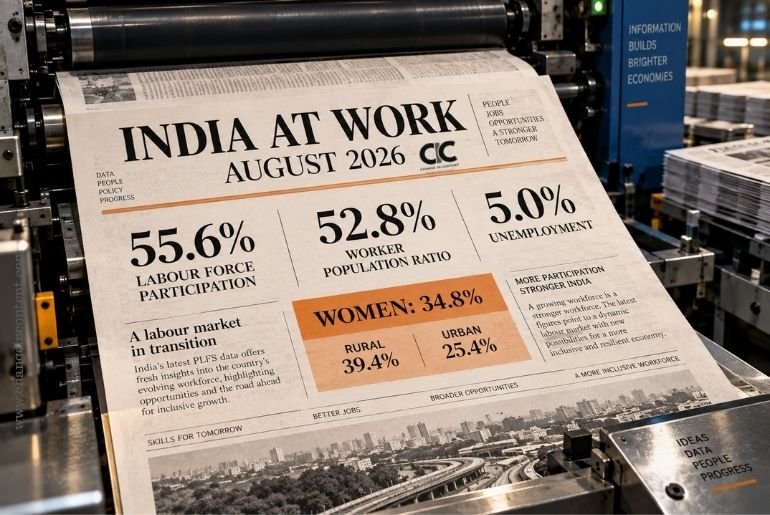
- The PLFS Monthly Bulletin August 2026 puts India’s overall Labour Force Participation Rate for people aged 15 and above at 55.6%, up from 55.4% in July and 55.0% a year earlier.
- Female LFPR increased for the second consecutive month, from 34.4% in July to 34.8% in August. A year earlier, it was 33.7%.
- Rural women drove most of that improvement. Female LFPR in rural India rose to 39.4%, while the urban female rate was broadly flat at 25.4%. Compared with August 2025, rural female LFPR is up 2 percentage points, while urban female LFPR is down 0.7 percentage points.
- India’s overall Worker Population Ratio rose to 52.8%, the highest level recorded since March 2026. Female WPR also improved year-on-year, from 32.0% to 33.0%.
- Overall unemployment eased marginally to 5.0%. Rural unemployment fell to 4.1%, its lowest since January 2026, while rural female unemployment fell from 4.3% to 3.9%.
PLFS Monthly Bulletin from August 2026
India’s labour market moved a little further in August. Not dramatically. But in the right direction on several important measures. More people were participating in the labour force. A larger share of the population was working. Rural unemployment declined. And women’s labour-force participation rose for the second month in succession.
The PLFS Monthly Bulletin from August 2026, released by the Ministry of Statistics and Programme Implementation, places the all-India Labour Force Participation Rate at 55.6%, compared with 55.4% in July. The Worker Population Ratio rose from 52.5% to 52.8%, while unemployment eased from 5.1% to 5.0%.
For women, the headline is also positive. Female LFPR reached 34.8%. But, once again, the national figure conceals two rather different employment stories.
Female LFPR has risen for 2 months running
June had put female labour-force participation at 32.7%. July took it to 34.4%. August has now moved it to 34.8%.
The year-on-year movement is also positive. Female LFPR was 33.7% in August 2025, meaning participation is now 1.1 percentage points higher.
Female employment has risen too. The female Worker Population Ratio reached 33.0%, compared with 32.0% a year earlier. That distinction matters.
LFPR measures women who are working or seeking/available for work. WPR tells us how many are actually working. When both move upwards, the data offers a stronger signal than participation rising on its own.
Our July PLFS analysis had identified the rebound in women’s participation after a weaker June. August suggests that improvement did not immediately disappear.
But rural India is still doing most of the lifting
This is the most important detail in the August release.
- Female LFPR in rural areas rose from 38.8% in July to 39.4% in August.
- Urban female LFPR barely moved: 25.3% to 25.4%.
The year-on-year comparison makes the divergence clearer.
- In August 2025: Rural female LFPR: 37.4%. Urban female LFPR: 26.1%
- In August 2026: Rural female LFPR: 39.4%. Urban female LFPR: 25.4%
Rural women’s participation therefore rose by 2 percentage points over the year. Urban women’s participation fell by 0.7 percentage points.
That does not make the rural gain less significant. It does tell policymakers and employers where the stubborn part of the problem remains.
Why the urban female number deserves attention
A quarter of urban women aged 15 and above are participating in the labour force under the monthly Current Weekly Status measure.
That number has not materially improved across the past several monthly releases. It matters because urban India should, in theory, contain many of the conditions associated with women’s employment: expanding service sectors, formal jobs, higher education, technology, financial services, professional employment and denser labour markets.
Yet access to jobs is only one part of the equation.
The recent Change in Content analysis on why fewer women work in India looked more closely at the mixture of labour demand, care, commuting, job quality, social expectations, education and household economics that can shape women’s participation.
The monthly PLFS cannot tell us which of these explains August’s urban number. It tells us where to keep looking.
Rural employment strengthened more broadly
The rural improvement goes beyond women. Overall rural LFPR rose to 58.2%, compared with 58.0% in July and 57.0% in August 2025. Rural WPR increased to 55.8%, up from 55.4% in July and 54.5% a year earlier.
At the same time, rural unemployment fell from 4.5% to 4.1%, its lowest recorded level since January 2026.
Read together, these numbers are encouraging. More people were participating. More were working. And a smaller proportion of the rural labour force was unemployed.
Among rural women specifically, unemployment fell from 4.3% in July to 3.9% in August.
A low unemployment rate still needs careful interpretation
This is particularly important when reading women’s labour data. An unemployment rate of 3.9% among rural women does not mean that almost every rural woman has a job.
The unemployment rate is calculated only among people who are in the labour force. Women outside the labour force are not counted as unemployed. That is why LFPR, WPR and unemployment need to be read together.
For women especially, participation can tell us something that the unemployment rate cannot: how many women are economically active or trying to become so in the first place.
This distinction has become central to Change in Content’s labour-market coverage because an apparently low unemployment number can coexist with low participation.
Urban India remained comparatively flat
For the overall urban labour market, August was quieter.
Urban LFPR remained unchanged from July at 50.4%. Urban WPR also stayed at 47.0%. And urban unemployment was broadly stable at 6.8%, compared with 6.7% in July.
Compared with August 2025, both urban participation and employment are slightly lower: LFPR has moved from 50.9% to 50.4%, while WPR has moved from 47.5% to 47.0%.
The contrast with rural India is therefore not limited to women. August was, to a significant extent, a rural labour-market improvement story.
What August adds to India’s women-at-work story
One month should never be asked to prove a structural change. But consecutive months begin to establish something worth watching.
Female LFPR: June: 32.7%. July: 34.4%. August: 34.8%
Women’s labour-force participation has recovered meaningfully from June.
Female unemployment has also fallen from 5.9% in June to 5.1% in August.
The question now is whether the improvement holds through subsequent months and, more importantly, what kind of employment sits behind the rise.
That second question matters because participation alone does not tell us whether a woman has entered salaried work, self-employment, agriculture, a household enterprise or another form of work.
Our recent analysis of the rise in women at work in India made precisely this distinction: India’s participation gains are significant, but the next stage is about income, formality, ownership, stability and mobility.
And the monthly number is not the same as the annual 40%
Readers may reasonably ask another question. If India’s female LFPR was 40% in the 2025 annual PLFS, why does August 2026 say 34.8%? Because they are not the same measure.
The monthly PLFS uses Current Weekly Status, based on a person’s economic activity during the preceding seven days.
The annual headline commonly cited uses usual status, which looks over a much longer reference period.
Someone who worked during part of the year but not during the survey week can therefore be represented differently under the two measures.
The August bulletin itself specifies that its LFPR, WPR and unemployment estimates use Current Weekly Status.
This is not a contradiction in the data. It is a difference in measurement.
Policy Pulse: August is encouraging. The geography of the improvement matters.
The August bulletin gives India several positive employment signals.
- Overall participation is higher.
- The share of people actually working is at its strongest level since March.
- Rural unemployment has fallen.
- Female participation has increased for a second month.
- Female employment is higher than it was a year ago.
Those developments deserve to be reported as progress. But the same release also contains a clear policy signal.
The improvement among women remains heavily rural. Urban female LFPR is 25.4%, almost exactly where it was in July and below its level a year ago.
For a labour market that wants to draw more women into formal services, manufacturing, technology, retail, logistics and professional employment, that is the number worth carrying into the next bulletin.
India does not have one female employment story. August makes that clearer again.
Editorial Note & Sources
Monthly PLFS estimates use the Current Weekly Status (CWS) approach and should not be directly compared with annual usual-status indicators without identifying the different reference periods. Unemployment is measured as a proportion of the labour force, not of the entire population aged 15 and above. The August 2026 monthly estimates are based on 3,70,160 persons, including 2,11,353 in rural areas and 1,58,807 in urban areas.
Sources
- Ministry of Statistics & Programme Implementation/Press Information Bureau: Press Note on Periodic Labour Force Survey Monthly Bulletin, August 2026, 15 September 2026. Primary source for all August LFPR, WPR, unemployment, rural–urban and gender indicators used in this article.
- Ministry of Statistics & Programme Implementation/PIB: PLFS Monthly Bulletin, July 2026. Primary comparison source for month-on-month movements between July and August.