
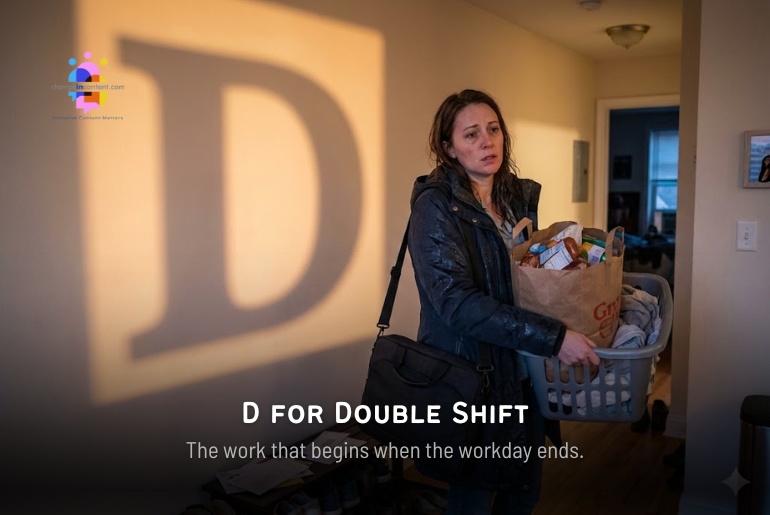
In the fourth chapter of our A–Z Year-End Glossary, we turn to a reality that defines the lives of millions of working women: the Double Shift. It is the unpaid, often invisible second job that begins when the paid one ends. Long after laptops shut down, women step into another full workload. This load includes cooking, cleaning, caregiving, planning, and carrying the mental load that keeps households running.
If A explored ambition, B tackled bias, and C uncovered early social training, D exposes the everyday exhaustion that robs women of rest, growth, and even joy. The Double Shift is not a personal failing or a matter of “time management.” It is gendered labour, baked into expectation.
D for Double Shift: The hidden, unpaid second job
Most working women live this double shift routine. She may be a wife, a mother, a sister, an aunt, or even the eldest daughter. She finishes her office work, then jumps straight into the long list of unpaid tasks at home. Cooking, cleaning, caring for family members, and handling the invisible mental load all fall on her shoulders. Moreover, this double shift wears them out, reduces their rest time, and often holds them back from reaching their full potential.
What do we mean by the double shift?
So what is the double shift? It is the reality of how full-time working women still do most unpaid housework and childcare. They finish one job in the office, then start another job the moment they step inside their house. Cooking, cleaning, childcare, elder care, planning, scheduling, and emotional labour.
People also call it the second shift, a term popularised by sociologist Arlie Hochschild in her 1989 book, The Second Shift: Working Families and the Revolution at Home. Many women worked eight hours for pay and then spent another eight hours running the home.
Even with today’s better policies on full-time work for women, fair treatment in the workplace, and the right to paid maternity leave, old gender expectations have not brought about any progressive change. In most homes, the man or partner still does not step in and share the load. So a woman may be a manager in the office, but at home she still carries most of the daily chores while her partner does far less.
How the double shift wears women down
The double shift impacts women in ways people rarely talk about. Working women keep asking themselves whether they can advance in their careers and still be good mothers or wives. Even when a partner helps a lot, a small voice still whispers in a woman’s head. It tells her to pick up groceries, plan the kids’ weekend, finish small chores, and stay one step ahead. It is internalised guilt that society hands to women from a young age, and it turns into a heavy mental load.
Research shows how deep the internalised guilt goes. A 2024 study by Abraham, along with Vijayamba R, Assistant Professor at NLSIU, and Srinivas Raghavendra, Associate Professor at Azim Premji University, looked at urban graduate women. They discovered that for every hour a woman spends at her salaried job, she ends up doing 6.6 extra minutes of unpaid housework. Abraham noted that this happens because women feel they need to compensate for the time they spend away from home, even though they earn and contribute just as much as their partners.
For decades, study after study has shown that women do much more housework and childcare than men. Full-time working women often end up doing a second full-time job at home. India’s 2024 Time Use Survey showed that women and girls above the age of six spent about 426 minutes a day on unpaid domestic and care work, almost the same as in 2019. They spent 341 minutes on paid work.
The double shift also affects their health and happiness. A 2024 IndiaSpend report found that married working women get far less time for rest, hobbies, friends, and even basic self-care compared to married working men. Mothers, especially, feel the pressure. They are 1.5 times more likely than fathers to spend an extra three hours a day on household work and childcare. Moreover, 10% more single mothers reported spending an additional 3 hours on housework and care work than mothers overall.
Equal effort matters at work and home
Companies can do a lot to reduce the double shift for women. When they create flexible hours, normalise work from home when needed, and treat caregiving as a shared responsibility, women stop feeling like they juggle two full-time jobs. These steps also help fathers because flexibility becomes normal for everyone, not just mothers. It means fathers feel free to adjust their schedules, take leave, or handle school runs and doctor visits. When companies support all parents equally, fathers take on more of the home duties, reducing the burden on women.
When both partners work the same number of hours, it makes sense for both to share the same amount of housework, childcare, and daily planning. This balance gives women more rest, more time for themselves, and more space to grow in their careers. It also teaches families that home duties are not “women’s work.” They are life skills that everyone should handle. When men step in entirely, the load becomes lighter, the stress goes down, and the home becomes a fair place instead of a second job for women.
The final thoughts on the double shift
The double shift shows that progress at work does not automatically translate into progress at home. Even as women gain better policies, fair treatment, and career opportunities, old expectations at home continue to weigh heavily. The unpaid second shift affects their time, energy, health, and even their sense of self. But change is possible. Companies can play a key role by supporting flexible hours, gender-neutral caregiver leave, and normalising work-life balance for all parents. When both partners share the load, women gain rest, freedom, and space to grow, while homes become fairer for everyone.
Changeincontent will be back with the following letter in the glossary, exploring another challenge working women face every day.
Changeincontent perspective
The Double Shift is a reminder that gender equality cannot be measured only by office policies or leadership pipelines. Progress at work means little if the home remains frozen in old ideas of who must nurture, clean, plan, remember, and anticipate. At Changeincontent, we believe the real revolution begins when labour inside the home is treated with the same respect as labour outside it. As long as women carry two jobs, they will keep paying for inequality with their sleep, energy, ambition, and health. Shifting the load is not generosity — it is justice.
Disclaimer: The views expressed in this article are based on the writer’s insights, supported by data and resources available both online and offline, as applicable. Changeincontent.com is committed to promoting inclusivity across all forms of content. We broadly define inclusivity as media, policies, law, and history. It encompasses all elements that influence the lives of women and marginalised individuals. Our goal is to promote understanding and advocate for comprehensive inclusivity.
