
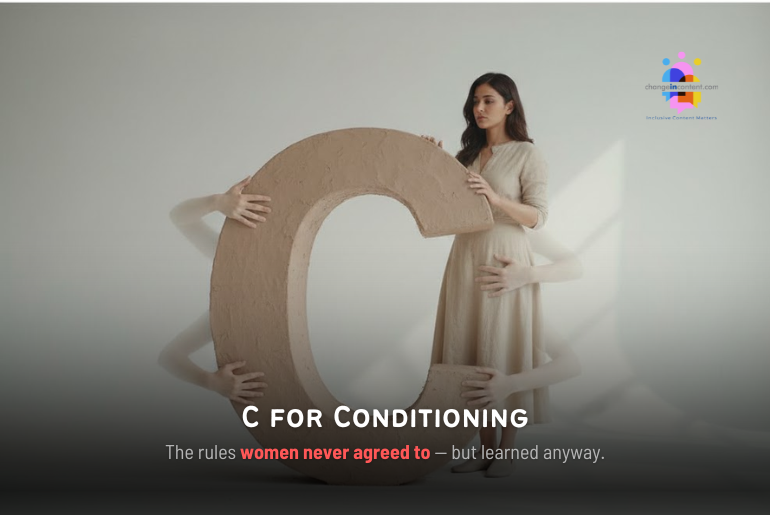
In the third chapter of our A–Z Year-End Glossary, we look at a force so familiar that most women mistake it for personality: Conditioning. It starts early, long before job titles or workplace hierarchies enter the picture. Girls are taught to be agreeable, careful, and endlessly accommodating. And those lessons quietly follow them into conference rooms, performance reviews, negotiations, and leadership roles.
If A was ambition reclaimed, and B exposed the systems that hold women back, C explains why so many of those barriers feel personal instead of structural. Conditioning is not just about behaviour. Instead, it shapes who women are allowed to be, and how confidently they can take up space.
How conditioning limits women at work
Conditioning affects how women see leadership and how others see their potential to lead. From childhood, many girls hear messages that push them toward caregiving roles, while boys hear messages that reward assertiveness and ambition. Below are the most common types of workplace conditioning women face.
The “Don’t Be Difficult” Conditioning
How honest can I be without upsetting someone? That pressure makes women soften their words, apologise before giving feedback, or take on extra work just to avoid conflict. It quietly erodes their authority.
Will they think I’m rude? Am I being too direct? Will this make people uncomfortable? That split-second hesitation gives others room to question their credibility. A man can walk into a meeting, point out what’s not working, and walk out with authority. A woman can say the same thing and spend the rest of the day managing comments like, “She’s in a mood,” or “She could’ve said that nicer.”
Assertiveness is not hostility. Being direct is not being difficult. You’re doing your job, just like everyone else.
Microaggression Conditioning
Microaggressions are something women face so often in their workplace. A woman speaks in a meeting, and someone cuts her off mid-sentence. She presents an idea, and the group ignores it until a man repeats the same point later, and suddenly everyone loves it. A new colleague assumes she’s the intern or the assistant, even when she’s the most senior person in the room.
Microaggressions also shift how others see women. When a woman’s ideas get ignored or misattributed, people start believing she contributes less. When she gets cut off repeatedly, colleagues start thinking she has less to say. That’s why reclaiming space matters so much. The more consistently women claim their voice in these moments, the harder it becomes for teams to erase or overlook them.
The Likability Trap
The likability trap shows up the moment a woman steps into a position of authority. When she leads with confidence, people often describe her as harsh, cold, or intimidating. When she tries to sound warmer or more collaborative, those same people question her capability or assume she lacks control. She can’t win either way.
Women often feel pressure to justify every choice to avoid being seen as bossy. However, don’t over-explain your decisions. People may debate your tone, but they can’t argue with the results.
Emotional Labour Conditioning
In most organisations, women end up carrying the invisible work of keeping teams emotionally steady. They step in when colleagues are upset, smooth tension after disagreements, mentor juniors who need guidance, and maintain the small rituals that keep teams bonded. None of this appears in job descriptions, yet teams come to depend on it.
Over time, women are conditioned to think this work is simply part of who they are, rather than additional labour on top of their actual responsibilities. This work matters, but it drains energy and rarely counts in performance reviews.
The most effective advice here is to set boundaries so that the team remembers emotional labour is still labour. It forces colleagues and managers to see the work for what it is, rather than treating it as an automatic service from women.
The final thoughts: Breaking the cycle
Every time a woman questions her right to speak, hesitates before giving feedback, takes on emotional labour she never agreed to, or worries more about being liked than being respected, the cycle will never break.
It’s time to break that cycle. Women shouldn’t lose professional opportunities because they were raised to stay agreeable, accommodating, and endlessly available. Workplaces shouldn’t benefit from women’s silence or exhaustion. And young girls shouldn’t grow up learning that ambition has limits or that authority comes with punishment.
Every boundary, every direct sentence, every “No, that won’t work for me,” rewrites expectations not just for today’s workforce, but for the generation entering it next.
Changeincontent will return with the following letter in the glossary, exploring another challenge that working women face every day.
Disclaimer: The views expressed in this article are based on the writer’s insights, supported by data and resources available both online and offline, as applicable. Changeincontent.com is committed to promoting inclusivity across all forms of content. We broadly define inclusivity as media, policies, law, and history. It encompasses all elements that influence the lives of women and marginalised individuals. Our goal is to promote understanding and advocate for comprehensive inclusivity.
