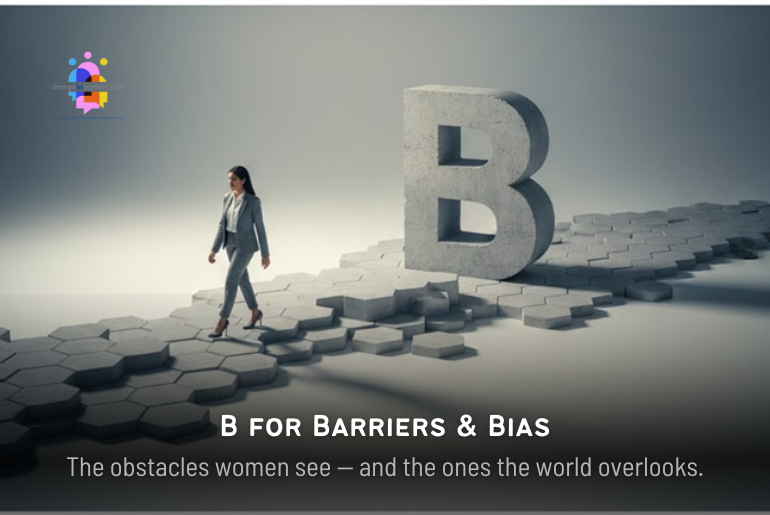
As we move to the second chapter of our A–Z Year-End Glossary, we confront what stands between ambition and opportunity: the Barriers and Bias. It shapes women’s everyday experiences at work. Some are loud and undeniable. Others are quiet, polite, and disguised as “normal”. Together, they decide who gets heard, who gets promoted, and who is asked to wait their turn.
If A was about reclaiming ambition, B is about the forces that try to shrink it. From small slights to structural inequality, this chapter is about the invisible rules women are expected to follow, and why naming them is the first step in breaking them.
B for Barriers and Bias: The hidden obstacles for women at work
So, how many biases and barriers do women actually face at work? A study that surveyed 900 women leaders in healthcare, higher education, law, and nonprofit organisations tried to find out. It identified at least 30 different kinds of bias.
These 30 types of bias cover everything from body size and marital status to communication style, clothing, and even accent. It shows how discrimination isn’t just about appearance or age. It can extend to how a woman speaks, leads, or expresses herself.
Now, that study only looked at a small group of women in specific professions. If we think about the global workforce, where women make up more than 40% of all workers, the number of barriers is likely much higher. And that’s without counting the millions of women who work in informal or undocumented jobs, where inequality is often worse.
The Gender Social Norms Index (GSNI) confirms that these biased attitudes haven’t changed much in the past decade. Almost 9 out of 10 people around the world, both men and women, still hold at least one bias against women. Half of all respondents believe men make better political leaders, and more than 40% think men are better suited for top business roles.
How many biases do women still face at work?
Even with years of progress toward gender equality, women continue to face barriers that affect their careers and personal lives. Below are some of the most common biases that women continue to experience in professional spaces.
Pay bias
Unequal pay remains one of the most persistent challenges for working women. According to the World Economic Forum, closing the global gender pay gap will take another 132 years if progress continues at the current pace.
India ranks 135 out of 146 in the Global Gender Gap Index (2022). Data from the World Inequality Report (2022) shows that men earn about 82% of total labour income, while women earn only 18%. The Periodic Labour Force Surveys (2019–2023) also reveal that this difference exists across all kinds of employment, with the self-employed men earning 2.8 times more than women in the same category.
Sexual harassment and discrimination
Sexual harassment and discrimination continue to create unsafe work environments for many women. Studies show that one in three women face either physical or sexual violence in their lifetime, from a partner or a non-partner.
In India, the Prevention of Sexual Harassment (POSH) Act, 2013, was introduced to create safer workplaces and ensure women have access to proper redressal systems. However, awareness and implementation often remain limited, especially in smaller organisations and informal sectors. (Read more about POSH here)
Double standards and expectations
Double standards continue to influence how women are judged compared to men. In many workplaces, men who speak up or take charge are seen as confident and capable, while women who do the same are labelled “bossy” or “too aggressive.”
One study found that men who assert themselves are often viewed as natural leaders, but women are penalised for doing the same. This double standard also appears in performance reviews and promotions, where we reward men for potential and evaluate women on how docile or soft-spoken they are.
Such expectations can limit women’s chances to grow. Many feel pressure to stay polite, agreeable, and cautious just to fit in, even when those traits are not linked to performance. Over time, this makes it harder for women to take risks, ask for opportunities, or be recognised for leadership.
B for Bias: Naming it is just the beginning
These are only a few examples of the many barriers women face at work. The list is far longer and often overlaps with factors such as race, age, menstruation, maternity, class, or ability. Over the coming weeks, the rest of this glossary will explore more of these biases through words that capture the everyday realities of women at work.
Progress begins with awareness. For women, that means learning to recognise bias when it happens and speaking up with confidence. Building networks, supporting one another, and asking for what is fair are small but powerful ways to shift culture from within. For organisations, the next step is to move beyond awareness and act. Regular pay audits, safer reporting systems, inclusive leadership training, and open conversations about bias are commitments that help build better workplaces.
Changeincontent perspective on barriers and bias
Barriers and bias do not disappear just because we have learned to label them. They disappear when organisations stop treating them as “women’s issues” and start recognising them as structural failures.
At Changeincontent, we believe accountability must move beyond policies and statements. It must live in the daily decisions leaders make. It must show in whose voice we amplify, whose potential we nurture, whose mistakes we forgive, and whose ambition we allow to be real. Until then, women will continue fighting an uneven battle that the system pretends not to see.
Also read: The A–Z of women & work: A year-end glossary | A for Acquisitive Mindset.
Disclaimer: The views expressed in this article are based on the writer’s insights, supported by data and resources available both online and offline, as applicable. Changeincontent.com is committed to promoting inclusivity across all forms of content. We broadly define inclusivity as media, policies, law, and history. It encompasses all elements that influence the lives of women and marginalised individuals. Our goal is to promote understanding and advocate for comprehensive inclusivity.