
The Quick Read
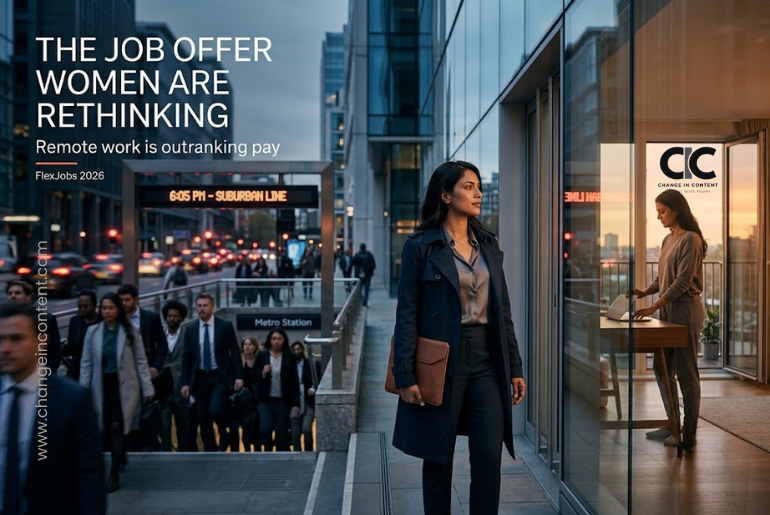
- Women prioritise remote work when choosing the single most important factor in a new job, according to a 2026 FlexJobs survey of more than 1,700 US workers.
- 37% of women chose remote work as their top priority, compared with 24% who chose compensation.
- Among men, compensation ranked first at 31%, while remote work followed closely at 30%.
- When deciding whether to apply for a role, 78% of women consider remote-work options, 66% consider salary, and 64% consider flexible schedules.
- The findings do not mean women are willing to accept poor pay. They suggest that location, time and control over the working day increasingly form part of how women assess compensation itself.
- The Indian context makes that conversation particularly relevant because women continue to carry substantially more unpaid domestic and caregiving work than men.
Women prioritise remote work over pay
For decades, job offers have been built around a familiar assumption: show people the money. Women may be rewriting that equation.
New research from FlexJobs finds that women prioritise remote work over compensation when asked to identify the single most important factor in a prospective job. Remote work was chosen by 37% of women, while 24% selected compensation and another 17% chose flexibility.
Men answered differently. Compensation ranked first at 31%, narrowly ahead of remote work at 30%.
That makes remote work unusually powerful in women’s career decisions. But interpreting the finding as “women will take less money to stay home” would miss almost everything interesting about it.
The stronger reading is that women are increasingly placing a monetary value on control over where and when they work.
What did the FlexJobs survey actually find?
FlexJobs surveyed 1,701 US workers between 9 and 22 June 2026. Women made up 70% of respondents, men 27%, while the remainder preferred another description or did not identify their gender. More than half of those surveyed were experienced professionals, and nearly one-third had children under 18 living at home.
When respondents were allowed to consider several factors while deciding whether to apply for a job, the difference between women and men became clearer.
| Job consideration | Women | Men |
| Remote work | 78% | 70% |
| Salary | 66% | 68% |
| Flexible schedules | 64% | 49% |
| Work-life balance | 55% | 48% |
| Benefits | 46% | 39% |
Salary remains highly important to women. The 66% figure leaves little room to argue otherwise.
What changes is its position inside a broader calculation. Women were 15 percentage points more likely than men to consider flexible schedules, the largest gender difference recorded in this part of the survey.
The job is no longer being evaluated only by what appears in the salary column. The commute counts. So does schedule control. So does whether a parent can pick up a child, attend an appointment, or finish work without giving away another two hours to travel.
Why might remote work carry more value for women?
FlexJobs found other differences that help explain the result.
Women reported greater workplace stress: 33% said they felt stressed often or very often, compared with 24% of men. They were also more likely to report financial pressure, despite placing remote work ahead of compensation when choosing their single biggest job priority.
Remote work does not necessarily compete with financial wellbeing. For some women, it may contribute to it.
Working remotely can reduce:
- Daily commuting costs
- Time spent travelling
- Spending on meals and workwear
- Reliance on paid care for every hour spent outside the home
- The logistical cost of managing appointments or emergencies
There is a time dividend too. An hour saved at either end of the working day can make a substantial difference to someone carrying responsibilities outside work. It does not make remote work a solution to unequal care. It may simply make an unequal system easier to survive.
That distinction deserves attention.
The Indian numbers make the preference easier to understand
The FlexJobs study is American. Its findings should not be presented as evidence of how Indian women would answer the same survey. India does, however, offer a strong reason to take the underlying preference seriously.
The Government of India’s 2024 Time Use Survey found that female participants aged 15 to 59 spent an average of 305 minutes a day on unpaid domestic services, while women participating in caregiving spent around 140 minutes daily, compared with 74 minutes among men who provided care. Women were also almost twice as likely as men to participate in household caregiving: 41% versus 21.4%. That changes the economics of a commute.
For somebody already doing hours of unpaid work, removing travel can determine whether paid employment fits into the day at all.
Change in Content has previously explored what women want from digital work. Flexibility featured prominently, but alongside security, fair income, safety and opportunities to grow. The combination matters. Women do not benefit from flexible work if flexibility becomes the excuse for lower-quality employment.
Remote work can help women stay. It can also make them easier to overlook.
There is a catch. Remote work can remove barriers to employment while creating new barriers to advancement. The employee saves the commute but misses the conversation after the meeting.
She can remain in the workforce while caring for somebody at home, but her office-based colleague becomes more familiar to the manager deciding who gets the next assignment. She gains flexibility and loses visibility.
Change in Content’s earlier examination of the work-from-home gender gap looked at precisely this tension. When unpaid domestic responsibilities remain unequal, working from home can result in women performing paid and unpaid work in the same space, often at the same time.
There is more encouraging evidence too. A recent Swedish study covered by Change in Content found that women reported improvements in autonomy, supportive working conditions and overall work experience after hybrid working was introduced. However, the study involved a relatively small sample and should not be generalised too widely.
The useful workplace model therefore may not be “everyone at home”. It is flexibility without invisibility.
Employers may be pricing job offers incorrectly
Companies competing for women talent often concentrate on salary bands, bonuses and benefits. Those remain fundamental. Equal work still deserves equal pay, and flexibility must never become a cheaper substitute for fair compensation.
But the FlexJobs findings suggest that employers should recognise time autonomy as part of the employment proposition.
A role offering a marginally higher salary but requiring five days of commuting may be less attractive than a comparable remote role. That is not irrational. Workers calculate the value of jobs through money, time, stress, freedom and opportunity. Employers do exactly the same thing when evaluating benefits against costs.
Women are entitled to make the same calculation. For organisations, this creates several practical questions:
Can the job genuinely be performed remotely? If yes, requiring physical attendance needs a stronger reason than habit.
Does flexible work damage promotion prospects? If remote employees receive fewer projects, weaker feedback or less access to leadership, the policy carries a hidden career cost.
Are managers trained to lead distributed teams? Flexibility without good management quickly becomes isolation.
Are outcomes being measured rather than presence? A workplace cannot claim flexibility while treating time in the building as evidence of commitment.
The FlexJobs survey also found that women care strongly about what happens after they join. Feeling valued or recognised influenced engagement for 73% of women, while 58% valued learning opportunities and 57% meaningful work.
Remote work gets someone through the door. It cannot carry an entire career by itself.
The Change Ahead: Women are Pricing Time Differently
The headline says women prefer remote work to salary. The fuller story is more useful.
Women have not suddenly stopped caring about money. Two-thirds of female respondents still considered salary when evaluating whether to apply for a job. They are attaching greater value to something salaries have often ignored: control over time.
For women carrying paid work alongside care, household responsibilities, commuting and everything that happens between them, time is not an abstract wellbeing benefit. It is an economic resource.
Employers should pay attention. Remote work can widen the pool of women able to participate, return after a break or remain employed through different stages of life. But offering flexibility while limiting pay, progression or visibility merely creates another trade-off.
The better future is not one in which women choose between money and flexibility. It is one in which a good job stops asking them to.
Editorial Note and Disclaimer
This article is based primarily on the FlexJobs Women & Men at Work Report, conducted in the United States in June 2026. The survey was promoted through FlexJobs’ general audiences, social media and newsletters, and its respondent profile should be considered when interpreting the findings. Indian context has been added using official Time Use Survey data from the Ministry of Statistics and Programme Implementation. Findings from the US survey should not be assumed to represent Indian workers without comparable research. This article is intended for editorial and informational purposes and does not constitute employment or career advice.
Sources
- FlexJobs: Women’s & Men’s Work Priorities Differ Around Flexibility, Pay & Stability
- Ministry of Statistics and Programme Implementation: Time Use Survey 2024
