
What You Must Know
- Karnataka expanded its Council of Ministers on 3 August 2026, inducting 19 legislators and taking the total strength to 33.
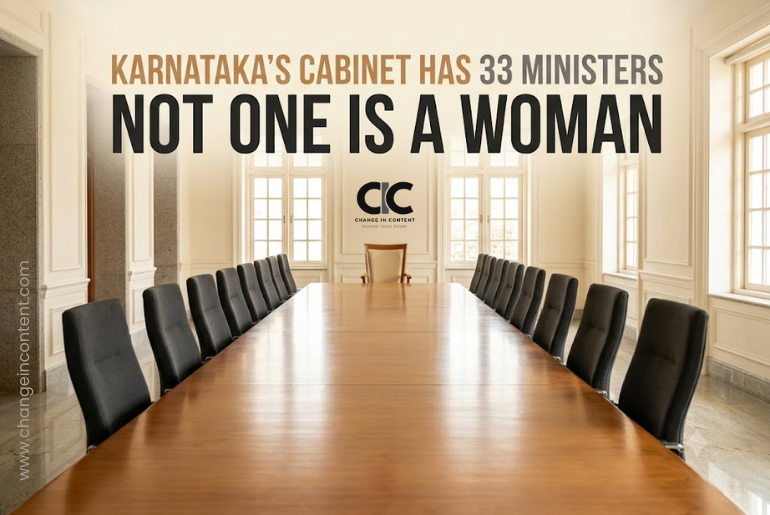
- Not one member of the expanded Cabinet is a woman.
- MLC Gayathri Shanthegowda appeared on the announced lists but was not sworn in.
- Karnataka elected only 10 women to its 224-seat Legislative Assembly in 2023.
- One Cabinet vacancy reportedly remains, creating an immediate opportunity to correct the absence.
No woman minister in Karnataka Cabinet
A Cabinet photograph usually tells a story about political balance. Regions are represented. Communities are considered. Seniority, loyalty and electoral influence find their place.
The photograph from Karnataka’s latest Cabinet expansion tells another story too. Every minister in the frame is a man.
There is now no woman minister in the Karnataka Cabinet after 19 legislators were sworn in on 3 August 2026. The expansion took the Council of Ministers to 33 members, but did not bring a single woman into the state’s highest executive decision-making body.
This article does not claim to know why individual appointments were made or what negotiations shaped the final list. Cabinet formation involves political, regional, community and administrative considerations that are rarely visible in full.
Yet the outcome is visible enough: women have no seat at Karnataka’s Cabinet table.
For a state widely associated with technological progress, educational opportunity, enterprise and modern urban development, that absence is difficult to overlook.
A large Cabinet found room for many interests, but no woman
The expansion was designed to accommodate a wide range of political expectations. The newly inducted ministers represented different regions, communities and levels of legislative experience. Gender did not survive that balancing exercise.
Reports indicate that MLC Gayathri Shanthegowda’s name appeared on the lists of legislators expected to take the oath. She was later dropped and was not sworn in. Other women reportedly considered for ministerial positions included Nayana Motamma, Roopakala Shashidhar, Kaneez Fatima, Arathi Krishna and former minister Laxmi Hebbalkar. None entered the Cabinet.
The previous government had one woman minister, Laxmi Hebbalkar. Even that was modest representation in a full-sized ministry. The latest arrangement brings the number down from one to zero.
A single woman would not have delivered gender balance. Her presence would, however, have prevented the complete exclusion Karnataka faces today.
That is where the development moves beyond the fortunes of individual political leaders. Ministerial appointments carry institutional meaning. They show who is considered ready to govern, who receives executive authority and whose political experience is recognised at the highest level.
An all-male Cabinet sends an outdated message, regardless of whether that message was intended.
Karnataka’s political pipeline is already narrow
The Cabinet reflects a representation gap that begins much earlier.
Women won only 10 of Karnataka’s 224 elected Assembly seats in 2023. They formed less than 5% of the House. PRS Legislative Research found that women have remained below 5% of elected members in every Karnataka Assembly election since 1962. The state last elected more than 10 women MLAs in 1962.
That is more than six decades without meaningful improvement.
Candidate selection has a direct bearing on this outcome. Political parties cannot build a strong pool of experienced women legislators when few women receive tickets in winnable constituencies. Later, when Cabinets are formed, the limited number of elected women is presented as a practical constraint.
The cycle is familiar:
- Women receive fewer opportunities to contest.
- Fewer women enter the Assembly.
- A small pool is considered for ministerial office.
- Women’s absence from senior government is then explained as a shortage of experienced candidates.
The shortage is created by political decisions long before a swearing-in ceremony.
Change in Content examined a similar contradiction after the 2026 Tamil Nadu elections. Women participated strongly as voters, but remained a small minority among elected legislators. The state improved its numbers, yet women still occupied fewer than one in ten Assembly seats.
Karnataka’s position is more severe. Women are underrepresented in the legislature and now entirely absent from the Cabinet.
Progressive policy cannot replace women’s political power
Karnataka has introduced or considered several measures affecting women’s work, health and welfare. It has debated menstrual leave, supported women-focused programmes and frequently positioned itself as a progressive state.
Policies benefiting women deserve recognition. They do not substitute for women participating in the decisions behind those policies.
A government can design schemes for women while giving women little authority over budgets, implementation and priorities. This creates a familiar political arrangement: women are highly visible as beneficiaries and voters, but far less visible as ministers.
Decisions across the entire Cabinet shape women’s lives.
Transport affects whether women can study and work safely. Industries policy influences the jobs available to them. Finance determines public spending. Housing affects mobility and security. Health policy determines access to reproductive and primary care. Agriculture, education, labour, urban development, policing and digital governance all carry gendered consequences.
Women’s political representation should therefore not be confined to the Women and Child Development portfolio. Nor should that department automatically be treated as the only natural ministerial destination for a woman.
Women can lead finance, home affairs, industries, infrastructure, technology, transport, agriculture or any other department. Political inclusion becomes meaningful when women hold authority across the business of government.
Representation changes which questions enter the room
A woman minister cannot be expected to speak for every woman in Karnataka. Women differ by caste, class, region, religion, age, disability, profession and political belief. No individual can represent that full range of experiences.
Representation still matters.
Cabinet discussions are shaped by the knowledge, priorities and experiences of the people participating in them. When every person at the table is a man, the government loses a set of perspectives that should form part of its executive thinking.
The concern is not that male ministers are incapable of framing policies for women. Governments have a duty to serve all citizens. The concern is that women should also hold the authority to shape policy for the entire population.
Research from local governance in India has shown that women’s political participation can affect public priorities, including investments in drinking water, roads, sanitation, health and education. Karnataka itself has seen women cross the 50% mark in parts of its Panchayati Raj system, including victories from seats that were not reserved for them.
Women have demonstrated their ability to govern at the village, district, state and national levels. The question of competence was settled long ago. Access remains the unresolved part.
Welfare promises and political representation must meet
Women are a crucial electoral constituency across India.
Political campaigns speak directly to them through cash transfers, free transport, food support, healthcare promises, housing assistance and livelihood programmes. Parties closely track women’s voter turnout and often celebrate their support after an election. That attention does not consistently translate into political power.
Women may be central to campaign strategy but peripheral to candidate lists. They may be recognised as a decisive vote bank but not as a substantial pool of ministers. Their needs are discussed extensively while their authority remains limited.
Karnataka’s Cabinet therefore presents a wider democratic contradiction. A government can recognise women as citizens whose welfare matters while failing to recognise enough women as leaders who should govern.
India is already in the process of passing the Constitution (106th Amendment) Act, providing for one-third reservation for women in the Lok Sabha and state legislative assemblies once the connected census and delimitation requirements are completed. Until implementation, political parties retain considerable control over how quickly women’s representation improves.
The law offers a future structural correction. It should not become a reason to delay voluntary action in the present.
One vacant seat offers Karnataka an immediate choice
Reports suggest that one place remains vacant in the 34-member limit available to Karnataka’s Council of Ministers. Demands have already emerged for that berth to be offered to a woman.
Filling it with a woman would not resolve Karnataka’s long-standing political gender gap. One appointment cannot correct decades of low candidate selection or raise the Assembly’s female representation beyond its present level.
It would still be a necessary correction. It would restore at least one woman to the Cabinet, bring a missing perspective into executive discussions and prevent the state from continuing with an entirely male ministry.
The longer-term work requires more:
- More women must receive tickets in viable constituencies. Political parties need to move beyond nominating women mainly where their chances of winning are weak.
- Women legislators need substantial responsibilities. Committee leadership, party assignments and legislative work help build the experience later used to assess ministerial suitability.
- Cabinet representation should be considered during political balancing. Gender should not become the factor addressed only after every other demand has been accommodated.
- Women must receive major portfolios. Representation loses force when women are repeatedly restricted to departments traditionally labelled as social or feminine.
- Parties should develop visible leadership pipelines. Local representatives, councillors, legislators and party organisers need routes into senior political office.
Political talent does not appear automatically at the moment a Cabinet is formed. It is identified, supported and given opportunities over time.
Political neutrality does not require silence on exclusion
Let us not mistake the critiquing of the absence of women from a Cabinet for opposition to a political party. Every party that governs must answer questions about representation. The standard should remain consistent regardless of which party is in office.
A government may make credible policy decisions in one area and fall short in another. It may support women through schemes while failing to include them adequately in power. Reporting that contradiction is part of democratic scrutiny, not political campaigning.
Change in Content has previously written about the sharp decline in women’s representation after Bangladesh’s 2026 elections. The setting was different, but the wider concern remains relevant: when political systems change, women’s place within the new arrangement cannot be treated as an afterthought.
Karnataka’s Cabinet can still change. Its present composition should nevertheless be recorded for what it is: a setback for political inclusion in one of India’s most prominent states.
The Change in Content Perspective: A Progressive State Needs Women in Power
Karnataka has every reason to see itself as a state of possibility. It hosts global technology companies, respected universities, ambitious start-ups, major industries and a politically aware civil society. That image makes its all-male Cabinet more striking.
We cannot measure progress only through investment, infrastructure, innovation or welfare schemes. It is also visible in who gets to make decisions.
Karnataka does not lack women with political experience, public credibility or administrative ability. What it lacks today is a woman inside its Cabinet. The vacant ministerial berth provides an opportunity to correct the immediate omission. The more durable response will begin before the next election, through stronger candidate selection and genuine investment in women’s political careers.
Women should not have to wait for an institution to run out of other claims before their representation is considered. A state that speaks confidently about its future should not enter that future with half its population missing from the Cabinet table.
Editorial Note and Sources
This article is based on publicly available reporting about the Karnataka Cabinet expansion of 3 August 2026 and data on the composition of the state legislature. It examines the development through the lens of political inclusion and does not endorse or oppose any political party, leader or individual candidate. Cabinet membership and portfolios may change after publication; readers should consult official government notifications for the latest position. The views expressed are editorial in nature and are intended to encourage informed public discussion.
Sources
- Karnataka Legislative Assembly
- PRS Legislative Research: Profile of the 16th Karnataka Legislative Assembly
