
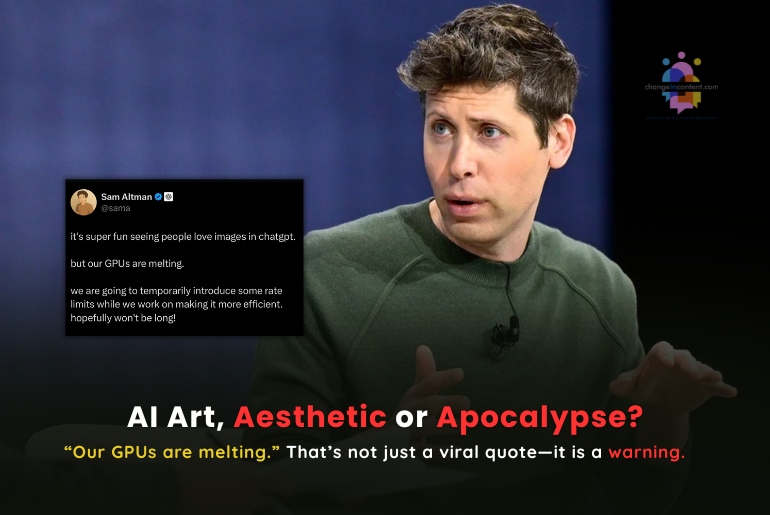
The viral flood of Studio Ghibli-style AI images has turned social media into an animated playground. However, beneath the charming visuals lies a much darker reality. OpenAI CEO Sam Altman recently posted that their GPUs are “melting” under the pressure of image requests. That has temporarily forced the company to throttle usage. And what is driving this pressure? A relentless obsession with generating Ghibli-inspired AI art at breakneck speed. This viral obsession, now famously dubbed the ChatGPT Ghibli Trend, is not just an aesthetic fad—it is a cautionary tale.
As companies and users scramble to ride the wave of virality, few are stopping to ask: What does this cost? Not in terms of subscriptions or copyrights alone but energy, ethics, and ecological consequences.
The ChatGPT Ghibli trend: From playful to problematic
Let us get one thing straight: the ChatGPT Ghibli Trend was never just fun. It was problematic the moment people started using a machine to replicate the artistic legacy of Hayao Miyazaki—a man who has called AI an “insult to life itself.” But now, the issue has grown far beyond ethics in art. We are now watching our machines overheat—literally.
Altman’s viral X post—“It’s super fun seeing people love images in ChatGPT. But our GPUs are melting”—is a tongue-in-cheek warning that perfectly sums up our AI recklessness. We are pressing “generate” like it is harmless. It Is Not.
What is actually melting? Understanding the energy drain
GPUs, or Graphics Processing Units, are power-hungry engines behind AI art generation. Unlike CPUs, which do one task at a time, GPUs are built to perform thousands of operations simultaneously. That makes them ideal for the complex computations required to turn your pouty selfie into a whimsical anime version of yourself.
But here is the thing: GPUs suck up massive energy. Every prompt you enter to “Ghiblify” your face requires thousands of parallel calculations. Multiply that by millions of users doing the same, and suddenly, AI art is not harmless fun. It is a carbon footprint waiting to happen.
AI companies require enormous cloud infrastructure and energy sources to keep up with demand. The cost is not just in dollars—it is in energy, heat, and unsustainable digital consumption. And now, even OpenAI’s hardware cannot keep up.
Copyright wars are only one part of the problem
Most of the current conversation is still stuck on copyright—rightfully so, given the lawsuits and backlash. But reducing this entire issue to “style stealing” misses the larger crisis.
Studio Ghibli’s visual identity is not just a style—it is a spirit, a legacy of hand-drawn magic. Reducing it to an algorithm for a few likes on Instagram is aesthetic exploitation. But now, that very trend is also contributing to system overloads, infrastructure strain, and unchecked environmental impact.
And let us not forget: this entire viral moment is built on a foundation of AI models trained on datasets that included unlicensed art.
ChatGPT Ghibli trend: When creativity becomes consumption
Altman says this image-generation tool is a “new high-water mark for creative freedom.” But is it really freedom, or is it gluttony disguised as creativity?
We are not saying you should not enjoy AI. We are saying: Acknowledge The Cost. Every click to “generate more” does not just use pixels. It drains power, which contributes to rising carbon loads, and validates a cycle of unsustainable content creation.
Do you really need a Ghibli version of your coffee cup, your dog, or your last vacation? Or are we just trapped in the illusion of creativity, where volume replaces value?
Brands, this is your responsibility too
Major brands like Amul, T-Series, Hyphen, Lenskart, and Zomato have all joined the ChatGPT Ghibli Trend for engagement. But at what cost? These brands have a reach that shapes digital behaviour. When they normalise this kind of exploitation (artistic or environmental), they make it trendy, not problematic.
It is time for brands to pause and rethink. Can you promote your next campaign without turning a blind eye to stolen styles and melting GPUs? Can you inspire, without extracting?
Creativity without responsibility is just consumerism in disguise.
Conclusion: The ChatGPT Ghibli trend and its actual cost
We are now watching a trend that began with “art” crash into the wall of ecological reality. The ChatGPT Ghibli Trend may have started as playful mimicry, but it is fast becoming a symbol of thoughtless consumption. A trend where beauty masks burnout—of servers, of ethics, and of imagination.
Changeincontent perspective
Just a day ago, we spoke out against the AI Ghibli art trend, calling it theft guised as creativity. Now, we are here again—not just defending artistry but advocating for responsibility in every sense.
AI is not the villain. Misuse is.
If your content is causing server stress, copyright lawsuits, and environmental strain—all for a few seconds of digital applause—then it is time to rethink your creative process.
At Changeincontent, we do not just want trending content. We want conscious content. Let the ChatGPT Ghibli Trend be the wake-up call it is meant to be.
Disclaimer: The views expressed in this article are based on the writer’s insights, supported by data and resources available both online and offline, as applicable. Changeincontent.com is committed to promoting inclusivity across all forms of content. We broadly define inclusivity as media, policies, law, and history—encompassing all elements that influence the lives of women and marginalised individuals. Our goal is to promote understanding and advocate for comprehensive inclusivity.
