
The Brief
- Women should help decide how streets, transport and public spaces work, with a say before plans and budgets are settled.
- Reliable connections, usable toilets and places to rest can make it easier to work, study, care for others and enjoy an evening out.
- Chennai’s Gender and Policy Lab and participatory park planning in Vienna offer different examples of bringing women’s experiences into urban decisions.
- Good design must account for differences in income, age, disability and daily routines. There is no single woman whose needs represent everyone.
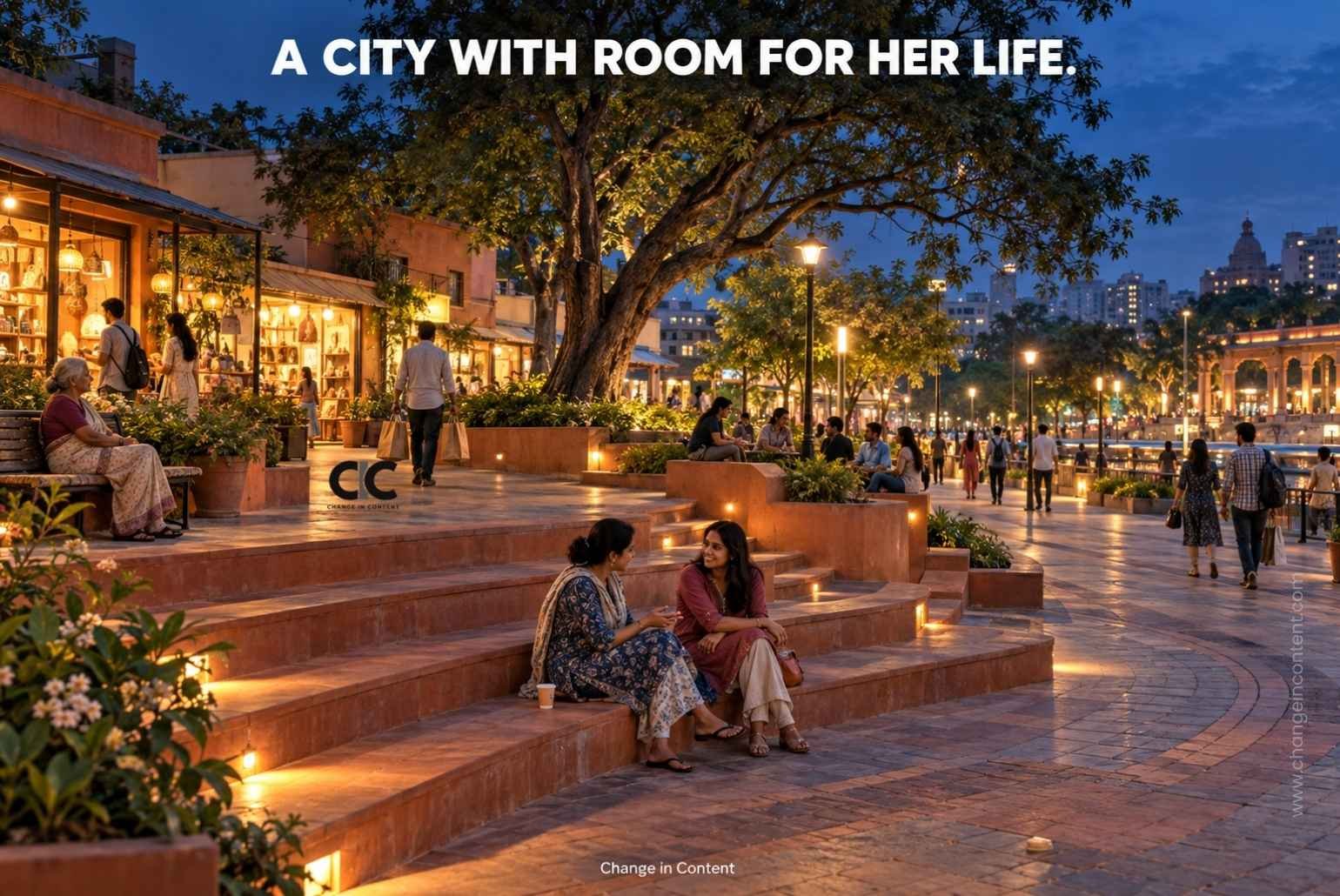
You should be able to sit down in your city without buying a coffee. Stay for a while, watch people pass, decide what to do next. A woman should be able to enjoy that small freedom without needing an errand to explain her presence. Cities designed for and by women would take such ordinary pleasures seriously, alongside getting to work and getting home safely.
A recent discussion reported by The Hindu asked for women and girls to help shape public spaces. Held on 16 September to mark 15 years of UN Women’s Safe Cities and Safe Public Spaces initiative, the consultation connected safety with mobility, economic opportunity and participation in urban decisions. (Internationly)
It is an invitation to think about an entire day. What would change if a city were planned around the lives women actually lead, and the lives they would like to lead?
The journey would include all the stops
A line drawn from home to office looks wonderfully efficient. Add a school drop-off, a medical appointment or a stop to collect groceries, and the journey becomes a different design problem.
The World Bank’s work on Indian urban transport describes women’s greater tendency to make several shorter journeys and travel outside peak hours. These are patterns planners need to understand, without assuming that every woman is a mother or that care should remain her responsibility. (World Bank)
Consider a hypothetical nurse whose shift ends after the most frequent buses have stopped running. The hospital may be well connected at nine in the morning. That does little for her journey at night. Or consider a shop worker who changes buses twice: an inexpensive fare becomes less useful if each connection brings another long wait.
The cost reaches beyond the ticket. Paying for a more manageable journey can become part of the hidden expense of keeping oneself safe. Declining a shift or an evening class carries a different cost, one that never appears on a transport receipt.
A better plan would examine the whole journey, including the pavement between the stop and the destination. It would ask when people need to travel, what transfers cost and whether someone using a wheelchair can complete the same route. These details also help fathers collecting children, older residents and anyone whose working day runs outside office hours.
You could stay out without planning around your bladder
A public toilet can look satisfactory on a map and be unusable in practice. The questions are unglamorous: Is it open? Is there water? Does the lock work? Can someone enter with a mobility aid? Who cleans it, and how often?
Try planning an afternoon around uncertainty over those answers. The café begins to look less like a treat and more like a necessary purchase. A longer outing becomes something to reconsider.
Seating and shade deserve the same attention. They give someone a place to recover from a tiring walk, wait comfortably or simply enjoy being outside. For a street vendor, shelter and nearby facilities belong to the working day. For someone experiencing pain or fatigue, the distance to the next seat can change whether a trip feels possible.
The World Bank’s India toolkit includes practical recommendations on lighting, walking routes, fares and grievance systems, alongside women’s representation in transport and municipal decision-making. Much of this work concerns how a city operates after construction is finished. A lamp needs repair; a toilet needs staff; a bus service needs to remain reliable. (Worldbank.org)
India already has experience to build on. The World Bank describes its cooperation with Chennai and the city’s Gender and Policy Lab as part of the work that informed the toolkit. The Chennai initiative provides a useful starting point for asking how women’s experiences can reach departments responsible for everyday services.
Girls might ask for somewhere to dance
In Vienna’s Mortarapark, girls helped plan part of the park through discussions, walks and workshops. More than 30 girls aged nine to 15 developed ideas in 2005. Their choices included a picnic and dancing area, a treehouse and seating with tables for homework, according to the city’s account of the project’s opening in 2006. (Presse-Service)
The detail worth lingering over is the homework table. Asked what they wanted, the girls had something more specific to contribute than a general request to feel welcome. They could describe what they hoped to do there.
That is what participation can uncover. A planner may see an underused corner. A teenager may see somewhere she and her friends could spend an hour after school. Whether that becomes a good space depends on listening to those users, testing the design and remaining open to changes.
There is no reason to reproduce a Viennese park in an Indian neighbourhood. The useful practice travels more easily than the layout: ask the people whose presence is missing what would make the space usable and enjoyable for them.
Women’s right to spend time in public without a stated purpose deserves that kind of attention. A city should accommodate a woman meeting friends, playing sport or doing absolutely nothing for twenty minutes. Her contribution to the economy can wait until she has finished her tea.
Who gets to change the drawing?
Women architects, engineers, transport planners and elected representatives need authority over decisions. Residents need a way to influence them too. Being invited to a presentation after the important choices have been made offers little scope to change the outcome.
One consultation cannot supply a universal women’s perspective. A domestic worker travelling before dawn, a student coming home from a library, a trans woman using public facilities and an older woman crossing a busy road may identify different priorities. Meeting times, language, accessibility and compensation for participants’ time affect whose knowledge reaches the room.
An honest process would show what residents asked for, what changed and why some requests could not be met. It would return after the space opens. Are the women who helped design it actually using it? Who still stays away?
Design also has limits. Better lighting cannot excuse harassment, and a camera cannot substitute for a response to a complaint. The aim should be to make public life easier to access, with services and behaviour that support that freedom. Telling women to go home earlier cannot count as a successful urban intervention.
The Change Ahead
Ask what would make a city better for women and the answers may sound almost modest: a dependable bus, a working toilet, somewhere to sit, a say in what gets built next. Together, those details decide how much of a city a person can use.
The most convincing result would be visible in an ordinary evening. A woman finishes work, meets a friend and stays for another cup of tea because she wants to. The journey home is manageable. Tomorrow’s alarm is her own concern. For once, the city gives her a reason to linger.
Editorial Note
This is researched commentary, prompted by The Hindu’s coverage and supported by World Bank and City of Vienna material. The nurse and shop-worker examples are hypothetical; no interviews or site visits were conducted. The original Hindu page could not be opened directly, so the consultation details were checked through an accessible reproduction of its report. Design proposals and interpretations are Change in Content’s. Historical examples are dated and are not presented as proof of current city-wide outcomes.
Sources
- The Hindu: Experts call for cities designed for and by women to create a safer environment, September 2026. Accessible reproduction consulted.
- World Bank: India: Making public transport more women-friendly, December 2022.
- World Bank: New toolkit to make transport and public spaces in India more gender inclusive, 8 December 2022.
- City of Vienna: Girls’ participation in the redesign of Mortarapark, 23 June 2006. Official German-language account, paraphrased in English.
