The Brief
- Women accounted for just 5% of negotiators across 57 peace processes reviewed in 2025. In three processes led or co-led by the UN, their share reached 22%.
- Bahous described women negotiating safe passage for civilians and mediating local disputes while remaining largely excluded from formal negotiations.
- She asked governments for specific commitments on representation, development assistance and protection against reprisals.
- For workplace leaders, a practical place to start is one forthcoming decision: who sees the draft, who can change it and who has the resources to carry it out?
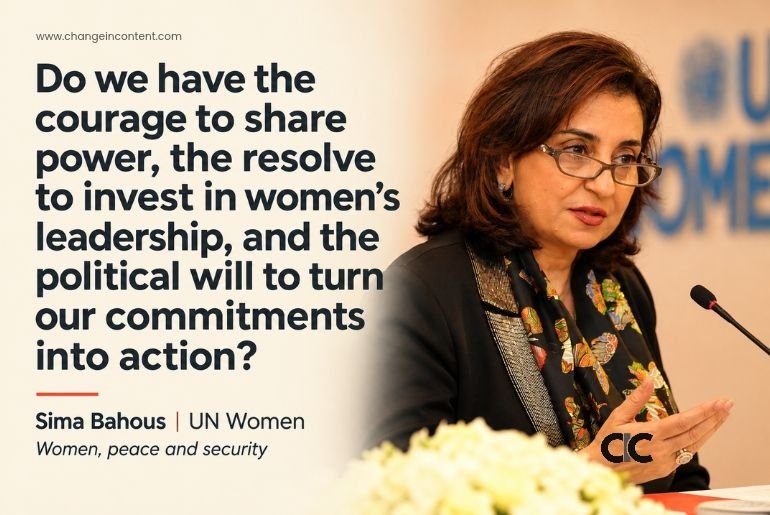
“Do we have the courage to share power, the resolve to invest in women’s leadership, and the political will to turn our commitments into action?”
— UN Women’s published post for Sima Bahous’s address, 27 October 2026
What did Sima Bahous ask the Security Council to confront?
A woman who can negotiate safe passage for families caught in fighting has already demonstrated something a peace delegation needs. Yet the authority she earns locally may count for little when formal negotiators are chosen. That gap ran through the address by Sima Bahous on women and peace and security at UN Headquarters on 27 October 2026. The UN Under-Secretary-General and UN Women Executive Director was presenting the Secretary-General’s annual report to the Security Council.
Bahous gave the Council a reason to examine what actually makes it into an agreement. Of 13 ceasefire agreements reached in 2025, she said, none contained substantive provisions concerning women and girls or explicitly prohibited sexual violence. Silence in a ceasefire text does not make such violence lawful. It does, however, leave a concrete question for those monitoring the agreement: what have the parties expressly undertaken to prevent and report?
She also made exclusion a question of money. Among women’s organisations surveyed in crisis settings, 45% reported having less than six months of funding left. An organisation may know which route is safe for a convoy or which local dispute is about to escalate. That knowledge is harder to act on if the people who hold it cannot be sure they will still have jobs in six months.
Sima Bahous on Women and Peace and Security: What she asked member states
Bahous asked Member States to seek at least one-third women’s participation in peace processes they support, with parity as the ambition. She called for at least 15% of official development assistance to conflict-affected countries to advance gender equality, including at least 1% for women’s organisations. Her third demand concerned accountability for crimes against women and girls and protection for peacebuilders, rights defenders and humanitarian workers facing reprisals.
Those requests were addressed to governments. The funding percentages are not targets for an employer’s budget, and a difficult meeting at work bears no comparison to negotiating under threat of violence. What travels from the speech is a question about institutions: how do people who depend on women’s expertise decide how much authority to entrust to them?
For leaders: Let expertise change the first draft
Consider a manufacturer expanding its night shift. The operations head asks a woman shift supervisor to review the transport plan. She points out that the last pickup leaves before handover ends. If the route, budget and vendor contract have already been signed off, the invitation gives her responsibility for spotting a problem without much chance of fixing it.
The operations head can change that sequence. Give the supervisor the draft timetable while routes and costs are still open. Authorise her to test it against the handover on the floor, propose a revised departure and bring that proposal directly to whoever approves the contract. The useful evidence of inclusion is a bus that leaves at a time workers can use.
Our reporting on workplace safety for women examines what happens when responsibility extends beyond the gate.
For businesses: Look at what the budget pays for
A company that wants more women to lead commercial accounts might fund a leadership course. The course may be excellent. But if the same senior people keep control of pricing, client negotiations and margins, graduates return to jobs in which they cannot practise what they have learnt.
At the next account review, give a qualified manager responsibility for a renewal, specify which terms she can negotiate, and pay for someone to cover the work she will hand over. Then assess her on the deal she led.
That change costs management time and may require a staffing decision. It also gives the company something more useful than an attendance certificate when the next account director is chosen: evidence of how she handled a customer and a commercial decision.
For managers and colleagues: Change what happens after someone objects
A manager’s most revealing decision can come a week after a woman questions a proposal.
- Is she still on the client call?
- Does she see the revised draft?
- If the team adopts her recommendation, will she explain it to the customer herself?
Someone can be thanked warmly in a meeting and quietly lose ownership of the work afterwards.
A manager can record who raised the issue, what changed and who will lead the next conversation. A colleague has a smaller but useful intervention available: if you are asked to present another person’s analysis, name its author and ask whether she would like to present it. Check with her first, especially if the issue is sensitive. Credit should expand her choices rather than volunteer her for extra work or unwanted exposure.
For an individual contributor, there is also a fair question to ask before accepting an assignment: Which decisions can I make, and which need your approval?
Managers should welcome that question. Better still, answer it when offering the work. As our review of women in leadership in 2026 explored, the assignments available to someone today shape what a selection panel will recognise as experience tomorrow.
The change to make before the next meeting
Pick one decision due this month. Ask the woman whose expertise the team relies on what she would change while there is still time to change it. Agree who can approve her proposal, what resources it needs and when she will get an answer. She may disagree with the eventual decision. She should at least be able to tell how it was reached and what became of her advice.
Bahous asked the Security Council to account for promises made to women whose lives and communities are at stake. For the rest of us, the honest response begins with the much smaller decisions we actually control.
Editorial note and sources
This is a Bureau analysis of UN Women’s as-delivered transcript of 27 October, on the occasion of the Secretary-General’s annual report, S/2026/758. The hero question reproduces UN Women’s headline. In the closing remarks, Bahous introduced the same challenge as an indirect question. The statistics and policy requests above are attributed to her speech. The workplace situations are illustrative; the recommendations are Change in Content’s analysis.