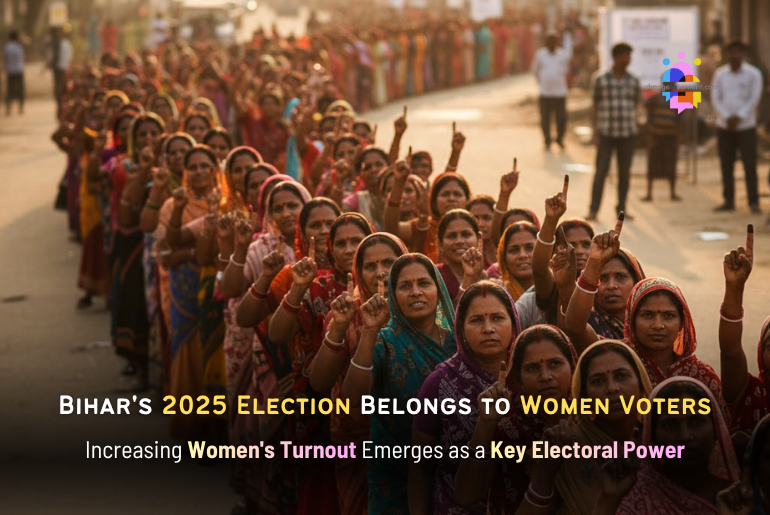
For the first time in the state’s history, women’s voter turnout (71.8%) surpassed men’s (62.8%) by a massive margin. This increasing number of women voters in the 2025 Bihar election marks a historic shift in India’s electoral narrative. More than 2.51 crore women voted, outnumbering men by over 4.3 lakh votes.
The 2025 Bihar Legislative Assembly Elections will be remembered not just for the formation of the government but for something far more powerful. That is ‘the rise of women’ as the decisive political force.
In a state once known for patriarchal control and male-dominated politics, Bihar’s women are now rewriting the story.
The introduction to a much-needed change
The 2025 Bihar Legislative Assembly elections recorded the highest number of women voters in the state’s history. The two-phase voting ended on Tuesday, 11 November 2025, with an overall turnout of 66.91%.
The data from the polls shows male voter turnout of 62.8% while women reached 71.8%. This is the highest turnout since the first Bihar elections in 1951, according to the Election Commission of India. The record-breaking participation of women voters played a significant role in the election outcome. They vote in greater numbers, influence political priorities, and can even change the direction of an election.
More women vote than ever before in Bihar
The Election Commission set up 45,399 polling stations in the second phase alone. Across both phases, the scale of the election was enormous. More than 8.5 lakh polling staff worked on the ground. In addition, 1.4 lakh polling agents represented 2,616 candidates. There were also 243 general observers, 38 police observers and 67 expenditure observers who monitored the process.
Women voters in the 2025 Bihar elections: The game-changing numbers
Women voters played a significant role in this year’s result. In Phase One, 69.04% of women voted while 61.56% of men voted. In Phase Two, women reached 74.03% turnout. Men recorded 64.1%. This is the fourth election in a row in which women have voted in higher numbers than men.
In 2010, 54.49% of women voted, while 51.12% of men voted. The gap grew in the next elections. In 2015, women reached 60.48% and men stood at 53.32%. In 2020, women recorded a voter turnout of 59.69%, while men recorded 54.45%. In 2025, a total of 2.51 crore women took part in the polls, compared to 2.47 crore men, giving women a lead of 4.34 lakh votes.
Women-focused development to women-driven voting power
The growing turnout of women did not happen overnight. It was built slowly over years of state policies aimed at improving safety, education, and income support for women.
The government introduced several steps that directly affected women’s daily lives. These include cycles for girl students, free school uniforms, reservations for women in local bodies, support through Jeevika self-help groups, a ban on alcohol, and a 35% reservation for women in government jobs. Each step added to the next, creating an empowering foundation for women’s confidence and independence.
Professor Rakesh Ranjan from Patna University explains this with a three-group model. According to him, women voters in Bihar fall into high-income, middle-income and low-income groups. Women in the first two categories often vote in line with their family or husbands. The third group is different. These women come from low-income households and earn through small work like street vending or home-based trades. Many of their husbands migrate for jobs, so these women make their own political decisions. Professor Ranjan says this segment responded the most to the latest financial support and other women-centric schemes.
Economic benefits and financial incentives turn women into active voters
About six weeks before voting, the state government transferred ₹10,000 each into the accounts of almost 1.41 crore women under the Chief Minister Mahila Rozgar Yojana. The scheme aims to help women start or expand small income activities. Women linked to self-help groups or planning to join received this money first. After six months, those who grow their work may receive up to ₹2 lakh more.
Along with this, the Kanya Utthan Yojana provides up to ₹50,000 per girl child for her education from birth until she completes graduation. The idea is to support girls over a long period, not just for one stage of schooling.
All these programmes link basic welfare with economic opportunity. Because of this, many women now see their vote as a direct tool for better income, better safety and better futures for their daughters.
The rise of politically aware women
This rise in women voters is not limited to Bihar. We can see it in other places as well. For example, Zohran Mamdani’s mayoral campaign in New York City drew strong support from young women. Exit polls show that 84% of Gen Z women aged 18-29 voted for him. This indicates that more women, especially young women, are taking part in elections and making independent choices.
However, this increase has also brought more misogynistic remarks. Each time women show strong voting power, online spaces react with anger and mockery. After the Mamdani exit poll numbers came out, many voices from the so-called “manosphere” said that women should not vote at all. Similar comments appear during the Bihar elections as well. Some people say that women are not “serious” voters or that they cannot make political decisions on their own.
Reason for the increased number of women voters in the 2025 Bihar elections
But women are no longer voting only because a husband, father or brother told them to. Many now choose based on what matters to them. They connect their vote to their daily lives, their safety, their income and their future.
If we see a high turnout of women, it comes from growing political awareness. More women understand what government decisions mean for them. They know what they want, what they do not wish to and whom they trust to deliver it.
Conclusion: When women vote, India listens
The 2025 Bihar election shows women are no longer just part of the voter list. Their turnout has grown with every election, and now their votes decide which promises matter and which leaders rise. As more women step forward, political parties must rethink their strategies. They can no longer treat women as a side group. Women are now a decisive force. The future of elections will depend on how well leaders listen to them, understand them and deliver real change.
Changeincontent perspective
At Changeincontent, we see this not just as a political story, but as a social revolution.
For decades, Bihar has been the testing ground for gender reforms, such as cycles for girls, Jeevika self-help groups, alcohol bans, and government job reservations for women. Those small, consistent acts of inclusion have built a generation of confident, informed, and financially aware women.
The 2025 Bihar Election proved that empowerment does not end at the doorstep. Instead, it enters the polling booth.
When women vote in record numbers, they do not just participate; they prioritise safety, education, healthcare, and dignity. These are issues policymakers often dismiss as “soft politics” but which actually shape real lives.
Bihar’s women have changed the rules. Now, the question is: will politics change with them?
Also Read: Combating online misogyny in politics: The role of women, media, and AI.
Disclaimer: The views expressed in this article are based on the writer’s insights, supported by data and resources available both online and offline, as applicable. Changeincontent.com is committed to promoting inclusivity across all forms of content. We broadly define inclusivity as media, policies, law, and history. It encompasses all elements that influence the lives of women and marginalised individuals. Our goal is to promote understanding and advocate for comprehensive inclusivity.