
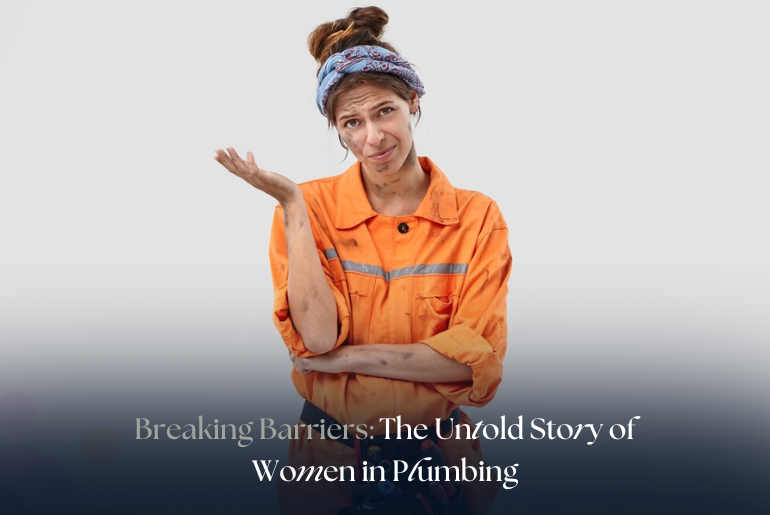
When you hear the word “plumber,” what comes to mind? Likely, not a woman. The plumbing industry has long been male-dominated, with women comprising less than 1.5% of the global plumbing workforce. Depending on the country, the percentage of women in plumbing fluctuates. Some nations report as little as 1% of women plumbers, and others reach up to 3.5%. This striking disparity exists despite countless examples of women making significant contributions to plumbing and sanitation throughout history.
In the U.S., women make up only about 2.5% of plumbers and represent around 13% of plumbing apprentices. The numbers in the UK are not great as well. There are about 12,000 to 15,000 female plumbers in the UK. They make up just 1% of the total plumbing workforce, which is between 120,000 and 150,000. In Australia and New Zealand, less than 1% of plumbers are women. Even in developing countries like India, the plumbing industry, like many skilled trades, remains overwhelmingly male-dominated, with very few women in hands-on plumbing roles.
Yet, the story of women in plumbing is one of resilience, determination, and quiet defiance. From the unsung women of the 19th century who stepped up during sanitation crises to modern pioneers redefining what’s possible, these stories deserve to be heard. They remind us that inclusion is not just about opportunity; it is about rewriting narratives and creating spaces where everyone belongs.
Women in plumbing: More than just a pretty face
Despite such contributions, the plumbing industry is still largely shaped by gender bias. Women in plumbing often face stereotypes. They are sexualised, and they are overlooked for their expertise. In fact, many women in plumbing are still being underestimated or dismissed because of their gender. This bias is evident in the low number of women in the industry. Moreover, people minimise or undermine their skills, as seen with figures like Lillian Ann Baumbach.
Lillian Ann Baumbach became America’s first female master plumber at the age of 21. The Master Plumber course is notoriously difficult to this day, but Lillian passed the test while many of her male classmates did not. Even so, the industry and media were quick to label her as the “pretty plumber” and turn her into a pin-up girl during the Korean War.
The persistent stereotypes
Even in commercials and posters, women plumbers are often reduced to sexualised stereotypes. Take Kohler’s “Jo’s Plumbing” ad, for example. The woman plumber appears young, attractive, and dressed in tight clothing that accentuates her figure. It is nothing like what an actual plumber would wear on the job. Such portrayals misrepresent women in traditionally male-dominated trades. They make it even more challenging for them to gain respect and be taken seriously in the industry.
As Saransh Jain, co-founder of Changeincontent.com, points out, “These are the problematic narratives that brands need to consciously move away from. The humorous storytelling cannot hide the commodification of women. Patriarchy, sexism and humour go hand in hand. Even 90% of stand-up shows across the world reflect humour at the cost of women.”
What is holding back women in the plumbing industry?
The main reason there are fewer women in plumbing is that most enter the industry through family connections. Even Lillian Ann Baumbach followed her father into the trade. During the summer, she assisted him with plumbing jobs. Similarly, M. Cary & Daughters Plumbing, one of the first women-owned plumbing companies in the U.S., was originally started by the family’s father.
A lack of role models and support systems
Back in the day, you would not see a woman entering plumbing without a family member already on the job. The reason is simple: the industry was (and in many ways still is) unwelcoming to women. Its male-dominated nature, the lack of visible female role models, and the prevalence of stereotypes made it nearly impossible for women to see plumbing as a viable career path unless they had family connections. Most women found it almost impossible to break into a field that was not designed to support or include them.
Safety concerns and harassment for women in plumbing
On top of that, plumbing is a job that often requires women to work alone in the homes of strangers. That can make them vulnerable to sexual assault. In addition, the industry’s reputation for harassment and discrimination makes it an unwelcoming space for many women.
Wage gaps, practical barriers on sites and limited opportunities
Pay gaps continue to be a problem, with women often earning less than men despite doing the same work. In addition to pay disparities, inadequate facilities on job sites further alienate women. Many sites don’t provide separate restrooms for women or even necessities like toilet paper.
Even something as basic as uniforms shows how poorly the industry caters to women. How many companies actually consider a woman’s comfort when designing a uniform? Most are designed with men in mind. It leaves women to struggle with ill-fitting clothing. In male-dominated fields like plumbing and construction, the lack of thought given to women’s comfort, safety, and practicality in work attire is even more pronounced.
Inspiring change: The ripple effect of women supporting women
Representation matters. When women see others thriving in non-traditional roles, it creates a ripple effect of empowerment. Some brands are focusing on real, impactful initiatives rather than just tokenistic CSR efforts.
1. Finolex Pipes: A case study in empowerment
Finolex Pipes and Fittings, one of India’s most trusted pipe brands, has released an inspiring Diwali short film featuring an empowering portrayal of a woman plumber. The ad begins with a distressed housewife calling to get her pipes fixed before Diwali. When the plumber arrives, the housewife is visibly surprised to see a woman in the role. Hesitant, but more out of curiosity, she asks, “So women can be plumbers too?“ The woman plumber confidently replies, “Of course,” to which the housewife responds, “I have never seen one before.“
The woman plumber responds to the housewife’s surprise by saying she’s heard that question countless times before. However, she adds, “If you set your mind on something, nothing is impossible.” As the plumber works, she notices the dress the housewife has stitched herself and praises her for her craftsmanship. She even asks if she could get one made for her niece. The housewife is taken aback. She explains that it is just a hobby and that she doesn’t even run a business. But the plumber encourages her, offering to pay her upfront for the dress as an advance.
The moment is a touching reminder that the time has come for women to inspire and uplift one another. This empowering campaign sends a clear message that women are not only breaking barriers but also encouraging other women to do the same.
The campaign
[penci_video url=”https://www.youtube.com/watch?v=0piVoEVRKAo” align=”center” width=”720″ /]
What stands out most in the campaign is how it focused on the story and message rather than just promoting Finolex’s products. It did not objectify the woman plumber or make the ad feel like a hard sell. Instead, it stayed true to its core values by showing how women can inspire each other and create change.
The message is simple yet powerful: when women connect and support one another, it makes a ripple effect, helping more women rise and break barriers. It is not just about plumbing; it is about building a community of women who encourage and empower each other to succeed.
The final thoughts: From one to many
Most of us often see plumbing as a physically demanding job, and many argue it is not ideal for women. But let us not forget women do physical labour every day, starting with childbirth. Women are expected to work twice as hard for half the recognition men get. When a woman carves out a space for herself in a male-dominated field, it is not by luck. She has had to be exceptional to succeed in the first place, all while dealing with harassment, the constant fear of assault, toxic masculinity, and the lack of support or mentorship.
Women often share stories of how other women in the industry or strong female role models have inspired them to pursue plumbing. These role models changed the way they saw the trade and helped them believe they could succeed in it, too. This ripple effect is powerful, not just in plumbing but in all trades.
Although we have made progress in bringing women into fields like plumbing, there is still a long way to go. To continue moving forward, we need to spread the word, challenge old stereotypes, and break down the limits society places on women. By doing this, we can create more opportunities for women to enter any field they choose without being held back.
At Changeincontent.com, we believe stories like these are essential for challenging stereotypes and creating inclusive spaces. When women break into fields like plumbing, they not only carve out opportunities for themselves but also pave the way for others to follow. It is not just about fitting pipes; it is about breaking barriers and building futures.
References
What Percentage of Plumbers are Female?
Disclaimer: The views expressed in this article are based on the writer’s insights, supported by data and resources available both online and offline, as applicable. Changeincontent.com is committed to promoting inclusivity across all forms of content, which we define broadly to include media, policies, law, and history—encompassing all elements that influence the lives of women and gender-queer individuals. Our goal is to promote understanding and advocate for comprehensive inclusivity.
