
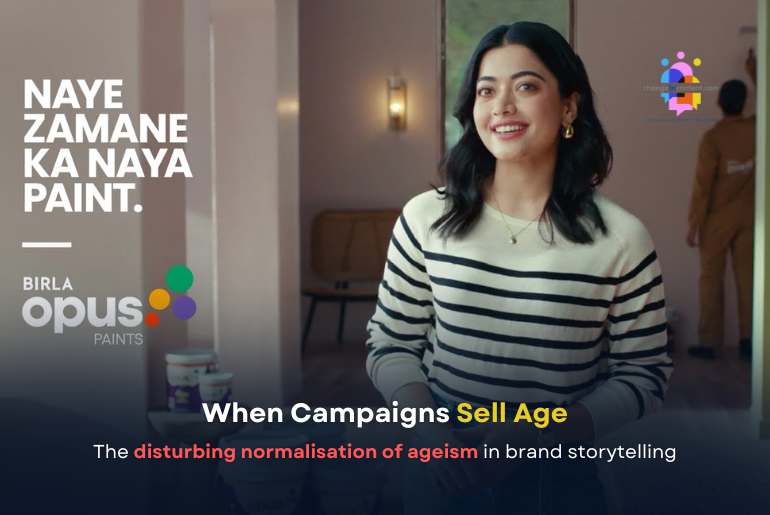
Ageism in campaigns is not just about what is said. Instead, it is about what is shown, implied, and repeated until it becomes normal. When mainstream brands like Birla Opus feed this cycle, it raises serious concerns about what we value and who we sideline.
When asked what counts as ageism, most people would say it is unfair treatment, such as in the workplace, because of your age. While this is true, many often overlook that ageism also appears in how the media portrays older people. Advertising campaigns, television shows, and movies all play a significant role in influencing public attitudes. In the media, ageism has become a culturally accepted form of prejudice against older people, particularly older women.
The funny thing is, sometimes the way ageism appears in the media is so subtle that it is easy to miss. But it is definitely there. Moreover, it is creating negative perceptions and reinforcing stereotypical images of people who are older than society’s so-called “young age” standard.
A closer look at the Birla Opus Paints campaign
A good example is the Birla Opus Paints campaign featuring Rashmika Mandanna and veteran actor Neena Gupta. The campaign promotes Birla Opus Paints as the youngest paint brand designed for modern consumer needs. One of the campaign videos clearly shows how age-based stereotypes continue to influence advertising narratives.
In the video, Rashmika Mandanna represents the young, modern consumer who promotes the “new-age” Birla Opus Paints. Neena Gupta, on the other hand, portrays an older consumer who sticks to the old ways. Neena Gupta’s lines, like “Jo pehle se chal raha tha, wahi lagana tha na,” show that her character prefers sticking to past habits and traditions. Rashmika Mandanna then steps in and says that Birla Opus Paints has better, more modern features. She suggests that the old ways are no longer good enough.
[penci_video url=”https://www.youtube.com/watch?v=eWFGnrDJH5k” align=”center” width=”720″ /]
Through this, the ad portrays Rashmika, a younger actress, as the symbol of “new,” “modern,” and “desirable.” At the same time, Neena, an older actress, is shown as part of a past that no longer fits the new standards—something to move past.
Ageism in campaigns: Selling paint, selling age bias?
Rashmika, as the younger actress, takes the spotlight as the face of change. At the same time, Neena Gupta, even with her seniority and experience, becomes the symbol of outdated thinking. While it is natural for brands to market themselves as modern and innovative, the Birla Opus Paints campaign subtly ties youth to relevance.
This kind of storytelling, even if unintentional, sends the wrong message. It shows that newer ideas belong only to the young, while older individuals are resistant to progress. Something like youth equals innovation, while age equals stagnation! One cannot help but wonder why the brand could not show two actresses of the same age debating the benefits of new versus old products.
Instead of creating a positive connection between generations (let’s say, both young and old appreciating new ideas together), the ad divides them. The ageist thinking of the campaign makes youth seem better and more relevant while making older people seem outdated.
Rethinking media: The need for responsible content
A survey with responses from over 1,250 women across 46 countries revealed that nearly 80% of women have encountered ageism in the workplace. The situation is even more concerning in industries like advertising, marketing, and media. A survey by Campaign and MEC showed that 42% of employees in these fields have witnessed ageism towards colleagues. Moreover, 32% have personally experienced it.
Perhaps the most shocking statistic is that 79% of industry employees agree that the advertising and media sectors are ageist. Despite these troubling statistics, irresponsible content that perpetuates ageist stereotypes continues to be produced and consumed.
Regardless of whether you are an established brand or just beginning, creating responsible content should not be compromised, especially when it reaches a large audience. Conversations and data alike show that the consequences of ageism on society are only increasing. That makes it more critical for brands to rethink their messaging. As influential brands, you must take responsibility for the content you put out into the world.
Ageism in campaigns: The final thoughts
Media and brands, with their advertising, hold a lot of power—so much so that they can dictate what’s “cool” and what’s “outdated.” But with that power comes the responsibility to stop recycling tired old stereotypes. Ageism in the media may not always be loud or obvious, but it carries a lasting negative impact. It is time to recognise and challenge these subtle messages before they continue to build an exclusionary mindset.
The responsibility doesn’t lie solely with the brands. As consumers, we also play a role in holding the media accountable. It is on us to question the content we consume, to call out what feels off, and to demand narratives with a more inclusive picture.
The advertising industry needs a wake-up call—not just about ageism, but about how layered biases manifest.
For a deeper dive into another form of women’s portrayal in media, read our article on The disturbing portrayal of liberated women in media.
Disclaimer: The views expressed in this article are based on the writer’s insights, supported by data and resources available both online and offline, as applicable. Changeincontent.com is committed to promoting inclusivity across all forms of content. We broadly define inclusivity as media, policies, law, and history, encompassing all elements that influence the lives of women and marginalised individuals. Our goal is to promote understanding and advocate for comprehensive inclusivity.
