
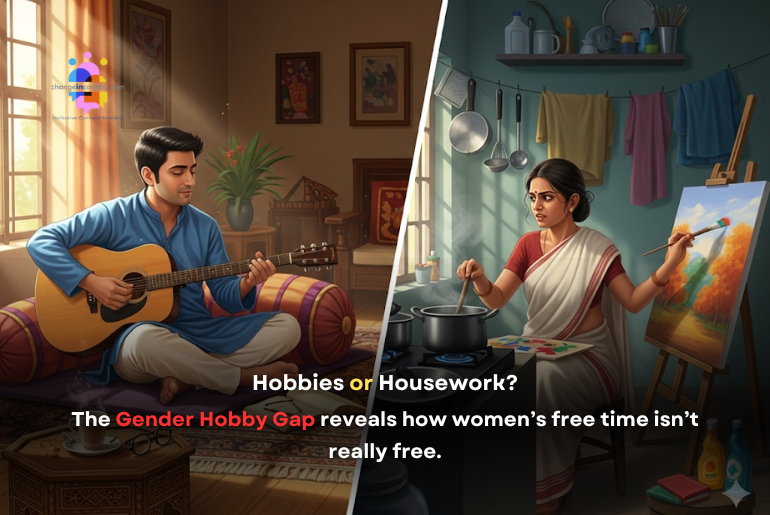
The Gender Hobby Gap is not merely about how men and women spend their free time. Instead, it is about who gets to have “real” free time at all. While men often enjoy uninterrupted leisure, women’s hobbies are constantly squeezed between housework, caregiving, and mental load. That is not a choice; that’s inequality dressed up as lifestyle.
Understanding the Gender Hobby Gap
Do you have a hobby?
Not the kind you do for any money, but something you genuinely enjoy in your free time. As kids, hobbies came naturally. Reading, painting, gardening, sports, and collecting random things – we always found time. College didn’t kill the habit either. But adulthood? Especially for women? That’s where hobbies start disappearing faster than you blink. Somewhere between cooking dinner, handling deadlines, checking school projects and keeping life from falling apart, hobbies became a distant memory for women.
It’s easy to blame “adulting” or “bills” for stealing your free time. Even if everyone technically gets 24 hours a day, not everyone gets to use them equally. There is an unfortunate fact that women have less free time on average compared to the opposite sex.
Women have less time for hobbies
Research from the Gender Equity Policy Institute, as reported in “The Free-Time Gender Gap,” shows that women have 13% less free time than men. Among young women aged 18 to 24, they have 20% less free time than men of the same age, which is one of the largest free-time gender gaps.
The Time Use Survey shows that women spend fewer minutes on leisure activities compared to men, even though both genders work long hours. On average, all young employed adults spent around 1 hour and 45 minutes in leisure activities. However, rural young women spent less, around 1 hour and 20 minutes. In rural areas, young men spend nearly an hour on mass media activities, while women spend around fifty minutes.
The largest share of daily time goes to sleeping and self-care, ranging between 11 and 12 hours. Young women in urban areas spend about 11 hours on these activities, the least among all groups. In contrast, young rural men spend nearly 11 hours and 50 minutes in the same activity, the highest recorded average.
The weight of unpaid work
Women rarely have the time or energy for hobbies, as they often spend extra hours each day on unpaid domestic work. In 2024, approximately 41% of women aged 15 to 59 reported participating in caregiving for household members. Male participation in the same age group stood at just 21.4%.
The time commitment in unpaid domestic work also shows a disproportionate burden on women’s time. Women who engaged in caregiving devoted around 140 minutes each day to it, while men spent only 74 minutes. The difference is nearly double.
Men get leisure and women get logistics
Even when a woman manages to hold on to a hobby, calling it true leisure feels generous. The reason is not simply time. It is the uneven structure of how hobbies themselves are allowed to exist within households, especially in traditional or heteronormative relationships.
A man might say, “Let’s go to the beach.” A woman starts planning in advance, booking, budgeting, and making sure everything back home won’t collapse while she’s away. By the time she gets to the beach, half her energy has already been spent.
Men often enjoy hobbies that feel like a mini escape, happening far from home with long, uninterrupted hours. They may go golfing or trekking early in the day, which is usually the busiest time for women, with meals to cook, laundry to do, and kids to prepare for school. Since women often handle these tasks, their own free time usually shrinks, while men can enjoy hobbies without worrying about household duties. Women’s hobbies, on the other hand, are scheduled around the household duties and the mental load of keeping everything afloat.
Many women subconsciously choose activities tied to caregiving roles, such as forming mom groups to discuss their children’s studies or exam preparations. While these gatherings can be enjoyable and supportive, they often remain an extension of domestic duties rather than an escape from them. For example, when their children are in high school or preparing for competitive exams, they may form “mom clubs” to share updates, tips, and moral support. While this offers a sense of community, it still revolves around the stress of their children’s education rather than personal relaxation or joy.
Lack of support turns hobbies into chores for women
Men often have someone, usually their partner, handling the household tasks and childcare while they enjoy their hobbies. Someone keeps the home running, meals ready, and kids taken care of. Women, on the other hand, don’t always get the same support. If they want to take up a hobby that requires leaving the house, they still have to worry about chores, meals, and family schedules.
The lack of support at home often forces women to choose hobbies that do not interfere with their daily responsibilities. Unlike men, who can dedicate long hours to activities such as golfing, trekking, or cycling, women often have to balance housework, meal preparation, and caregiving. It means their leisure activities must be flexible enough to pause at any moment and resume later without much disruption.
As a result, women often pick hobbies that fit within the home environment. Reading, knitting, gardening, painting, or light fitness routines become popular choices because they can be managed between chores or during short breaks. These activities are designed to coexist with domestic duties rather than provide complete freedom from them.
Women continue to carry a larger share of household responsibilities, which limits their ability to engage in hobbies that require long, uninterrupted hours outside the home. Without equal support or shared domestic duties, hobbies for women often become another task to manage rather than a genuine escape or source of rejuvenation.
The final thoughts
If hobbies are supposed to bring joy, relaxation, and a sense of personal freedom, then women deserve more than quick, fragmented moments between chores. They deserve hobbies that feel like hobbies, not like guilty breaks squeezed between unpaid work. Equal sharing of housework would mean women don’t have to choose between self-care and responsibility. It would free up mental space, physical energy, and actual time, turning hobbies from rushed chores into real moments of joy.
Changeincontent perspective
At Changeincontent, we believe hobbies are not luxuries; they are acts of selfhood. The Gender Hobby Gap shows us how even leisure is gendered, with women’s joy often reduced to “productive” extensions of housework. Calling this out is not nitpicking, but a reminder that equality must extend to the most human aspects of our lives.
Also Read: The Bechdel Test is failing women more than films are.
Disclaimer: The views expressed in this article are based on the writer’s insights, supported by data and resources available both online and offline, as applicable. Changeincontent.com is committed to promoting inclusivity across all forms of content. We broadly define inclusivity as media, policies, law, and history. It encompasses all elements that influence the lives of women and marginalised individuals. Our goal is to promote understanding and advocate for comprehensive inclusivity.
