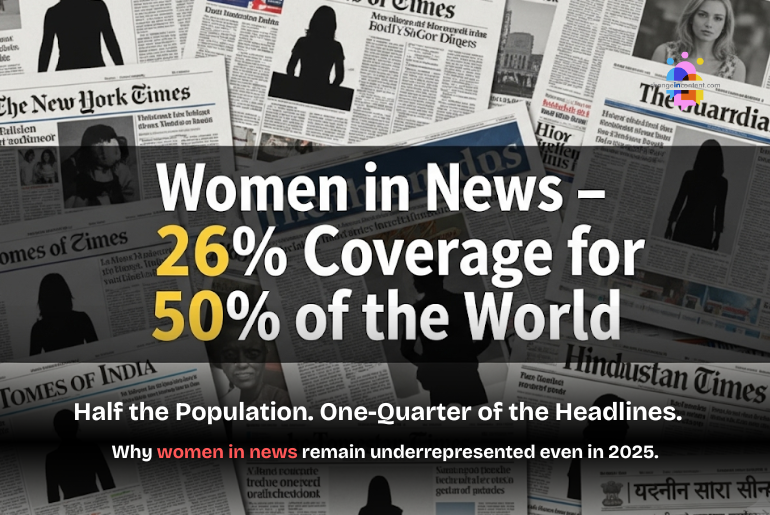
The 2025 GMMP findings make one fact clear: the misrepresentation and underrepresentation of women in news are not just a gap; they are a crisis for democracy. While women form nearly 50% of the world’s population, they appear in only one out of every four news stories. In India, the numbers are even worse. This imbalance shapes how society views power, leadership, and even violence, erasing women’s experiences from the nation’s most influential narratives.
Women in news: The numbers behind the silence
For thirty years, the Global Media Monitoring Project (GMMP) has tracked how women are represented in the news, whether as subjects, sources, or reporters, and compared their media visibility to that of men. Conducted every five years, it remains the most extensive and longest-running study on gender in media. Coordinated by the World Association for Christian Communication (WACC) with support from UN Women, this project highlights the gender gaps in media representation. It identifies areas where change is urgently needed.
The latest 2025 GMMP report states that while women make up half of the world’s population, they appear in only a quarter of news stories. This statistic has remained relatively unchanged over the past 15 years, with only a nine-point improvement since the project began three decades ago.
Underrepresentation and misrepresentation of women in news
The 2025 GMMP report highlights the continued underrepresentation and misrepresentation of women in global news. Out of 30,000 news stories analysed across 90 countries, only 26% included women as subjects or sources. Even in areas that directly affect women, such as gender-based violence (GBV), coverage remains minimal. Fewer than two in every hundred stories address GBV, despite the widespread impact it has on women worldwide.
Stories of abuse and violence, which should demand urgency, rarely reach headlines. When women appear in news about GBV, they are most often presented as victims or narrators of personal experiences. Men, meanwhile, are more likely to appear as experts, officials, or spokespersons. The study also noted that the occupation or role of many women featured in GBV stories, nearly one-third, was left unspecified, leaving their identity and authority ambiguous.
When roles are defined, men often appear as criminals, police, or legal professionals. Women, however, are more commonly portrayed as celebrities, homemakers, or children.
Regional differences and minority voices
Globally, women’s representation in the media varies by region. North America comes closest to parity, with four out of ten people in the news being women. In contrast, Asia and the Middle East show some of the lowest figures, with only 19% of news subjects being women.
The GMMP also reported how race, ethnicity, and other forms of identity influence media visibility. Across both traditional and digital news, only six in every hundred people featured come from racial, ethnic, religious, or other minority groups. Of these, women make up just 38%. The likelihood of a woman in the news being from a minority group remains less than 1 in 10.
The Indian context
In 2020, women made up only 14% of news subjects and sources across print, television, and radio in India. It represented a significant decline from earlier years, when the share was 22% in 2010 and 21% in 2015.
The 2020 Global Media Monitoring Project, which was coordinated in India by the Network of Women in Media, also revealed that far more male reporters covered stories across all major topics, including those related to gender. Women’s sources featured heavily in entertainment and activism but were nearly absent from positions of institutional power.
Around 60% of the women cited as sources came from entertainment or cultural fields, such as acting, singing, or writing. Very few women are quoted as spokespersons for institutions, governments, or organisations. In fact, that number fell to 8% in 2020, compared with 15% in 2015. Women in the Indian news are more likely to be presented as celebrities or activists rather than as leaders, experts, or decision-makers.
Newsroom diversity: When women report, women are heard
The 2025 report also found that the presence of women journalists makes a huge difference. When more women report, more women’s voices enter the public record.
Women reporters are slightly more likely to cover GBV than their male colleagues. When they do, they highlight the majority of the issues related to gender based violence, including the online form. Around half of the reports on technology-facilitated gender violence also come from women journalists.
Men still dominate reporting across newsrooms. However, the study found a slight shift in GBV coverage. Around 3% of female journalists report on GBV, compared with just over 2% of male journalists. Although the difference may seem small, it still matters. Stories reported by women were more likely to cover issues such as sexual harassment, assault, and intimate partner violence, while male reporters more often covered feminicide and trafficking.
Why newsroom diversity matters
All these points that newsroom gender diversity directly controls which stories get told and how they are framed. However, Stephanie Fillion, a freelance journalist and board member of the UN Correspondents Association, explained that many newsrooms struggle to prioritise gender representation. Journalists often work with fewer resources on representing women’s voices and limited time, which prevents them from digging deeper into whose voices get represented.
But there are small signs of progress
While the overall picture is discouraging, the study does record some progress. In 1995, women made up just 28% of reporters in traditional news. That number has grown to 41% today. Moreover, stories written by women journalists consistently feature more women as subjects, which is 29% compared to 24% in stories written by men.
Kalliopi Mingeirou, chief of the Ending Violence against Women and Girls Section at UN Women, described the report as both a roadmap and a reminder of stalled progress. She stressed that when only one in four people featured in the news is a woman, democracy suffers. Public discourse becomes distorted when women’s voices are absent, leaving incomplete narratives of society.
As Mingeirou stated, “Without women’s voices, there is no full story, no fair democracy, and no shared future.“
The final thoughts
Three decades of research reveal how little has changed in the portrayal of women in the news. Women remain just one-quarter of those represented, and gender-based violence remains a near-invisible subject despite its global impact. There has been some progress, particularly in the rising number of women journalists. Their presence leads to more inclusive coverage. However, without equal presence in the stories that shape public debate, women remain sidelined in the very spaces where power, culture, and democracy are defined.
Changeincontent perspective
At ChangeInContent, we believe news is not just about reporting events, but about shaping public consciousness. The underrepresentation of women in news does more than silence voices; it distorts reality. For true equity, the media must not only feature women but also reframe them as leaders, experts, and decision-makers, rather than just as victims or entertainers.
Also Read: Sexualisation of crimes in news media: TVR vs. addressing the real issues.
Disclaimer: The views expressed in this article are based on the writer’s insights, supported by data and resources available both online and offline, as applicable. Changeincontent.com is committed to promoting inclusivity across all forms of content. We broadly define inclusivity as media, policies, law, and history. It encompasses all elements that influence the lives of women and marginalised individuals. Our goal is to promote understanding and advocate for comprehensive inclusivity.