
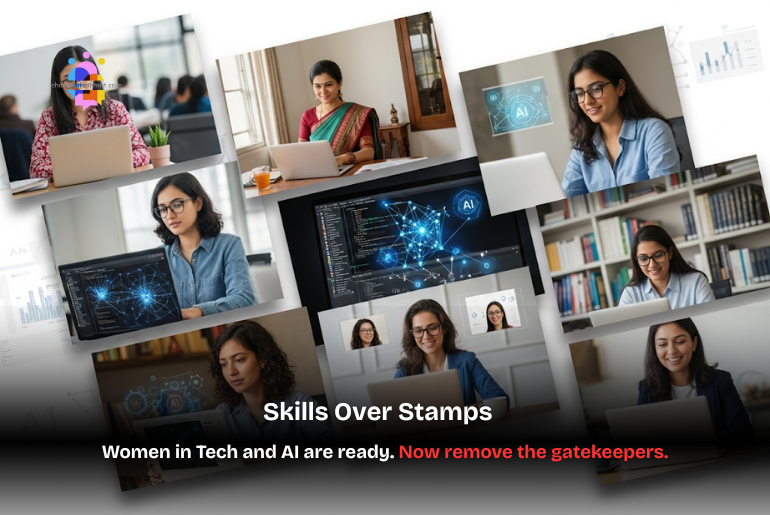
The story of Women in Tech and AI is about acceleration with friction. Apna.co’s 2025 survey shows women (especially Gen Z and those from Tier-2/3 cities) are sprinting toward AI skills to unlock better roles. But while intent is soaring, the runway isn’t smooth: access to quality opportunities, strong mentors, and advanced programs remains uneven. That gap is where ambition often stalls.
Women in tech and AI: The upskilling spike
AI skills matter more than ever, as the most in-demand professionals are those who know how to use it. Research already shows that workers who use generative AI perform almost 40% better than those who don’t. This is especially true for people in tech, especially women in technology.
A new 2025 survey from Apna.co finds that most women in tech, particularly those from Gen Z and smaller cities, are turning to AI skills as a means to advance in their careers. Yet, while most women in the tech sector recognize that AI-based skills can unlock better opportunities, equal access to upskilling remains out of reach.
78% of women in tech see AI as a career game-changer
On Engineer’s Day, Apna.Co, India’s leading jobs and careers platform, released a survey of more than 11,000 women working in technology. Over half of the respondents were from Gen Z, aged under 25, with nearly 60% coming from Tier 2 and Tier 3 cities, and almost two-thirds having studied at non-elite colleges. Most participants work in core technology roles, especially software engineering, design, data science, research, and IT security. The survey reports that 78% of women in tech believe that AI can help them access better and in-demand opportunities.
A significant takeaway is the strong preparation women are undertaking for the AI era. Around 58% said they are already learning AI or machine learning, either through their jobs, online courses, or self-study. Another 24% plan to start soon. In fact, 62% of younger women in Gen Z are actively developing these skills. Women from smaller cities and non-elite colleges are even more determined, with 70% saying they are already upskilling.
Their career goals are also very specific. Nearly half want to become AI software developers, while others are looking at data science, ML roles, product management, and research. These preferences indicate that women are opting for high-demand, industry-facing careers where AI expertise has become increasingly indispensable.
Women in tech say AI expertise matters more than elite colleges
For a long time, gaining admission to a top college was seen as the only way to succeed in India’s tech industry. A degree from a big-name institution often carried more weight than skills. However, the new survey indicates that this mindset is shifting. Today, nearly two-thirds of women in technology say that having up-to-date AI skills matters more than graduating from a prestigious college.
About 74% of respondents from Tier 2 and Tier 3 cities believe that skills determine career success more than a famous college name, compared to 66% of women in metro cities. Women who studied in non-elite colleges strongly share this view, with 56% saying that AI knowledge can create more opportunities than a degree from a top institution. On the other hand, only one-third of graduates from elite colleges agree. It shows that old ideas about hierarchy still influence some parts of the sector.
Instead of chasing recognition tied to where they studied, many now see expertise in AI as the real key to building a future in tech.
Women in tech and AI: Challenges still remain
Women in technology are eager to learn AI, but they still face real obstacles. The survey asked what holds them back from pursuing opportunities in AI. 42% said they need better access to quality opportunities, 27% mentioned a lack of mentorship, and 19% said advanced training programs are missing. These numbers indicate that while women are motivated, they require additional support to reach their full potential.
There have been numerous previous reports indicating that half of women lack the AI skills necessary to succeed. While both men and women work in jobs with varying exposure to generative AI, women are slightly more likely to hold office-based roles that AI is most likely to change. About 32% of men work in roles with the lowest AI exposure, compared to only 27% of women. Even then, women face challenges in acquiring the skills needed to adapt to these AI-driven changes.
Out of 1.6 million AI professionals worldwide, only 22% are women, and at leadership levels, they hold less than 14% of executive roles. Not to mention, women have fewer mentors or role models in senior positions. It is causing less access to high-profile projects that build experience.
Networking gaps, biases in hiring and evaluation, and expectations around long working hours can add further barriers. Unfortunately, workplace biases mean that women often require additional support, guidance, and access to resources to advance in high-paying, senior AI careers.
Nirmit Parikh, Founder and CEO of Apna.co, says, “This survey shows that women in tech are ready to embrace AI – not as a buzzword, but as a real driver of equal opportunity. At Apna, our mission is clear – when access meets intent, technology can power an inclusive workforce where opportunities are defined by skills and ambition.“
The final thoughts
The Apna survey concludes that women in technology are ready to upskill in the era of AI. They are learning, adapting, and aiming for high-demand roles where AI skills matter most. However, real progress depends on providing access, mentorship, and opportunities that match their drive.
Even when women understand the importance of AI, they often face additional hurdles compared to their male peers. If women have access to the right learning resources, guidance, and mentorship, they can fully develop the essential AI skills necessary for career growth.
Changeincontent perspective
At ChangeInContent, we’re bullish on this momentum, and blunt about the bottlenecks. Skills beat pedigree only when access is real: structured projects, visible mentors, and skill-based hiring signals. Companies that publish skill maps, pair women with sponsors (not just mentors), and measure promotions by outcomes (not optics) will win the next wave of AI talent.
Also Read: Women in AI: Underrepresentation, bias, and barriers.
Disclaimer: The views expressed in this article are based on the writer’s insights, supported by data and resources available both online and offline, as applicable. Changeincontent.com is committed to promoting inclusivity across all forms of content. We broadly define inclusivity as media, policies, law, and history. It encompasses all elements that influence the lives of women and marginalised individuals. Our goal is to promote understanding and advocate for comprehensive inclusivity.
