
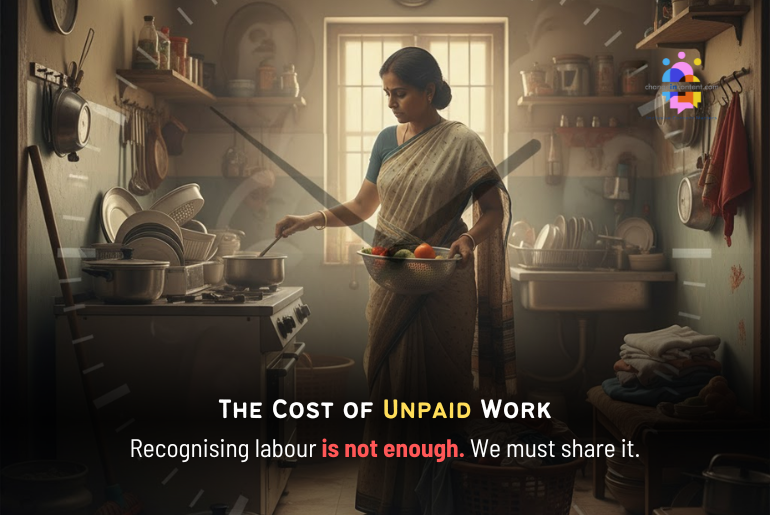
In 2023, a Spanish court ordered a man to pay his ex-wife €204,000 ($237,584) for 25 years of unpaid domestic work. The court calculated the amount using the minimum wage for each year the couple lived together. This case drew attention to the unpaid work that women quietly do 24 hours a day, seven days a week, that keeps families cared for and homes running.
In the Spanish case, the court found that the husband had allegedly prevented his wife from working outside the home, forcing her to financially depend entirely on him. For over two decades, she handled every household task, while her own opportunities for financial independence were taken away from her.
Unpaid domestic work and time poverty
Across the world, women bear the majority of domestic responsibilities, encompassing tasks such as cooking, cleaning, caring for children, and caring for the elderly. It not only leaves them overworked but also leads to “time poverty.” When women spend most of their day managing the household, they often have little to no time for rest, personal hobbies, education, or paid employment.
A woman might wake up at 5 a.m. to prepare breakfast and lunch for her family, get her children ready for school, clean the house, and care for an elderly parent. By the time she finishes, most of the day is already gone. Even if she wants to work or study, she simply doesn’t have the time or energy left.
Unlike paid jobs, household work doesn’t come with fixed hours or breaks. It persists throughout the day, often extending into the late night. Over time, time poverty also affects their physical and mental health.
Women’s unrecognised unpaid labour
A 2018 report by the International Labour Organisation shows that, on average, women in India spend 352 minutes, almost six hours, every day on household chores and caregiving, while men spend only about 52 minutes. According to the global data, women account for 76.2% of all unpaid care work, and in the Asia-Pacific region, this number increases to 80%.
Recent data from the 2025 Time Use Survey (TUS) show that traditional gender roles persist. Women spend around 140 minutes daily on caregiving activities, compared to just 74 minutes for men. In terms of total domestic responsibilities, women dedicate nearly 19.8% of their day to unpaid household work, while men account for only 2.7%.
The survey also highlights disparities in paid employment. On average, men spend 473 minutes (about 7.8 hours) per day on paid work, whereas women spend only 341 minutes (around 5.7 hours). This gap indicates that women continue to bear the majority of household responsibilities alongside their paid jobs, often resulting in a reduction in their paid work hours.
The cost of unpaid labour, as per the survey
According to a 2023 report by the State Bank of India, unpaid work contributes an estimated Rs 22.7 lakh crore to the Indian economy. That is roughly 7.5% of the country’s GDP. At the same time, experts point out that increasing women’s participation in the formal workforce could have an even greater impact. It has the potential to boost India’s GDP by as much as 27%.
These numbers demonstrate that acknowledging unpaid domestic labour and enabling women to join the workforce are essential steps for achieving economic growth and gender equality.
Does putting a price tag on domestic work close the gender gap?
There is a debate about whether women should be paid for domestic work. While some see payment as a way to recognise the value of household labour, others worry it might have unintended consequences. Many economists and social researchers believe that paying women for home-based work could actually worsen the very gender gap society is trying to close.
Their concern is that if women start receiving money for housework, it may encourage them to remain confined to domestic roles instead of seeking jobs outside the home. For instance, in countries where women already face pressure to stay home, families might use this payment as a reason to stop women from joining the workforce. Over time, this could further reduce the number of women in paid employment, limiting their exposure to new opportunities, professional growth, and financial independence.
Again, it will do nothing to prevent time poverty. She would still be working 24 hours, but this time for minimum wage. Her life would still revolve around what should or shouldn’t happen in the house. It will not do any good for women’s empowerment.
The issue of power dynamics
Another issue is the power dynamic it creates within households. If a husband becomes the one who pays his wife, it could reinforce the outdated idea that he controls the family finances. This kind of arrangement might unintentionally suggest ownership or dependence, instead of partnership and equality. Moreover, paying one family member from the same household income does not really increase the total income. It simply moves money from one pocket to another.
Even if a price tag is placed on domestic work, it raises a new set of questions and challenges. Should this labour be counted under the formal or informal sector of the economy? If it is recognised as work, will it be included in the country’s Gross Domestic Product (GDP), and if so, how will it be measured? Whether such payment would be taxed, and if so, how that would affect household finances. Valuing domestic labour requires careful consideration of economic, social, and policy implications.
The cost of unpaid work: Valuing women beyond wages
The goal, therefore, should not only be to compensate women for domestic work but to change how society views and shares that work. Actual progress lies in making household responsibilities a shared duty rather than assigning them to one gender. When men and women share household responsibilities, such as cooking, cleaning, and caring for family members, the burden becomes lighter. The value of this work is, of course, acknowledged.
A couple can split tasks equally. One does the cooking while the other handles laundry or childcare. This kind of arrangement also helps each partner appreciate the time and effort that goes into maintaining a household. Someone who has never done grocery shopping or cleaned a house might not realise how demanding those tasks can be until they experience them themselves.
Over time, this approach does more to promote gender equality than simply putting a price tag on women’s unpaid labour. Money can acknowledge effort, but it doesn’t change attitudes. Recognising domestic work is essential. However, real change will come only when everyone, regardless of gender, shares it equally.
Changeincontent perspective
At Changeincontent, we believe that we cannot build equality solely on compensation. Instead, the society must build it on shared responsibility.
The cost of unpaid work is not measured merely in rupees or minutes. It’s measured in dreams deferred, careers stalled, and fatigue normalised. While recognising unpaid labour is essential, paying for it does not solve the underlying issue: gendered expectations of care.
India’s economy already benefits from women’s unpaid labour. It is worth an estimated ₹22.7 lakh crore. This amount is equivalent to nearly 7.5% of the GDP. But recognition must go beyond economics. It must challenge why this work remains “women’s duty” in the first place.
Equality will not come from counting hours. Instead, it will come from redistributing them. When men share domestic responsibilities, homes become fairer, families stronger, and women freer to choose.
As this piece by Anagha P. reminds us: Money can measure labour, but it cannot measure justice.
Also Read: Workplace Invisible Labour: The hidden burden of “Office Housework”.
Disclaimer: The views expressed in this article are based on the writer’s insights, supported by data and resources available both online and offline, as applicable. Changeincontent.com is committed to promoting inclusivity across all forms of content. We broadly define inclusivity as media, policies, law, and history. It encompasses all elements that influence the lives of women and marginalised individuals. Our goal is to promote understanding and advocate for comprehensive inclusivity.
