A working woman does not just have one job. She juggles three full-time roles. First, there is her actual job, the one with a paycheck. Then, there is raising children, a responsibility that never clocks out. And finally, there is the invisible workload that includes all the behind-the-scenes mental and emotional work and handling the thousand tiny details that no one else seems to think about. She does it, all while ensuring the house runs smoothly. These tasks demand time, energy, and skill. Still, they come with zero pay and minimal acknowledgement. That is the hidden burden that we call ‘Workplace Invisible Labour.’
But let us not stop at domestic duties and care work at home. It is time to also talk about and address the invisible labour women take on in the workplace, not just in their homes.
What workplace invisible labour looks like
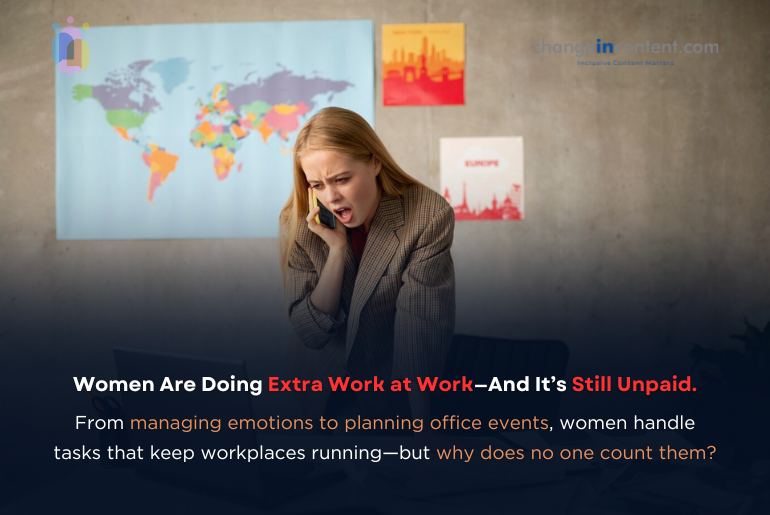
Invisible labour is not just a home issue. It exists at work, too. In the workplace, women spend more time on extra, unpaid, “non-promotable tasks” than men. Women are expected to plan office parties, organise team gifts, and remember birthdays. If a coworker faces a tough time, usually, a woman is made to volunteer to collect money, send flowers, or offer emotional support. Usually, women take notes and follow up with action points. If a new hire joins, they guide them through the transition. If there’s a diversity initiative, they are asked to lead it often without extra pay or recognition.
Sure, all these acts build a supportive workplace, improve team morale, and strengthen company culture. Yet, they are treated as secondary to “real” work. If they refuse, they risk being labelled unhelpful or cold. If they comply, they take on extra work that does nothing for their career. Meanwhile, men focus on tasks that lead to promotions and pay raises.
These tasks may not be in the job description, but somehow, they always find their way onto a woman’s plate. While men focus on high-impact work that leads to promotions, women get stuck managing the emotional and administrative upkeep of the office. This cycle continues because companies rely on it while refusing to acknowledge its value.
Being at higher risk of burnout
The Women in the Workplace report by McKinsey & Company and LeanIn.Org highlights how women, especially managers, take on extra “office housework” without recognition or reward. They plan team events, mediate conflicts, and check in on colleagues. At the same time, they handle the emotional labour that no one officially assigns but everyone expects.
When does this extra work happen? After hours, on weekends, and even during vacations. Women log off from their actual jobs only to keep working in ways that don’t count toward promotions or pay raises. Nearly 40% of women managers have thought about quitting or cutting back their hours, not because they can’t handle leadership but because leadership, for them, comes with an unpaid second job.
This exhaustion doesn’t end at the office. After work, many women step into their “second shift” at home. They handle more housework and caregiving than men, adding another layer of unpaid labour to their already overloaded schedules. While men are more likely to unwind after work, women make dinner, clean up, help with homework, and mentally organise the next day.
How the invisible labour worsens the pay gap
Women don’t just earn less because of lower wages. They also lose money over a lifetime by doing work that doesn’t count. Time spent on invisible labour means time not spent on high-impact tasks that lead to promotions and raises.
Harvard Business Review defines non-promotable tasks as those that benefit the company but don’t contribute to performance evaluations or career growth. Women take on these tasks more often, filling in for absent colleagues, serving on low-visibility committees, and managing duties that don’t move them up the ladder.
While men are strategising, leading major projects, and getting noticed by executives, women are planning office events, mentoring new hires, and handling workplace conflicts. These responsibilities help the organisation but do nothing for the person doing them.
Networking also takes a hit. High-value projects put employees in front of decision-makers who influence promotions. Meanwhile, the ones organising team-building activities and handling office morale remain behind the scenes. No one gets a raise for being the one who remembers birthdays.
The final thoughts on the workplace invisible labour
Women handle the unspoken tasks that keep both offices and homes running. Still, this work remains undervalued, unrecognised, and unpaid. While companies praise team players, they fail to see how much of that teamwork depends on women doing extra, unnoticed work.
The solution is not for women to “just say no” to extra tasks. It is for workplaces to stop assuming they will say yes. Companies must stop treating invisible labour as an endless resource and start compensating it fairly. Leadership roles for women shouldn’t come with a hidden second job.
The burden of Workplace Invisible Labour is just one side of the coin. As we highlighted in our previous piece on the double shift and invisible labour, women already carry the weight of unpaid labour at home.
Whether in professional spaces or personal lives, women are expected to handle tasks that go unnoticed and unpaid. At Changeincontent.com, we continue to push for a world where women’s work—visible or invisible—is recognised and compensated. That is why we advocate for #NoWomensDay: token celebrations will never fix the systemic inequalities women face every day.
Disclaimer: The views expressed in this article are based on the writer’s insights, supported by data and resources available both online and offline, as applicable. Changeincontent.com is committed to promoting inclusivity across all forms of content. We broadly define inclusivity as media, policies, law, and history—encompassing all elements that influence the lives of women and marginalised individuals. Our goal is to promote understanding and advocate for comprehensive inclusivity.