
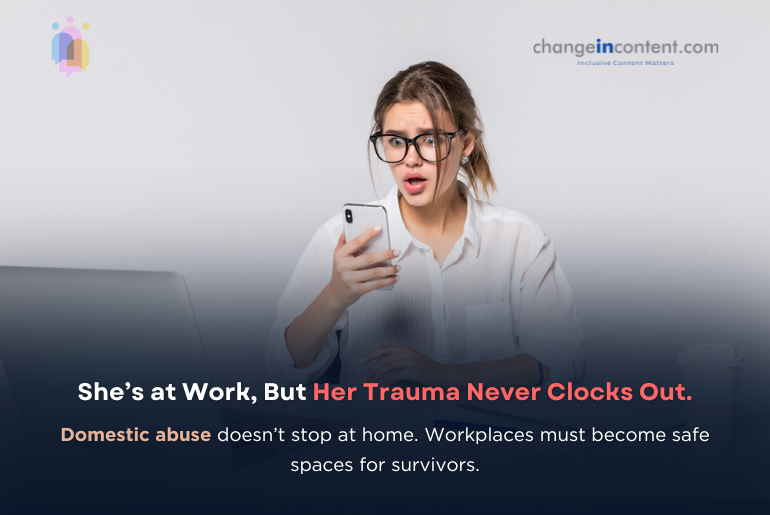
According to NCADV.org, 1 in 3 women and 1 in 4 men have faced physical violence from an intimate partner. That’s not just a statistic. It’s a reality that many of our colleagues might be silently dealing with while trying to meet deadlines and smile through Zoom calls.
I remember that many years back, during my stint at a print media company, I thought I was happy. I was reasonably successful and pretty, married the man I loved, and was living in Mumbai. Since everything was going great, I bought our first home, and everything seemed perfect. What was not ok was that I used to break into hives. I didn’t know why. One day, my manager, a woman in her 50s, asked me why my husband kept calling me so many times at work. I was surprised by her question. Little did I know that I was living with a man who was a control freak and was suspicious and keeping track of my movements. My hives were the tell-tell signs of the emotional abuse I was subjected to.
The workplace as a safe space
If she hadn’t asked me the question, I would not have questioned his calls. But what was happening was that I was perennially stressed. Even when I had to put my phone on silent before a meeting, I would give a call to my spouse and tell him that I would not be available for the next two hours. If the meeting lasted beyond two hours, every additional moment was agony for me. I knew I would come out and had to call him as there would be many missed calls from his end.
I still attribute my conversation with the great grand lady of Print Media to being an eye-opener. She made me think, and that was a starting point. I recognised the symptoms of abuse. The rest is another story. Very strangely, sometimes abuse creeps in slowly. The abuser behaves in a certain way, which the victim thinks is normal behaviour.
I am not saying that HR or colleagues should play therapist or solve someone’s personal issues. That’s unrealistic and, frankly, outside the job description. However, the workplace is often one of the few places where we spend 8-10 hours a day. A victim can be supported and be made to feel safe here, especially if they’re dealing with control, financial abuse, or physical threats at home.
Signs of domestic abuse in the workplace: What to pay attention to
There are signs. If a usually engaged colleague suddenly withdraws, frequently arrives late, takes an unusual number of personal calls, or has visible injuries with vague explanations, something might be wrong.
Your role as a manager or coworker allows you to provide necessary support, but victims of domestic abuse may not openly ask for help. So, learning to spot the signs and respond appropriately matters.
1. Shifts in social behaviour
- Always cancels plans or avoids after-work events
- Looks stressed, unfocused, exhausted and is high-strung
- Abuse makes one feel isolated and quieter in some cases
2. Controlling partner behaviour
- Receives constant calls, texts, or emails from their partner
- Does not allow their partner to travel for work
- May pressurise the partner to not accept a promotion in lieu of working extra hours
- May pressurise the partner to quit altogether
3. Physical and emotional changes
- Wears long sleeves in summer or sunglasses indoors for possibly hiding injuries
- Mood shifts after speaking with their partner
- Seems anxious, depressed, or frequently cries
4. Workplace performance and attendance
- Frequently takes PTO or arrives late without an apparent reason
- Shows a drop in performance, seems distracted or misses deadlines
- Stays at work unusually late, avoiding going home
5. Harassment and intimidation at work
- Their partner or ex shows up at the office unannounced
- They receive excessive or threatening phone calls
- Coworkers or HR receive messages from their partners questioning their whereabouts
Not all abuse leaves visible scars. Emotional, verbal, and financial abuse can be just as damaging, yet they often go unnoticed because they don’t fit the dramatic image of domestic violence we see in the media.
What you can do after noticing the signs of domestic abuse in the workplace
A supportive workplace notices every employee. It means building an environment where every employee is seen.
Here’s what can help:
- Support Systems: An organisation can work as a proxy family. The first step is to create a culture where employees feel safe enough to share concerns, regardless of gender. All genders get abused.
- Access to Resources: Partner with organisations that support domestic abuse survivors and make that information easy to find.
- Manager Training: Helping leaders recognise signs of abuse and respond appropriately. Training can also teach you how to approach the situation with care and sensitivity.
- Flexible Leave Policies: Understanding that some employees might need time off to deal with legal or personal matters related to domestic violence.
- Respect their choices: Regardless of your personal views, respect your coworker’s choices. Offer support without pushing advice or pressuring them into action.
Why this matters
Sometimes, it’s as simple as noticing, offering a quiet moment to check in, keeping HR informed, and making resources available without forcing the issue. While it is not the role of an organisation to intervene in trying to sort out domestic problems, it can be a place which recognises signs of suffering and becomes a support system for the one at the receiving end.
We strongly urge leaders to talk to their teams regularly in informal settings, facilitate open conversations, ensure that every employee is encouraged to meet with counsellors or mental health professionals periodically and assess how their employees are feeling. Helplines, in-house apps, and open discussions can help the person who needs it the most.
Signs of domestic abuse in the workplace: The final thoughts
Domestic abuse does not end when a survivor enters the workplace. It follows them through unseen emotional trauma, constant fear, and the pressure to carry on as if everything is normal. That is why we need systemic change, not just awareness.
At Changeincontent.com, we advocate for workplaces that do more than offer tokenistic Women’s Day celebrations—ones that create real, safe spaces where every woman, including survivors, is supported. #NoWomensDay is not about rejecting progress—it is about rejecting performative gestures when real change is still out of reach.
For more information about domestic violence resources, please see the following:
Domestic Violence | Deserted Indian Women
National Commission for Women › helplines
Disclaimer: The views expressed in this article are based on the writer’s insights, supported by data and resources available both online and offline, as applicable. Changeincontent.com is committed to promoting inclusivity across all forms of content. We broadly define inclusivity as media, policies, law, and history—encompassing all elements that influence the lives of women and marginalised individuals. Our goal is to promote understanding and advocate for comprehensive inclusivity.

1 comment
So well written . Covered all the “silent” pointers . So many times , abuse is silent , the symptoms remain unidentified