
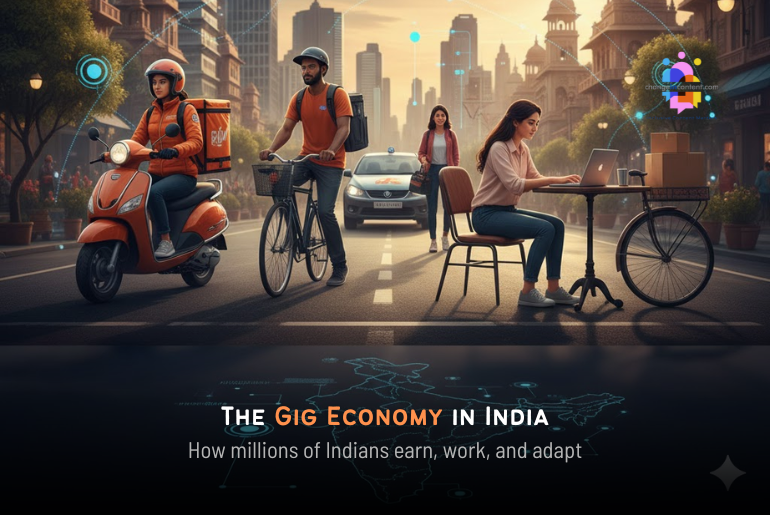
The Gig Economy now plays a central role in India’s labour market. In 2024, India’s gig economy was projected to be worth USD 455 billion. It is growing at a compound annual growth rate of 17%. By 2030, the country’s gig workforce is projected to reach 23.5 million. That is about 4.1% of the total workforce and nearly 6.7% of the non-agricultural workforce. At that scale, gig work could account for 1.25%-2.5% of India’s GDP.
But numbers alone do not explain what this shift really means.
When people hear the term gig workforce, many think only of food delivery riders. While they are a visible part of this system, the gig economy is far broader. It includes freelancers, platform workers, service providers, drivers, consultants, creators, and many others whose work does not fit into traditional full-time employment.
To understand the gig economy, we first need to understand who gig workers are and what makes this form of work fundamentally different.
Who is a Gig Worker?
So, who exactly counts as a gig worker? In simple terms, gig workers are often called independent contractors or freelancers. Most of us already know about and regularly work with freelancers in technology, content creation, online tutoring, marketing, tele support, and other digital services.
At the same time, the gig workforce goes far beyond laptops and home offices. Food delivery partners, doorstep delivery workers, last-mile logistics staff, drivers, online home services, and warehouse runners are also gig workers.
What really defines a gig worker is not the type of job, but the work arrangement. Gig workers earn income outside traditional, long-term, direct-hire employment. They undertake short-term, flexible work, often contingent on demand. That is the defining characteristic of the gig economy, a labour market built around temporary and flexible jobs.
Today, about 47% of gig workers are in medium-skilled jobs. Around 22% work in high-skilled roles, while about 31% are in low-skilled jobs. This mix shows how diverse the gig workforce truly is.
What is the Gig Economy?
The gig economy refers to a labour market where work is organised around short-term tasks, projects, or services rather than long-term employment contracts. Instead of being hired permanently by one employer, workers take on “gigs.” It refers to temporary assignments that you often get through digital platforms.
These platforms act as intermediaries. They connect workers to customers, set basic rules for payments and access, and use technology to manage demand, ratings, and performance. Workers, in turn, remain formally independent rather than employees.
This structure offers flexibility and speed but also shifts risk from companies to workers. Income depends on availability, demand, and platform rules rather than fixed salaries or benefits. This trade-off lies at the heart of the gig-economy debate.
Opportunities created by the Gig Economy
The gig economy has created numerous new opportunities, and its impact is expected to grow. By 2030, the gig economy could generate around 90 million jobs in the long term. It indicates a significant change in how people find work and earn a living.
A white paper released in September 2025 surveyed more than 90,000 residents across 15 districts in Delhi-NCR and included direct interviews with gig workers. It found that 70% of gig workers earned higher disposable incomes through flexible roles on platforms like Amazon, Flipkart, and Meesho. [The Economic Times]
The food delivery platform sector generated ₹1.2 trillion in gross output in 2023–24 and grew faster than the overall economy. During the same period, the sector directly employed 1.37 million workers, up from 1.08 million in 2021–22. Beyond direct jobs, each platform-linked role supports 2.7 additional jobs across the wider economy. This makes food delivery one of the largest sources of gig jobs in India’s services sector.
Why are more people turning to gig work?
For many workers, gig jobs make it easier to earn a living on their own terms. Flexible working hours mean people can choose when and how much they work. It benefits those who cannot adhere to fixed office schedules due to family duties, studies, or other responsibilities. Gig work also allows faster entry into income generation. Instead of waiting months for interviews and job offers, workers can often start earning within days.
Another key advantage is access to bigger markets. Through digital platforms, workers in small towns can take up jobs linked to urban centres or even global clients. As a result, it expands income options that were previously limited by location.
Why gig work appeals to students and early-career workers?
This kind of flexibility is most important for individuals who face barriers in regular jobs. Many women juggle unpaid care work and social expectations, which makes full-time office roles difficult to maintain.
Students use gig work to earn while studying, without dropping out or missing classes. Workers in smaller cities benefit because they no longer need to migrate just to find work. In this way, gig work helps people overcome social, educational, and location-based barriers that often exclude them from traditional employment.
Women have benefited from gig work through flexible hours and easier access to income, but it also comes with certain challenges, which we will explore in our next article on Women and Gig Work.
Changeincontent perspective on the Gig Economy
At Changeincontent, we view the gig economy neither as a silver bullet nor as a crisis. It is a system that reflects modern realities of urbanisation, digital access, rising living costs, and the need for flexible income.
For many, gig work has opened doors that traditional employment never did. At the same time, its rapid expansion raises serious questions about job security, worker protections, and long-term sustainability. Understanding the gig economy clearly is the first step toward designing policies and platforms that protect dignity without killing flexibility.
Summing up
The gig economy has become a major source of jobs, income, and opportunity for a wide range of workers, from high-skilled professionals to entry-level freshers. Millions of workers now enter the labour market through short-term, flexible roles that match their time, skills, and personal realities.
The gig economy brings both promise and responsibility. Its rapid growth and broad reach demonstrate how it generates income, supports households, and strengthens the national economy. Yet, this growth also raises important questions about the quality of work, income stability, and long-term security for those who depend on it.
Disclaimer: The views expressed in this article are based on the writer’s insights, supported by data and resources available both online and offline, as applicable. Changeincontent.com is committed to promoting inclusivity across all forms of content. We broadly define inclusivity as media, policies, law, and history. It encompasses all elements that influence the lives of women and marginalised individuals. Our goal is to promote understanding and advocate for comprehensive inclusivity.
