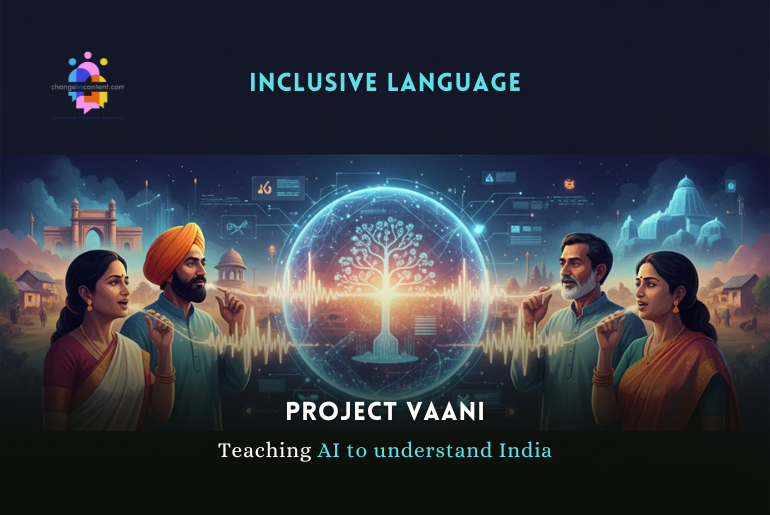
India is home to hundreds of languages and thousands of dialects, many of which change every few kilometres. Yet most AI tools still operate only in English and Hindi, and at best in a handful of regional languages. Even then, they struggle with the dialects and speech patterns people actually use in daily life. That is where Project Vaani becomes significant.
Designed to make artificial intelligence accessible, inclusive, and representative, Project Vaani aims to capture how India really speaks. Once complete, it will include more than 150,000 hours of speech data from every district in the country. That will make it one of the largest and most diverse speech datasets ever created in India.
At its core, Project Vaani recognises a simple truth: AI cannot serve people it does not understand.
What is Project Vaani?
Project Vaani is a large-scale, open-source initiative led by ARTPARK, IISc Bengaluru, and Google. The project aims to give voice to every Indian language and dialect by building one of the most comprehensive speech datasets in the country. Its goal is to collect more than 150,000 hours of speech and over 15,000 hours of transcription from more than 1 million people across all 773 districts of India.
Under Project Vaani, teams will gather speech samples over three years, covering the wide range of languages spoken across the country. The project follows a district-anchored approach, where more than 1,000 people are randomly selected from each district. This method helps capture real, everyday speech while ensuring diversity across education levels, urban and rural areas, age groups, gender, and other key factors.
The estimated cost of the initiative is approximately USD 30-40 million. The work forms part of IISc and ARTPARK’s Bhasha AI programme. It also includes RESPIN (Recognising Speech in Indian languages) and SYSPIN (Synthesising Speech in Indian languages). As part of the effort, IISc and Google will record about 1.5 lakh hours of speech, with a portion transcribed in local scripts.
The gender balance in Project Vaani
In addition to district-level diversity, Project Vaani also focuses on gender balance. The dataset includes 45.57% male audio and 54.37% female audio, which stands out in an AI space where women often remain on the sidelines. Many AI systems fail to represent women properly, both in the tools used for training and in how people use them.
Most voice-based technologies often struggle to recognise Indian women’s speech, accents, and pitch, especially in regional languages. By adding more women’s voices, Project Vaani builds AI systems that understand and respond better to women users. It improves the reliability of voice assistants, helplines, and other digital services.
The impact could be even stronger in rural areas, where many women rely on voice-based tools due to lower access to smartphones, keyboards, or digital literacy. AI that understands women’s speech in local languages can improve access to education platforms, health services, government schemes, and financial tools. In that sense, Project Vaani does not just improve technology. It helps ensure that more women, especially in rural India, can actually use and benefit from it.
How this project can help
Project Vaani aims to make AI systems in India more inclusive, useful, and based on how people actually speak. By building and sharing high-quality language data, the project can support better tools, wider access, and inclusive innovation across sectors.
Open and accessible language data
All datasets created under Project Vaani will be carefully curated and made open-source. The current version of the data is already available, and future releases are expected through platforms such as Bhashini under the National Language Translation Mission of MeitY. This open access allows researchers, startups, and developers to build and improve language technologies without starting from scratch.
Better speech and language technologies
Project Vaani will supplement core technologies like automatic speech recognition, speech-to-speech translation, and natural language understanding. Since the data reflects how people in India speak in real life, these tools can work more accurately across accents, dialects, and regions.
Reduced language barriers
One of the key goals of the project is to lower language barriers in technology. By supporting more Indian languages and dialects, digital tools can reach people who often get left out because they do not use English or other standardised forms of major languages.
Support for a new-generation AI language model
In the long term, Project Vaani will help build an AI-based language model that understands India’s linguistic diversity. This model will support both speech and text translation, marking a major shift from the earlier MuRIL model, which focused only on text.
The curated speech dataset from Project Vaani is already helping build and fine-tune AI models across several real-world applications. These include vernacular voice assistants that understand local speech patterns, regional translation engines that support multiple languages, and accessible communication tools for the visually impaired.
The data also supports AI-driven edtech platforms aimed at rural students, making learning tools more inclusive and easier to use. Beyond education, it supports rural telemedicine by enabling clearer communication between doctors and patients. Government and civic platforms benefit too, with voice-based citizen services becoming more responsive.
The closing thoughts
Project Vaani is a good example of what linguistic inclusion in AI can look like. By capturing real speech from across regions, dialects, and genders, it shows how technology can reflect how people actually communicate. This kind of effort moves AI beyond a few dominant languages and brings it closer to everyday users. Moreover, AI datasets should actively include women and their voices. When AI tools respect linguistic diversity from the start, they become more useful, fair, and accessible.
Changeincontent perspective
At Changeincontent, we see Project Vaani as a reminder that inclusion must begin at the data level. AI cannot be fair, accessible, or useful if it only understands a small, privileged slice of society.
By capturing real speech from women, rural users, and diverse communities, Project Vaani shows how technology can be built responsibly. This is not just about better AI products. It is about ensuring that India’s digital future does not silence the very people it claims to empower.
Also Read: AI and Women: AI follows women’s searches but not their struggles.
Disclaimer: The views expressed in this article are based on the writer’s insights, supported by data and resources available both online and offline, as applicable. Changeincontent.com is committed to promoting inclusivity across all forms of content. We broadly define inclusivity as media, policies, law, and history. It encompasses all elements that influence the lives of women and marginalised individuals. Our goal is to promote understanding and advocate for comprehensive inclusivity.