
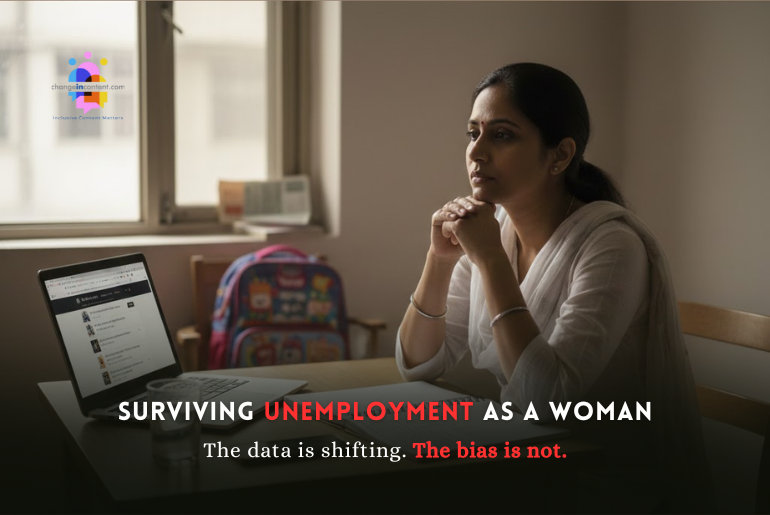
Surviving unemployment as a woman in 2026 is a lot more than just about finding the next job. It is about surviving the emotional theatre that unemployment triggers. The theatre is a mix of the polite questions, the unsolicited advice, and the quiet suspicion that you are no longer “serious.” At the same time, it is about the pressure to pretend you are fine so that you still look “hireable.”
India’s labour market data indicate that more women are entering the workforce, which is progress. But the lived experience of unemployment is still deeply gendered. The data can show participation and unemployment rates. It cannot show the invisible labour women do while unemployed, the unpaid caregiving that quietly eats into job-search hours, and the way “career gap” becomes shorthand for “less capable.”
This piece is a blend of both. The data, in its cleanest form. And the reality, in its messiest form.
Surviving unemployment as a woman: The numbers we cannot look away from
The latest Periodic Labour Force Survey (PLFS) monthly bulletin shows that India’s overall labour force participation rate for people aged 15 years and above rose to 56.1% in December 2025. Female participation also reached an annual high of 35.3%. Rural female participation reached 40.1%, while urban female participation stood at 25.3%.
On paper, this is a hopeful headline. More women are participating. More households are seeing women step into paid work, even if it is not always formal, even if it is not always secure.
The uncomfortable part
The unemployment rate (UR) for persons aged 15 years and above was 4.8% in December 2025. Urban unemployment rose to 6.7%, and urban female unemployment was 9.1% in December 2025. It is down slightly from 9.3% in November, but it remains one of the most significant pain points.
While the doorway into the workforce is widening, the corridor ahead still has traps. These traps are particularly prevalent among women in cities. They include a high cost of living, fewer safety nets, greater competition for formal roles, and a job market that can turn “potential” into a euphemism for “cheap.”
One more detail matters: these monthly estimates are based on a large sample, with 3,73,990 persons surveyed across rural and urban India. The numbers are not vibes. They are signals.
The context: What the PLFS data is actually capturing
PLFS is India’s primary official source for employment and unemployment trends. From January 2025, the methodology was modified to provide monthly and quarterly estimates. The monthly bulletin reports key indicators using the Current Weekly Status approach.
That means the data is designed to track movement, not only snapshots. It tells us when participation rises, when unemployment holds steady, and where the pressure is accumulating.
And right now, the pressure is accumulating in a very familiar place. Women are participating more, but stable, dignified employment still does not rise at the same pace.
Why it hurts more than it “should”: The gendered psychology of unemployment
Most people usually frame unemployment as a market problem. However, for women, it becomes a character trial.
A man without a job is “in transition.” A woman without a job is “not managing.” People do not always say it loudly. They imply this through tone: perhaps you should try something smaller, perhaps you should take a break, perhaps you should be realistic. Meanwhile, the world continues to expect unpaid labour from women at full volume. It comes in the form of care work, housework, emotional management, and family logistics. None of it goes away because a salary slipped.
This is why surviving unemployment as a woman is more than a financial challenge. It is an identity challenge.
And it gets sharper when a woman is experienced.
The economy loves experienced men because experience is “leadership.” The economy fears experienced women because experience is “cost.” The same years become wisdom in one body and inconvenience in another.
The myth that women lack ambition (and what the system conveniently ignores)
Across workplaces globally, the conversation keeps circling the same lazy question: why do women step back?
A better question is: what exactly are women stepping back into?
When roles are rigid, support is inconsistent, and growth is tied to proximity rather than merit, stepping back no longer feels like a choice. In reality, it begins to resemble self-preservation. Research on women’s careers continues to show that support, sponsorship, and visible opportunities are what keep women moving upward, not motivational slogans.
Unemployment is often where this gap becomes visible. Women who were already under-supported inside workplaces become even more under-supported outside them. There is no “pipeline” when you are not even inside the building.
Surviving unemployment as a woman: What to do when the job market is slow, but your bills are not
Let us get practical, without turning this into a lecture.
First, treat unemployment like a project with two parallel tracks: cashflow and credibility. Cashflow keeps you afloat. Credibility keeps you in the conversation. If you only chase credibility, you burn out. If you only chase cashflow, you risk getting locked into work that does not move you forward.
Understanding cashflow
Cashflow can include interim consulting, short-term contracts, part-time operational roles, teaching, or project-based work. It can also mean returning to a skill you had set aside for years because full-time work required a single identity. There is no shame in patchwork income. There is only shame in a system that demands dignity but does not offer stability.
Understanding credibility
Credibility is about visible proof of current relevance. Not performative LinkedIn posting. The real proof is a portfolio, a live project, a case study, a small build, a certification that maps to roles, a published piece, or a volunteer consulting project with measurable outcomes. If you have a career gap, the market tends to fill it with assumptions. Your job is to fill it with evidence.
Now the most challenging part: do not let rejection become narrative. Rejection is information, not a verdict. You can mourn it. But you cannot worship it.
What organisations must stop pretending they do not control
Women’s unemployment is not only a supply-side story where women must “upskill more.” It is also a demand-side story. This story shows how organisations hire, how they screen, who they trust, who they assume will “stay,” and whose life responsibilities they punish.
If organisations want talent in 2026, they need to move from sympathy to systems.
They need hiring that does not penalise career breaks. Screening that does not treat motherhood like a risk factor. Return-to-work pathways that are not charity. Role design that recognises that flexibility is not a perk, but infrastructure. And leadership that understands: when women drop out, it is not only women who lose. Organisations lose institutional memory, stability, and depth.
The changeincontent perspective: Why we are writing this, and what we are building
At Changeincontent, we do not publish stories to decorate timelines. We publish them to make workplaces harder to ignore.
When we write about unemployment, we are not only writing for jobseekers. We are writing for managers who quietly filter out career breaks. At the same time, we write for leaders who demand loyalty but cut safety nets. We also write for systems that celebrate women’s participation while refusing to fund women’s stability.
If you are an organisation looking to improve in 2026, talk to us. We help teams audit inclusion gaps, review policies through an equity lens, design return-to-work programmes, strengthen manager capability, and run workshops that move beyond posters and into real practice. Quiet change is still change, as long as it is measurable.
The closing thoughts
If you are unemployed right now, and you are a woman, you are not invisible because you lack value. You are invisible because the market has learned to price women’s labour without respecting women’s lives.
But data is shifting. Participation is rising. The question is whether dignity rises with it.
Surviving unemployment as a woman in 2026 should not require perfect optimism. It should require fairness. Until then, we do what women have always done: we adapt, we build, we stay visible, and we refuse to disappear quietly.
Disclaimer: The views expressed in this article are based on the writer’s insights, supported by data and resources available both online and offline, as applicable. Changeincontent.com is committed to promoting inclusivity across all forms of content. We broadly define inclusivity as media, policies, law, and history. It encompasses all elements that influence the lives of women and marginalised individuals. Our goal is to promote understanding and advocate for comprehensive inclusivity.
