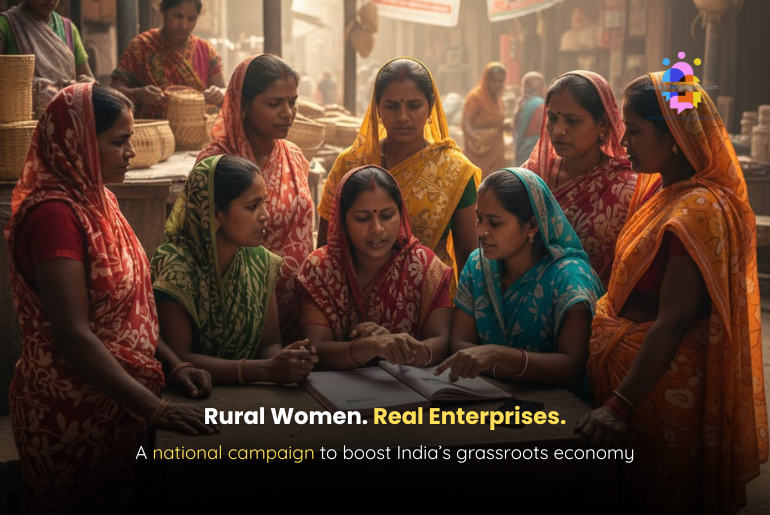
The government’s latest move to boost rural women entrepreneurship signals an important development. It shows a shift from viewing rural women as beneficiaries to recognising them as economic actors.
On January 12, 2026, the Ministry of Rural Development launched a National Campaign on Entrepreneurship under the Deendayal Antyodaya Yojana – National Rural Livelihoods Mission, with an ambitious goal. The government aims to train 50,000 community resource persons and provide entrepreneurship development training to 50 lakh women associated with self-help groups.
At the heart of this campaign lies a larger promise: building non-farm livelihoods that can sustain rural incomes beyond agriculture and bring women-led enterprises into India’s formal economic imagination.
Policy context: Why rural women entrepreneurship matters
For decades, rural livelihoods in India have remained vulnerable to climate shocks, seasonal employment, and market volatility. Agriculture alone has not been enough to provide stable, year-round incomes. Women, in particular, have borne the brunt of this instability. They end up working long hours in unpaid or underpaid roles while remaining largely invisible in economic data.
The Deendayal Antyodaya Yojana – National Rural Livelihoods Mission aims to change that trajectory. By organising women into self-help groups and linking them to credit, skills, and markets, DAY-NRLM has already demonstrated that collective economic agency works. The new campaign builds on this foundation by explicitly encouraging women to pursue enterprise ownership, not just income supplementation.
What the National campaign on entrepreneurship actually proposes
Launched by the Additional Secretary, Rural Development, the campaign is structured around scale and sustainability. The government has committed to creating 3 crore “Lakhpati Didis” by expanding non-farm livelihood opportunities. Lakhpati Didis are women earning at least ₹1 lakh annually.
The campaign focuses on two clear pillars.
- First, it aims to train 50,000 community resource persons to act as on-the-ground enterprise enablers. These women will identify viable business opportunities, guide start-ups, mentor entrepreneurs, and provide long-term handholding.
- Second, it seeks to provide entrepreneurship development programme (EDP) training to 50 lakh self-help group members, dramatically widening the pipeline of rural women with business skills.
This is not a pilot. It is a scale play.
Why non-farm livelihoods are central to this shift
Non-farm enterprises (small manufacturing units, food processing, services, retail, repair, logistics, and micro-entrepreneurship) have quietly emerged as one of the most resilient income pathways in rural India. Unlike agriculture, they are less exposed to monsoon cycles. At the same time, they allow women to participate without migrating or abandoning care responsibilities.
Previous initiatives, such as the Start-up Village Entrepreneurship Programme, show excellent results. They show that when rural women receive training, access to credit, and mentoring, enterprise survival rates improve significantly. This campaign seeks to replicate and multiply those outcomes nationally.
The role of community resource persons: The quiet backbone
The decision to invest in community resource persons is arguably the most critical aspect of this policy. Rural entrepreneurship does not fail because women lack ideas or effort. It fails because of weak market linkages, inconsistent mentoring, and early-stage risk exposure.
By creating a trained cadre embedded in communities, the campaign directly addresses these gaps. Let us not mistake these women as external consultants. They understand local markets, social constraints, and trust networks. Their role is not symbolic; it is structural.
Scaling rural women entrepreneurship without this layer would be unrealistic.
Who is involved and why that matters
The launch event brought together an unusual mix of state, financial, and knowledge institutions. Alongside senior officials from the Ministry of Rural Development were representatives from NITI Aayog and the National Bank for Agriculture and Rural Development. At the same time, there were organisations such as the Bill and Melinda Gates Foundation, IFMR LEAD, EDII, and IIM Calcutta Innovation Park.
This signals an intent to move beyond training alone and strengthen access to finance, data, research, and innovation. If these linkages translate into real credit flow and market access, the campaign’s impact could extend well beyond livelihood numbers.
Push for Rural Women Entrepreneurship: What this could change on the ground
If implemented with integrity, this campaign could alter three long-standing realities.
- First, it could normalise women as enterprise owners, not just contributors.
- Second, it could diversify rural economies, reducing overdependence on agriculture.
- Third, it could build financial credibility for women-led enterprises. That will open doors to formal loans rather than informal debt.
However, scale also brings risk. Training without follow-up, targets without quality checks, or credit without market access could turn this into another well-intentioned but diluted programme. Execution will decide everything.
The changeincontent perspective
At Changeincontent, we have consistently argued that real inclusion begins at the margins. We do not view rural women entrepreneurship as a “women’s issue.” We see it as an economic strategy. When women earn, they reinvest locally in education, health, and community resilience.
This campaign has the bones of a transformative policy. What it needs now is sustained political will, transparent monitoring, and a refusal to treat numbers as a measure of success. Lakhpati Didis cannot remain a headline. They must become a lived reality.
India’s push for Rural Women Entrepreneurship: Conclusion
Boardrooms alone cannot fulfil and shape India’s ambition to build a resilient, inclusive economy. It will be shaped in villages, markets, and small enterprises led by women who have waited long enough for recognition.
The National Campaign on Entrepreneurship is a step in that direction. Whether it becomes a turning point will depend on how seriously we take rural women, not as symbols, but as entrepreneurs.
Also Read: Bibi Fatima SHG wins UNDP’s ‘Nobel for Biodiversity’—Women-led farming goes global.
Disclaimer: The views expressed in this article are based on the writer’s insights, supported by data and resources available both online and offline, as applicable. Changeincontent.com is committed to promoting inclusivity across all forms of content. We broadly define inclusivity as media, policies, law, and history. It encompasses all elements that influence the lives of women and marginalised individuals. Our goal is to promote understanding and advocate for comprehensive inclusivity.