
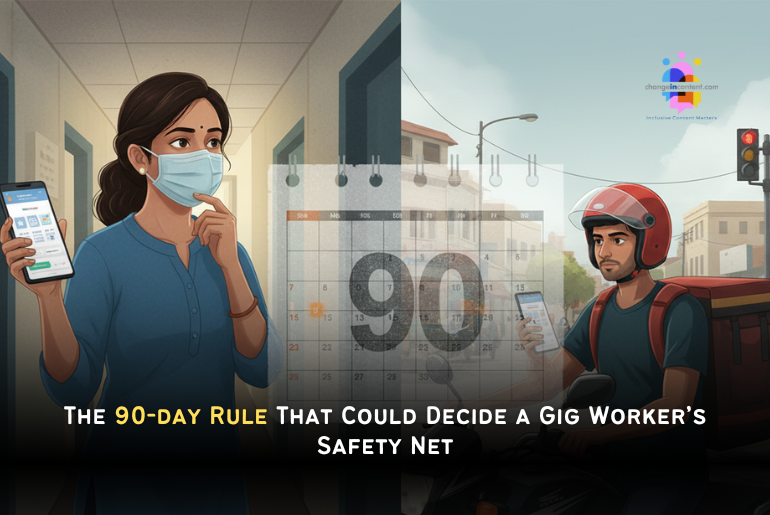
Labour laws exist to protect workers from unfair pay, unsafe jobs, and sudden loss of income. They set the ground rules for wages, work hours, and basic safety. In fast-growing work models like the gig economy, these rules become even more crucial. That is because workers often have limited control over wage security and working conditions. That is why ‘Gig Work and the 90-day Rule’ is not a minor technical detail. It is a gatekeeper.
In the third part of Gig Economy 101, we turn our focus to labour laws and the rules that cover gig workers. For years, gig and platform workers stayed in the informal labour category. This kept them outside the purview of labour laws such as the Payment of Wages Act, the Minimum Wages Act, the Employees’ Provident Fund Act, and the Employees’ State Insurance Act. As a result, many workers missed out on steady pay, long-term savings, and health benefits.
What changed for gig workers under the 2025 Labour Reforms
In November 2025, the government rolled out four labour codes as part of a major labour reform. These include the Code on Wages, the Industrial Relations Code, the Social Security Code, and the Occupational Safety, Health and Working Conditions Code, consolidating 29 labour laws.
Through the Code on Social Security (2020), the law officially recognised gig and platform workers and opened the door for social security schemes. For the first time, these workers came under social security and legal cover. Earlier, gig and platform workers depended mostly on voluntary schemes or CSR support. They had no legal right to PF, ESI, pension, or insurance. Now they qualify for government-notified social security benefits such as accident cover, health and maternity benefits, and other forms of support.
How the Social Security Code defines gig work, platform work, and aggregators
The law also introduced clear definitions to back the recognition of gig and platform workers. These terms now explain who does what in the digital work system:
- Aggregator: A digital intermediary or a marketplace for a buyer or user of a service to connect with the seller or the service provider.
- Gig worker: A person who performs work or participates in a work arrangement and earns from such activities outside of a traditional employer-employee relationship.
- Platform worker: A person engaged in or undertaking platform work
- Platform work: Work arrangement outside of a traditional employer-employee relationship in which organisations or individuals use an online platform to access other organisations or individuals to solve specific problems or to provide specific services or any such other activities which may be notified by the Central Government, in exchange for payment.
Gig work and the 90-day rule: The new eligibility threshold
Under the new draft labour rules, Indian gig and platform workers can come under the labour codes if they meet a 90-day work condition. To receive social security benefits provided by the Centre, a worker must remain linked to an aggregator for at least 90 days in a financial year. This rule sets a minimum level of participation, so only active workers qualify.
If someone works with only one aggregator, they must have completed at least 90 days in the previous financial year. If they work across more than one platform, the rule requires a total of 120 days.
If the rule says ninety days, I can do it some months. But when my child is sick or school is closed, my work drops. That does not mean I do not need cover. ~ (A 32 Year Old gig worker from a beauty platform)
The draft also explains what counts as a working day. Any day a gig worker earns money through a platform, even if the amount stays small, counts as an engagement day. If a worker connects with more than one aggregator, the system adds up their engagement days across all platforms. The draft also says that when a worker logs work with three aggregators on the same calendar day, it counts as three separate engagement days.
Where the 90-day rule falls short
Many gig workers do not get steady work. Some may only find jobs for a few days a month or take long breaks due to family, health, or a lack of demand. Even if they depend on gig work for income, they may not reach 90 days or 120 days. That blocks them from social security.
Especially for women involved in beauty and home services gig work, the demand often rises during festivals, weddings, a couple of weekends, or local events and drops at other times. Seasonal workers may put in long hours for a few months, only to see work slow down. Even if they earn well during busy periods, they may still miss the 90-day or 120-day mark.
Some weeks I get steady orders, some weeks it is dead. The app decides the flow. Then the same app decides whether I qualify. That is what feels unfair. ~ Suhana (Another gig worker from a home service platform)
According to Eternal CEO Deepinder Goyal, the average delivery partner on its platforms worked only 38 days in 2025. They put in about 7 hours on each working day. Just 2.3% of workers put in more than 250 days a year. Removing the 90/120-day eligibility requirement could make it easier for more workers to access social security benefits.
Platform power problem: Who controls your eligibility?
Another potential issue to address is how platforms still control access. Aggregators track work days and earnings. If a platform delays updates, blocks an account, or limits job access, the worker may struggle to meet the required days. This puts a lot of power in the hands of platforms rather than in the hands of workers. Moreover, workers who move between apps to get better pay or more work must hit 120 combined days. That higher bar may push workers to stay stuck with one platform even if it treats them poorly.
Other proposed changes that benefit gig workers
Beyond eligibility, the draft rules also introduce mechanics that could reshape gig work in everyday ways, from how minimum wages are calculated to how workers are registered and tracked for benefits.
1. Minimum wages
The draft rules also explain how minimum wages will work. When the government sets a daily wage, it divides that amount by 8 to arrive at the hourly rate. It will then multiply that hourly rate by 26 to calculate the monthly wage. For workers on a five-day workweek, the same hourly rate will help calculate the daily minimum wage.
Minimum wages sound good. But first thing that I want is that if I work today, that day should count today, not whenever the platform updates it. ~ Pankaj (A gig worker from a food delivery app)
While setting these minimum wages, the government will look at where the worker lives and works, how much experience they bring, and the level of skill the job requires. The rules group skills into four levels: unskilled, semiskilled, skilled, and highly skilled.
2. Digital identity and worker registration
Anyone aged 16 or older must sign up on a central portal, usually linked to Aadhaar. Aggregators must share work details electronically so each worker can obtain a digital ID or a Universal Account Number (UAN). Workers who qualify for benefits will receive a digital or physical ID card, and aggregators must keep work records up to date to ensure benefits are provided correctly.
These changes turn gig work from an informal setup into a more official system. Worker information is now recorded properly, and platforms have a clear responsibility to report it, making the system more transparent and reliable.
Changeincontent perspective
The 2025 labour reforms finally say the quiet part out loud: gig work is work. Recognition matters because it is the first step towards rights.
But the 90-day threshold shows the old instinct is still alive. It sounds like protection, but only for the “right kind” of worker. In India, the most vulnerable gig workers are often the least “continuous” on paper. Women step in and out due to caregiving. Beauty and home-service work rise around festivals and weekends. Domestic work demand fluctuates by locality and household budgets. These workers are not casual. Their income is.
If the system treats irregularity as disqualification, we end up with a safety net that works best for workers who already have stability. The policy intent should be the opposite, which means social security should soften volatility, not punish it.
The other risk is power imbalance. Platforms record your engagement days, control job allocation, and can suspend accounts. When eligibility depends on platform data, benefits stop being a right and start feeling like permission.
The need for a fairer version
A fairer version of this framework would do two things:
- Lower the eligibility barrier (or create graded benefits that start earlier instead of an all-or-nothing cut-off).
- Build real offline grievance support so workers can challenge missing days, unfair suspensions, and data errors without fear.
Gig work and the 90-day rule: The closing thoughts
The 90/120-day work rule ensures that active workers qualify for benefits, but it may exclude seasonal workers, women balancing caregiving, and those with irregular work schedules. At the same time, new measures such as digital IDs, transparent wage calculations, and official registration make gig work more transparent and accountable.
These changes don’t solve all challenges, like platform control, pay fairness, and algorithmic bias. Still, they lay the groundwork for a more secure and structured future for India’s growing gig workforce.
Disclaimer: The views expressed in this article are based on the writer’s insights, supported by data and resources available both online and offline, as applicable. Changeincontent.com is committed to promoting inclusivity across all forms of content. We broadly define inclusivity as media, policies, law, and history. It encompasses all elements that influence the lives of women and marginalised individuals. Our goal is to promote understanding and advocate for comprehensive inclusivity.
