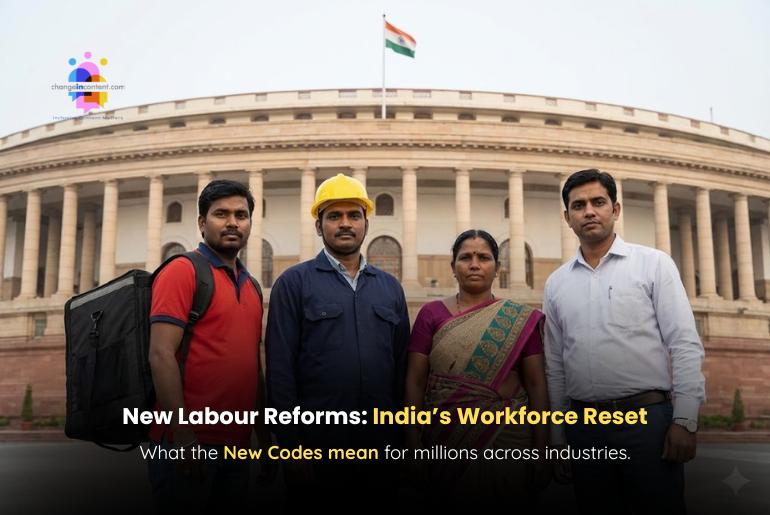
India’s New Labour Reforms mark one of the biggest shifts in the country’s labour law framework in decades. On 21 November 2025, the government announced a complete overhaul that merges 29 separate labour laws into four Labour Codes: the Code on Wages (2019), Industrial Relations Code (2020), Code on Social Security (2020), and the Occupational Safety, Health and Working Conditions Code (2020). The goal is simple: reduce confusion, cut paperwork, and bring India’s diverse workforce under one clearer, more predictable system.
The changes are sweeping. The number of rules has dropped from 1,436 to about 351. The number of compliance forms has fallen from 181 to 73. A single digital return has replaced physical returns, and the number of compliance registers has dropped from 84 to just 8. But beyond the simplifying headlines, the question remains: what does this mean for workers, especially those in gig work, MSMEs, plantations, hazardous industries, digital media, and IT?
This Policy Pulse analysis breaks down how the reforms affect workers across India’s major employment sectors.
Benefits of New Labour Reforms across key sectors
The new framework does not focus only on traditional employment. It also covers short-term roles such as gig work and app-based work, as well as new forms of work that have grown in recent years.
Fixed-Term Employees and Contract Workers
Fixed-term employees now receive the same benefits as permanent staff. They get leave, medical cover, and social security without any difference in treatment. The reforms also reduce the waiting period for gratuity. Workers can claim it after 1 year, rather than 5. These changes improve income stability during short contracts. They also encourage companies to hire directly and reduce excessive contractualisation.
Every worker also receives a free annual health check-up. These changes raise basic welfare standards and provide contract workers with greater stability.
Gig and Platform Workers
The reforms give formal recognition to gig and platform work, as well as the role of aggregators. It brings clarity to a fast-growing segment of the workforce. Aggregators must contribute 1 to 2% of their annual turnover to a social security fund, with a cap of 5% of the amount they pay or owe to gig and platform workers.
Workers will also receive an Aadhaar-linked Universal Account Number. This number makes it easy to access welfare benefits across states. It stays active even when workers move for jobs, helping them maintain their support without interruption.
Women Workers
The reforms prohibit gender discrimination and ensure equal pay for equal work. Women can take night shifts and work in all types of roles, including underground mining and heavy machinery, as long as they give consent and the employer puts safety measures in place.
Workplaces must also include women in grievance redressal committees. In addition, the family definition now allows women employees to include parents-in-law as dependents. This expands dependent coverage and brings more inclusivity into the system.
Youth Workers
Every worker now receives a minimum wage and an appointment letter. It helps with employment records, social security access, and formal recognition of work.
Employers cannot exploit workers by withholding wages. They must pay wages during leave and follow the floor wage set by the central government. These steps aim to secure a decent standard of living for young workers entering the labour market.
MSME Workers
All MSME workers are now covered by the Social Security Code, 2020, with eligibility based on the number of employees. They receive a minimum wage and essential workplace facilities such as drinking water, rest areas, and canteens.
The reforms also set standard working hours and require double wages for overtime. Paid leave and timely wage payment further improve job security within MSMEs.
Beedi and Cigar Workers
The beedi and cigar sector has long been known for informal work and low earnings. Now, the reforms ensure workers have a guaranteed minimum wage. Employers must also pay wages on time.
The working hours are capped at 8 to 12 hours a day and 48 hours a week. Therefore, any overtime must be voluntary and paid at twice the normal wage rate. Workers who complete 30 days of work in a year qualify for a bonus.
Plantation Workers
Plantation workers now fall under the Occupational Safety, Health, and Working Conditions Code and the Social Security Code. These Codes apply to plantations with more than ten workers or an area of five hectares or more.
The reforms make safety training compulsory. Workers learn how to handle, store, and use chemicals in a safe way. Employers must also provide protective gear to reduce accidents and chemical exposure.
Workers and their families gain full ESI medical cover. Children of plantation workers also receive access to education facilities.
Mine Workers
Mine workers now receive better safety rights and protection during travel to and from the worksite. The Social Security Code treats inevitable commuting accidents as work-related, depending on the time and location of the incident. The central government has issued standards to improve workplace safety and health. All mine workers receive free annual health check-ups. Working hours now fall within an 8 to 12-hour daily range and a 48-hour weekly limit.
Hazardous Industry Workers
Workers in hazardous industries now receive more oversight and improved working conditions. Every worker gets a free annual health check-up. The central government will set national standards to guide safety rules across all hazardous sites.
Moreover, women can work in all roles, including heavy machinery, hazardous jobs, and underground mining, as long as they consent and employers meet safety conditions. Each workplace must form a safety committee to monitor on-site risks and ensure safe handling of hazardous chemicals.
Dock Workers
All dock workers will now receive formal recognition and legal protection under the labour reforms. To ensure their rights, every worker must be provided with a mandatory appointment letter that guarantees social security benefits. Both contract and temporary dock workers will have access to the provident fund, pension, and insurance benefits. Employers are also required to fund annual health check-ups. In addition, dock workers will have access to essential medical facilities, first-aid, and sanitary and washing facilities, ensuring decent work conditions and overall safety.
Textile Workers
Textile workers, including migrant workers hired directly, through contractors, or through self-migration, now receive equal wages and full access to welfare benefits. They also receive PDS portability, which helps them access rations when they move for work.
Workers can raise claims for up to 3 years’ worth of pending dues. It gives them more time and flexibility to recover unpaid amounts. The reforms also guarantee double wages for overtime work.
Audio-Visual and Digital Media Workers
Digital and audio-visual workers, including journalists in electronic media, dubbing artists, and stunt persons, will now receive full benefits under the new labour reforms. To ensure clarity and fairness, every worker must receive a mandatory appointment letter that clearly states their designation, wages, and social security entitlements. In addition, the reforms guarantee the timely payment of wages. Furthermore, any work beyond the prescribed hours will require the worker’s consent and must be paid at least twice the normal wage rate, ensuring fair compensation for extra work.
IT and ITES Workers
The reforms improve fairness and transparency in the IT and ITES sector. Employers must release salaries by the seventh day of every month. Equal pay for equal work applies across roles, which supports women’s participation in the sector.
Women can choose to work night shifts at all establishments when safety measures are in place. This expands their earning opportunities and career choices. The system also requires quick resolution of wage disputes, harassment complaints, and discrimination cases.
Fixed-term employment rules and mandatory appointment letters ensure that workers receive social security and clear proof of employment.
Final thoughts: Why the New Labour Reforms matter
The New Labour Reforms bring decades-old laws under a unified framework, reducing compliance complexity and expanding protections across traditional and emerging sectors. From plantations and mines to gig work and IT services, the Codes broaden who is recognised, protected, and empowered.
But simplification on paper is only the first step. The real outcomes will depend on implementation. It depends on how seriously employers follow the Codes, how consistently states enforce them, and how accessible grievance systems become.
India’s workforce is large, diverse, and mobile. For these reforms to genuinely improve working lives, the system must stay transparent, responsive, and grounded in the realities of workers who keep the economy moving.
Changeincontent perspective
India’s New Labour Reforms bring clarity, but clarity does not equal justice. Simplifying 29 laws into 4 Codes is a major administrative reform. However, it cannot replace the lived experiences of workers who still battle delayed wages, unsafe workplaces, and informal employment disguised as flexibility. Policy reforms matter only when implementation reaches the last worker, not the last file in an office. India now faces its biggest test: proving that simplification can also mean dignity.
Also Read: New Labour Code 2025: A 4-day workweek may sound great—But what will it really take?
Disclaimer: The views expressed in this article are based on the writer’s insights, supported by data and resources available both online and offline, as applicable. Changeincontent.com is committed to promoting inclusivity across all forms of content. We broadly define inclusivity as media, policies, law, and history. It encompasses all elements that influence the lives of women and marginalised individuals. Our goal is to promote understanding and advocate for comprehensive inclusivity.