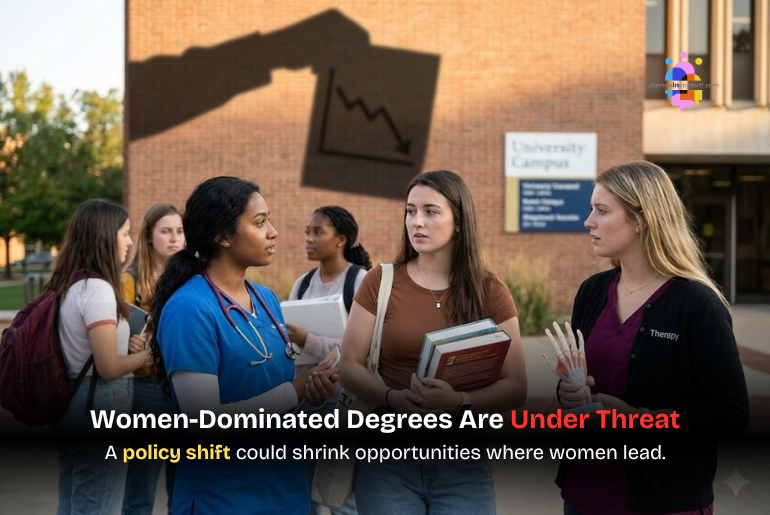
In the United States, women-dominated degrees have always faced an odd mix of respect and neglect. On one side are fields like nursing, education, therapy, public health, and social work. These professions keep entire systems running. On the other side is a persistent reality: despite their social value, these programmes often struggle for funding, recognition, and long-term security.
Now, a new policy shift from the U.S. Department of Education is raising urgent concerns. A proposed change in what counts as a “professional degree” could strip several women-heavy fields of their ability to access higher federal loan limits, making graduate education far more expensive.
This review is part of the One Big Beautiful Bill Act (OBBBA), which aims to tighten federal borrowing limits from 2026. But beneath the administrative language lies a larger question: why are the degrees most at risk also the ones women dominate?
Are women-dominated degrees under threat in the U.S.?
Gender divides in higher education are not new. In STEM fields such as engineering, physics, and computer science, women remain minorities. But across education, psychology, social work, public health, therapy, and several healthcare degrees, men form the minority, often dramatically so.
These women-dominated degrees have long faced structural disadvantages: lower federal investment, lower public visibility, and an undervaluing of professions associated with care work. The new policy review threatens to widen these gaps.
Which degrees qualify for professional status?
The proposed rule is part of the US government’s implementation of the One Big Beautiful Bill Act (OBBBA), a law aimed at tightening federal borrowing limits. Beginning July 1, 2026, the administration plans to enforce new caps on federal student loans for programmes that do not meet updated criteria.
Under this plan, the amount a student can borrow will depend, in part, on whether their degree is officially recognised as “professional.” The Department of Education defines a professional degree as one that prepares a student to begin practising in a specific field and requires more advanced professional skills than a bachelor’s degree.
The OBBBA introduces the Repayment Assistance Plan (RAP), which replaces Grad PLUS loans and caps Parent PLUS loans, setting fixed borrowing limits:
- $20,500 per year for graduate students
- $50,000 total for students in “professional” degrees
Degrees that qualify for higher loan limits
The Department has identified only 11 fields that meet these standards and will therefore qualify for the higher loan limits:
- Pharmacy (Pharm. D.)
- Dentistry (D.D.S. or D.M.S.)
- Veterinary Medicine (D.V.M.)
- Chiropractic (D.C. or D.C.M.)
- Law (L.L.B. or J.D.)
- Medicine (M.D.)
- Optometry (O.D.)
- Osteopathic Medicine (D.O.)
- Podiatry (D.P.M., D.P., or Pod.D.)
- Theology (M.Div. or M.H.L.)
- Clinical Psychology (Psy.D. or PhD.)
The department added that another 44 fields could still qualify as professional if they meet strict criteria. Programs that fail to meet these conditions may lose access to higher federal loan limits once the new rules take effect.
Students in other fields, including many that require rigorous study and professional training, may no longer be eligible for the same borrowing limits. It means that students in many other disciplines could face higher out-of-pocket costs and fewer financial options as they work toward graduation.
Women-dominated degrees that are potentially at risk
Several widely attended degrees now sit in a vulnerable position. The group of programmes that may struggle to meet the new threshold includes:
- Nursing
- Physician Assistant programmes
- Physical Therapy
- Audiology
- Speech-Language Pathology
- Occupational Therapy
- Public Health
- Social Work
- Teacher-preparation programmes
- Accounting
- Architecture
- Selected business master’s programmes
- Counselling and therapy programmes
How policy targets women-dominated professions
Now, when you look at the above list, most of the programmes flagged as “at risk” are where women are the majority. Women make up about 88% of registered nurses. They account for more than 70% of physical therapists and about 68% of physician assistants. In fields like speech-language pathology, the share rises to nearly 98%. Occupational therapy is about 86% women, social work is close to 84%, and teacher-training programmes are roughly 77% women.
Although a few male-dominated programmes appear in the early drafts, they make up only a tiny part of the list. The real impact falls on fields where women make up the majority of students and workers. These include nursing, therapy, counselling, social work, education, and several areas of health care. When these programmes lose access to higher loan limits, the students who rely on federal aid the most are the ones who get hit first. Since women make up the majority in these degrees, the rule affects their career paths far more than men’s.
What the proposal does
This proposal not only affects women already living in the United States. It also reaches women from other countries who travel to the U.S. for higher studies, including a growing number from India. Between 2020 and 2025, women made up roughly 35% to 38% of all Indian students enrolled in U.S. institutions. Many of them pursue graduate and professional programmes in health care, education, counselling, public health, and social work. These are precisely the fields now facing new definitions of what counts as a “professional” degree.
Fewer women entering and completing professional degree programmes means fewer women in leadership positions, licensure-based roles, and high-responsibility careers. It reduces opportunities for career growth and perpetuates existing gender inequities in professional recognition, pay, and influence.
Is this a way to quietly push women out of higher education and professional careers?
Women-dominated degrees in the US: The final thoughts
By changing which degrees count as professional, the policy mainly affects fields where women make up the majority of students. Nursing, therapy, social work, teaching, and health care programmes are all at risk. These are important jobs, and limiting access to loans makes it harder for women to finish their studies and start their careers.
The policy raises important questions about equity, opportunity, and the future of essential professions. It is not just about money. It is about who can enter these careers, who can complete advanced training, and whether the United States will continue to support the professional development of women, both domestic and international, in fields vital to society.
Changeincontent perspective
Policies rarely announce who they harm, but patterns do. When a reform quietly targets the programmes women dominate, the outcome is predictable: fewer women in essential professions, fewer women in leadership, and a pipeline designed to shrink rather than expand.
If the U.S. restricts access to women-heavy fields under the guise of “professional standards,” it risks building a future where critical sectors are understaffed, undervalued, and unmistakably male again. A country cannot claim progress while pulling the ladder out from under the very groups that keep its social systems alive.
Also Read: Wars on women escalate: When global conflicts turn personal.
Disclaimer: The views expressed in this article are based on the writer’s insights, supported by data and resources available both online and offline, as applicable. Changeincontent.com is committed to promoting inclusivity across all forms of content. We broadly define inclusivity as media, policies, law, and history. It encompasses all elements that influence the lives of women and marginalised individuals. Our goal is to promote understanding and advocate for comprehensive inclusivity.