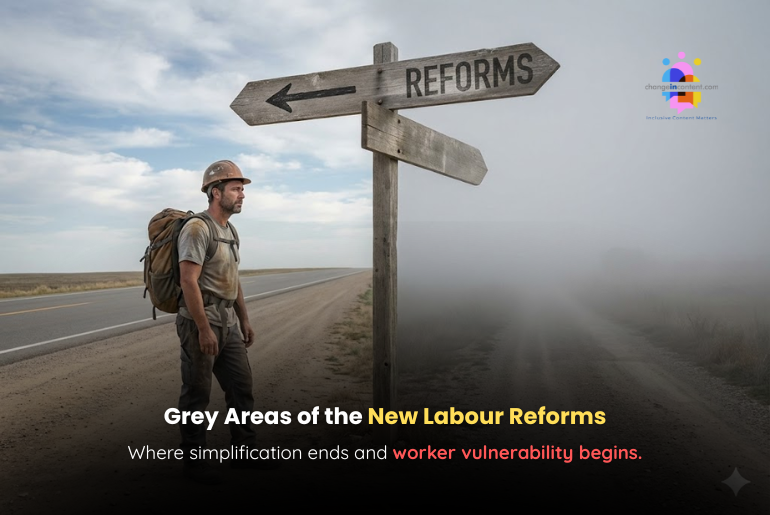
The Grey Areas of New Labour Reforms matter just as much as the headline benefits. In our previous feature, we broke down how India’s new labour codes merge 29 separate central laws into four simplified Codes. These reforms, passed by Parliament in 2020, are finally moving into uniform implementation across states after a five-year delay. On paper, they promise simplification, expanded social security, and more straightforward rules.
But as the rollout begins, trade unions, labour economists, and worker groups are raising difficult questions. While gig workers, women, and informal workers gain visibility in the law, several provisions risk weakening job security, shrinking safety coverage, and making collective bargaining harder. This Policy Pulse analysis looks more closely at where the reforms leave workers vulnerable and why these grey zones cannot be ignored.
Will the New Labour Codes lead to more layoffs?
All India Trade Union Congress (AITUC) General Secretary Amarjeet Kaur has raised concerns that the new labour codes could reduce job security. She argues that layoffs in nearly 60 to 70% of India’s industrial units will no longer need prior government approval. This concern comes from the Industrial Relations Code, which now makes it significantly easier for employers to reduce their workforce.
Earlier, any factory with 100 or more workers needed government permission before laying off employees. Now the threshold stands at 300 workers, and most industrial units fall well below that number. As a result, a large share of establishments can lay off their workforce without seeking approval from labour authorities.
At the same time, employers must still follow mandatory notice periods and pay due compensation. However, unions say the wider flexibility could weaken job security for workers in smaller and mid-sized units. As the codes move into implementation, this debate over layoffs and oversight sits at the centre of questions about the future of labour protections in India.
Higher factory thresholds leave small units and workers unprotected
The recent changes to the Occupational Safety, Health, and Working Conditions Code, 2020, have altered how the law identifies a factory. These changes remove many smaller units from basic safety and welfare requirements.
Under the updated rule, a unit that uses power must follow the code when it employs 20 or more workers. A unit that operates without power must follow it when it employs 40 or more workers. Earlier, the limits stood at 10 workers for power-operated units and 20 workers for non-power units.
When a unit qualifies as a factory, it must apply for a factory licence and meet several mandatory standards. These include access to drinking water, sanitation, and first aid, as well as clear rules on working hours, overtime, and timely payment of wages. The new threshold means many smaller factories and units no longer have to follow basic safety and welfare rules.
One of the most talked-about among the grey areas of New Labour Reforms
As a result, lakhs of workers in smaller units remain outside the protections of the law. They face potential safety hazards, inadequate facilities, and weaker enforcement of labour standards, which could compromise their health, safety, and working conditions.
How the new wage rule will change your paycheque
The new labour codes also have a revised definition of wages. Now, the salary must be split more evenly. Companies cannot load your pay with a large amount of allowances anymore. Allowances can only make up half of your total pay. So the remaining half has to be basic salary.
Basic salary is the part on which your PF and gratuity are calculated. When the basic salary increases, the amount deducted for PF also increases. This increases your long-term savings but reduces the amount you take home every month.
Take an employee who earns a CTC of ₹2,00,000 per month. Earlier, many companies kept basic pay low to reduce PF outflow. As per the earlier structure,
- Basic pay: ₹60,000
- Allowances: ₹1,40,000
- PF deduction at 12% of basic: ₹7,200
- Monthly take-home: higher because the PF deduction stayed low
Under the new definition, the employer must raise the basic to meet the 50% requirement. As a result, many employees will receive less money in hand even though their long-term savings increase. The revised structure would look like this:
- Basic pay: ₹1,00,000
- Allowances: ₹1,00,000
- PF deduction at 12% of basic: ₹12,000
- Monthly take-home: lower because PF deduction increases
New labour rules make strikes and union formation harder for workers
The new rules under the Industrial Relations Code, 2020, make it more difficult for workers to strike and organise collectively. Workers now have to give 14 days’ notice before going on strike. Earlier, this requirement applied only to state-run companies. The change restricts workers’ ability to take quick action during disputes, weakening their bargaining power.
Union formation has also become tougher. Under the old law, seven workers could form a labour union. The new code requires that a union include at least 10% of the workforce in the establishment or 100 workers, whichever is smaller.
In addition, a union must now have the backing of 51% of workers to negotiate directly with the management. If no union meets this threshold, a Negotiating Council must be formed, bringing together representatives from all registered unions that each have at least 20% support.
These rules make it harder for smaller groups of workers to form unions or take part in collective bargaining. Critics argue that this reduces workers’ leverage and makes legal strikes more challenging to organise, leaving them with limited tools to negotiate for better pay or working conditions.
Conclusion: Why the grey areas of New Labour Reforms can’t be ignored
India’s new labour codes introduce long-awaited clarity and bring new groups of workers (especially gig and platform workers) into formal policy frameworks. At the same time, the Grey Areas of New Labour Reforms reveal serious trade-offs. Easier layoffs, higher factory thresholds, redefined wage structures, and tighter rules on strikes and unions all shift the balance of power in ways that could weaken job security and worker voice.
The success of these reforms will depend on how these concerns are handled in practice: how state authorities enforce safety rules in small units, how disputes over layoffs are resolved, how wage restructuring is communicated and managed, and how workers are allowed to organise without fear. Economic efficiency cannot be the only benchmark. A labour system built for the future must protect workers’ rights with the same urgency that it protects ease of business.
Changeincontent perspective
India has chosen a bold route: compressing decades of labour law into a sleeker, more “efficient” structure. But whenever systems are streamlined, somebody’s complexity disappears from the conversation. That is usually the worker’s. The grey areas of these reforms are not technical glitches; they are political choices about who carries risk in the economy. If flexibility flows upwards and insecurity flows downwards, then the New Labour Reforms will not just be a legal shift; they will be a quiet redistribution of vulnerability. Policy cannot call itself modern if it leaves those at the bottom with fewer tools to fight back.
Disclaimer: The views expressed in this article are based on the writer’s insights, supported by data and resources available both online and offline, as applicable. Changeincontent.com is committed to promoting inclusivity across all forms of content. We broadly define inclusivity as media, policies, law, and history. It encompasses all elements that influence the lives of women and marginalised individuals. Our goal is to promote understanding and advocate for comprehensive inclusivity.